

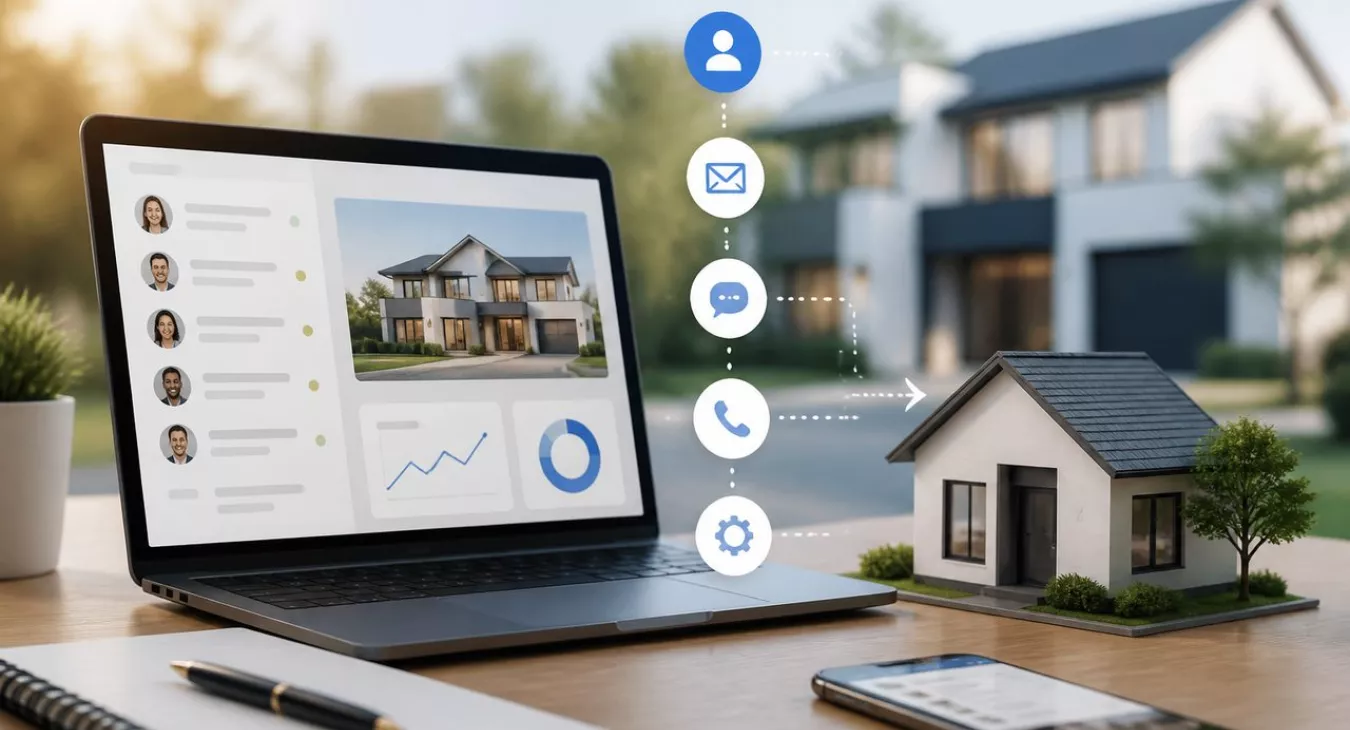
Master real estate lead follow-up strategies to convert more deals. Automate your pipeline, use proven scripts & close deals your competitors miss.
Products and Tools Mentioned in this Post


Follow Up Boss
Follow Up Boss is a real estate CRM that helps agents manage leads, automate follow-up, and increase conversions. Streamline your sales process today.
Contactually
Contactually is a real-estate-ready CRM with list building, skip tracing, calling, texting, automated follow-up, project management and websites under one login.
Table of Contents
- Why Real Estate Lead Follow-Up Systems Matter
- The 5-Minute Rule: Speed-to-Lead Response
- The 10-Day Goldmine Window: Intensive Nurturing
- Multi-Channel Follow-Up: Meeting Leads Where They're
- Personalization: Moving Beyond Generic Outreach
- Automation and Technology Stack for Scale
- Reviving Cold Leads: The 3-Step Playbook
- Building Value Into Every Touchpoint
- Follow-Up Consistency: Creating Sustainable Systems
- Real Estate Lead Follow-Up Scripts and Templates
Here's the hard truth: most real estate leads don't die because they were bad. They die because nobody followed up. The average agent makes just 1.3 follow-up attempts before throwing in the towel, but 80% of leads need 5+ contacts to actually convert. That gap between 1.3 attempts and 5+ contacts? That's where your deals are bleeding out. That's also where disciplined operators are eating your lunch.
If you're running hundreds of motivated-seller leads through your funnel, your follow-up system isn't optional — it's everything. Get it right, and you're closing deals. Get it wrong, and your competitors are.
This guide gives you the actual frameworks, scripts, tools, and benchmarks to build a follow-up machine that converts.

Why Real Estate Lead Follow-Up Systems Matter

The Cost of Poor Follow-Up
Every single lead that falls through the cracks has a real price tag. As of August 2026, Zillow Premier Agent leads cost $223 in major metros and $139 in non-major markets. But here's where it gets brutal — when you combine all your paid channels together, that blended average jumps to $480–$503 per lead. That's a 12.3% year-over-year increase, based on a 2026 NAR/RealScout/Deal Machine OS survey of 5,400 agents. So when you quit after one voicemail? You're literally burning money.
And it gets worse. Every lead your competitor picks up becomes their next referral source, their testimonial, their repeat client. You're not losing a single deal — you're losing a relationship worth tens of thousands in lifetime value.
Conversion Statistics That Prove Follow-Up Works
Here's what the numbers actually show: the industry average lead-to-close conversion rate for online and portal leads sits at just 0.4%–1.2%. That's pathetic. But top performers? They're hitting 3%–5% conversion rates — and it's not because they're getting better leads. It's pure systematization and relentless follow-up.
Look at these numbers:
- Only 8% of prospects convert within the first 30 days. That means 92% of your pipeline needs a longer nurture cycle.
- Internet leads typically require 8–12 touches before they convert.
- Make 6 or more contact attempts? Your conversion rate jumps 70% higher than if you halfheartedly try once or twice.
- 6–24 months — that's your typical nurture window before close.
If you're giving up at 1.3 attempts and most deals need 8–12, you're not even in the game. That's why learning how to score and qualify leads matters so much — you need to know which ones deserve that relentless persistence.
How Follow-Up Builds Long-Term Client Relationships
Referral and sphere-of-influence leads convert at 15%–25%. That's over ten times better than your cold portal garbage. And you know why? Relationship. Consistent, value-driven follow-up is how you turn a random internet inquiry into a warm referral machine. Every single touchpoint deposits money into your trust account — eventually it pays out in transactions and word-of-mouth business.
Back to topThe 5-Minute Rule: Speed-to-Lead Response

Why the First 5 Minutes Matter
Here's the reality: responding within 5 minutes makes you 21 times more likely to qualify that lead than waiting 30 minutes. Speed wins deals. But it gets wilder — you're 100 times more likely to actually connect with someone in those first 5 minutes versus half an hour later. That's the difference between a conversation and a voicemail box.
The average agent? 917 minutes. That's 15+ hours. According to Inman's 2025 Real Estate Technology Survey, that's how long most teams sit on fresh leads. Meanwhile, 78% of homebuyers go with the first agent who actually calls them back — NAR 2025 data. You snooze, you lose.
And here's the kicker: 40%–52% of qualified inquiries come in outside business hours. If you're only staffed 9–5, you're systematically missing nearly half your pipeline. That's leaving money on the table every single night.
Setting Up Immediate Notification Systems
The 917-minute average isn't your problem if you've got the right infrastructure. You don't need luck — you need systems. Here's what actually works:
- CRM real-time alerts: Push notifications via SMS and app the instant a lead submits a form or triggers any lead source integration. No delay. No exceptions.
- Lead routing automation: Set up workflows that distribute leads to whoever's available and escalate if nobody responds within 2 minutes. Round-robin keeps things fair and fast.
- AI voice agents for after-hours: These tools engage a lead seconds after form submission, qualify them with scripted questions, and book a callback — even at 11 p.m. You're working while you sleep.
- Multi-source aggregation: Pull everything into one notification stream. Zillow, Realtor.com, your website, Facebook — it all hits the same place. Nothing gets buried.
Real Estate Lead Follow-Up Call Scripts
You've got one shot. Make it count.
Your opener needs to establish credibility and urgency before they zone out or assume you're just another agent fishing for commissions.
Initial Call Opener (Buyer Lead):
"Hi [Name], this is [Your Name] with [Company]. I just saw your inquiry about [property/area] and wanted to reach out right away — I work exclusively in that market and I'd love to help you find the right fit. Do you've two minutes to chat about what you're looking for?"
Voicemail Script:
"Hi [Name], this is [Your Name] calling about your real estate inquiry in [area]. I specialize in that neighborhood and have some listings that aren't on the public portals yet. I'll send you a quick email as well — but feel free to call me back at [number]. Talk soon."
Here's what separates pros from everyone else: follow the voicemail with an immediate email or text that references the call. Multi-touch from contact one signals you're different.
Back to topThe 10-Day Goldmine Window: Intensive Nurturing

Day-by-Day Follow-Up Sequence
Your highest-conversion window? The first 10 days after capture. Here's why: lead intent is hot, most competing agents are still sleeping, and your speed alone puts you miles ahead. Eight meaningful touches across different channels before that window closes—that's your mission.
| Day | Channel | Action | Goal |
|---|---|---|---|
| Day 1 (within 5 min) | Phone + Email | Call immediately; send intro email with value offer | First contact, establish credibility |
| Day 1 (evening) | Text/SMS | Brief, personalized text referencing the property or inquiry | Second touch, confirm receipt |
| Day 2 | Send curated listings or relevant market snapshot | Deliver immediate value | |
| Day 3 | Phone | Follow-up call; reference what you sent on Day 2 | Build rapport, gather needs |
| Day 5 | Email or Video | Personal video message or neighborhood insight email | Stand out, deepen engagement |
| Day 6 | Text/SMS | Quick check-in text: "Did the listings I sent hit the mark?" | Low-pressure re-engagement |
| Day 8 | Phone | Call with new angle: "I've a property coming to market..." | Create urgency, new value hook |
| Day 10 | Email + Social | Final intensive-window email; connect on LinkedIn/social | Transition to long-term nurture |
Day 10 hits with no response? Don't ghost them. Shift to a long-term nurture cadence—weekly to monthly—instead. And here's the thing: most leads take 6–24 months to convert, so patience pays.
Email Templates for Days 1-10
Day 1 Email Subject: "Here's what's available in [Area] right now"
Body: "Hi [Name] — I wanted to send these over right away based on your inquiry. I've pulled [X] properties that match what you described. [Link to curated search]. What's most important to you in your next home/investment? Happy to narrow this down — just reply here or call me at [number]."
Day 5 Email Subject: "Something most buyers don't know about [Neighborhood]"
Body: "Hi [Name] — Quick insight I wanted to share: [specific neighborhood fact, recent sale, or market trend]. This is the kind of local intel that doesn't always show up on Zillow. If [area] is still on your radar, let's connect this week — I've a few listings coming up that haven't hit the MLS yet."
Multi-Channel Follow-Up: Meeting Leads Where They're

Phone Calls and Voicemail Strategies
Here's the truth: phone still converts better than anything else. But nobody picks up unknown numbers anymore. Your voicemail? That's actually your first impression—treat it that way. Keep it under 30 seconds. Reference something specific about what they're looking for. End with exactly what happens next. And timing matters. Call between 8–9 a.m. or 5–6 p.m.—those windows get the highest pick-up rates.
Email Sequences That Convert
Email's where you prove your worth. Build automated drip campaigns that fire immediately and run for months. What actually converts? Short emails. Under 200 words. One clear ask. And lead with something smart—a neighborhood market insight, a specific comp analysis, something real. Not "just checking in." Nobody responds to that.
Text Message and SMS Best Practices
Texts get opened. High open rates. But the compliance risk? It's real and it's expensive.
Before you text a single lead, talk to a lawyer who knows the TCPA. SMS is legally treated as a "call"—each violation carries per-message penalties. A2P 10DLC carrier registration is step one, but registration doesn't give you permission to contact anyone. You need explicit opt-in consent first.
Once a lead opts in, keep texts brief and personal. Conversational. Not a broadcast. "Hey [Name] — quick q on the [neighborhood] market. Do you've 2 min?" will outpull a generic marketing blast every single time.
Social Media and Video Follow-Up
Send a personalized 60-second video. Use their name. Address their specific situation. BombBomb or Loom makes this scalable. A video creates impact that text never will. And on social? Connect after the initial call—LinkedIn, Facebook, whatever keeps you in their feed without demanding a response. You're staying top of mind.
Direct Messages and Retargeting Ads
For leads that go silent, retargeting ads on Facebook and Instagram bring them back. Pixel your site. Build audiences from your CRM. Run value-content ads—market updates, neighborhood guides—to stay in front of prospects who've disappeared. No cold outreach needed. This strategy pairs perfectly with the advanced real estate marketing funnel strategies that move prospects from awareness straight to action.
Back to topPersonalization: Moving Beyond Generic Outreach

FORD Notes and Client Intelligence
FORD — Family, Occupation, Recreation, Dreams — isn't just some outdated framework. It's how you actually build rapport in your CRM and stand out from every other agent flooding their inbox. Every conversation needs updated notes. Their daughter's starting college next year? Write it down. They just got promoted and that's why they're moving? Log it. When you reference these details in your next call or email, you're not a salesperson anymore — you're a trusted advisor who was actually paying attention.
But don't stop there. Layer in property-specific intelligence: their must-have list, deal-breakers, timeline, financing status, competing properties they're eyeing. This data drives every single touchpoint that follows.

Property-Specific Follow-Up
Generic follow-ups vanish. Your touchpoints need teeth — reference the specific property they asked about, that neighborhood they mentioned, the price point they confirmed. "I found three properties matching your exact criteria" crushes "just checking in on your search" in terms of conversion rates. Why? Because you're showing you actually listened instead of running a robotic campaign.
Neighborhood Data and Market Updates
Position yourself as the local expert. Share neighborhood-specific market data — average days on market, list-to-sale ratios, recent comps, inventory trends. Leads save these emails. They screenshot them. They come back to you when they're ready because you've become their go-to data source. And here's the play: combine this approach with strategies from our guide on how to rank higher on Google and generate more real estate leads to build long-term organic authority in your market.
Reference Past Conversations
Start every follow-up with continuity. "Last time we talked, you mentioned waiting for rates to drop before pulling the trigger — here's what I'm seeing in the market right now." Three things most agents never demonstrate: continuity, competence, and genuine attention. You just hit all three.
Back to topAutomation and Technology Stack for Scale
CRM Systems for Real Estate
Here's the number that should scare you: only 46% of agents use a CRM system as of September 2026, according to NAR's 2026 REALTORS® Technology Report. More than half your competition is running follow-up from memory and a spreadsheet. That's your edge. A CRM isn't a nice-to-have — it's the foundation of any serious follow-up operation.
What should your CRM actually do?
- Automated drip sequences triggered by lead source and behavior
- Pipeline view with stage-based follow-up tasks
- Integrated calling, texting, and email with logged history
- Lead scoring and engagement tracking
- Mobile app with real-time notifications
Below is a real breakdown of the CRM options agents and investors actually use:
| CRM | Best For | Strengths | Limitations | Pricing |
|---|---|---|---|---|
| Contactually (KDS teamed up to create) | Agents and investors wanting an all-in-one platform | List building, skip tracing, calling, texting, email, funnels/websites, pipelines, workflows, social posting — all in one platform | No free tier; calling, texting, and minutes billed on top of plan; investor-specific list-stacking features may be thinner than dedicated investor CRMs | See contactually.net for current pricing |
| Follow Up Boss | Agent teams with high inbound volume | Strong lead routing, integrations, team accountability tools | Less built-in for investor workflows; pricing scales with users | Check current pricing; see our Follow Up Boss Review 2026 |
| REsimpli / REISift | Investors (wholesalers, flippers) | Deep investor-specific features: list stacking, motivated seller workflows, driving for dollars | Less suited for traditional agent follow-up; fewer IDX integrations | Check current pricing at provider sites |
| BoomTown | Mid-to-large agent teams with IDX site | Integrated IDX lead gen + CRM; strong team dashboards | Higher price point; less flexible for non-IDX workflows | See our BoomTown Review 2026 or BoomTown vs CINC comparison |
Disclosure: KDS (this site's publisher) teamed up to create Contactually. We've included it where it's genuinely competitive, but the table's designed to help you pick the right tool for your situation — not to push any single platform.
Note: This isn't the older Contactually CRM that Compass acquired. It's a separate, modern platform built specifically for real estate operators.
AI-Powered Follow-Up Tools
AI's moving fast in real estate. 48% of agents use AI tools weekly or daily (23% daily, 25% weekly), per NAR's 2026 REALTORS® Technology Report. But here's the catch: as of 2025, only 17% of agents report AI having a significant positive business impact. Most people are experimenting. Few are actually optimizing.
The AI moves that actually move the needle on follow-up:
- AI voice agents: Automated calling systems that engage leads within seconds of inquiry, qualify them with scripted conversations, and log outcomes to your CRM.
- Predictive contact timing: AI tools that analyze engagement patterns to recommend the optimal time to call or email each individual lead.
- Automated email personalization: Tools that dynamically insert relevant property data, neighborhood stats, and contact history into outgoing messages.
- Conversation intelligence: Call recording and analysis tools that identify objections, sentiment, and buying signals across your team's calls.
The trick is letting AI handle speed and volume while you keep humans in charge of relationship-critical moments. Automation without personalization is spam. Personalization without automation doesn't scale.
Inside Sales Associates (ISAs) and Coaching
Running a high-volume operation? An Inside Sales Associate handles first contact and qualification. That frees your lead agents to actually convert — appointments and closings. A trained ISA working inside a solid CRM can multiply the number of qualified leads that make it to a showing. And if you're building a team system, you need clear handoff protocols between ISA and agent so leads don't vanish in the handoff.
Metrics and Analytics Tracking
You can't improve what you don't measure.
- Speed to first contact (goal: under 5 minutes)
- Contact rate (percentage of leads reached on first attempt)
- Attempts per lead before contact
- Lead-to-appointment conversion rate
- Appointment-to-close conversion rate
- Average touches to conversion
- Channel-level response rates (phone vs. email vs. text)
Reviving Cold Leads: The 3-Step Playbook
Step 1 — Identify Which Cold Leads Are Worth Reviving
Not every cold lead in your database deserves your attention. Segment by source, recency, intent signals, and lead score. Which ones actually matter? The winners are leads from your best channels — referrals, direct mail, organic search — who've gone silent in the last 12 months. They're warm enough to revisit. For a deeper dive into prioritization, check out our guide on lead scoring for real estate investors.
Step 2 — Re-Engagement Strategies
Here's the thing: cold leads don't care about your old pitch. They need a new reason to pick up the phone.
Effective angles to restart the conversation:
- Market shift alert: "The market in [area] has shifted since we last talked — I wanted to make sure you had the latest numbers."
- New listing match: "A property just came to market that I immediately thought of for you."
- Rate/equity insight: Share financing or equity developments that actually change their ROI picture.
- Anniversary check-in: Past client bought a year ago? Hit them with a home value update. It opens the door to their next deal or a referral.
If you're working motivated seller lists, cold revival means layering fresh direct mail, cold calls, or door-knocking into the mix. See our guide on door knocking for real estate deals for how to stack channels effectively.
Step 3 — Turn Past Clients Into Referral Engines
Past clients sit at the top of the pyramid. They convert at 15%–25% — that's real money. Most investors ignore this segment. Don't be that guy. Quarterly calls, annual home value reviews, market updates, birthday touches — it's mechanical, but it works. This generates unsolicited referrals. And it doesn't happen by accident. You need CRM discipline here, same as you'd give any new lead pipeline.
Back to topBuilding Value Into Every Touchpoint
Market Updates and Trend Reports
Active inventory. Price trends. Days on market. Absorption rate. These numbers answer what every prospect is really thinking: "Why should I care?" That's exactly what a solid market update does—it gives them a concrete reason to actually open your email. Send monthly market snapshots consistently, and you stop being just another agent chasing commissions. You become the local expert.
Neighborhood Insights
Hyperlocal content crushes generic real estate content. Every single time. School district updates, new development announcements, local business openings, neighborhood price-per-square-foot trends—this is what a truly local expert knows. A portal algorithm? It'll never have this. And if you're serious about organic lead generation, our guide on ranking higher on Google shows exactly how neighborhood-level content strategy drives results.
Lifestyle Content and Resources
Not everything needs to talk about selling or buying. Home improvement tips. Relocation guides. Mortgage education. Community event highlights. This stuff keeps you in a lead's inbox without feeling like a sales pitch. Over 12–24 months of consistent nurture, this content mix builds real trust. That's what converts when a lead's actually ready to move.
Positioning as a Trusted Advisor
The top closers in this business aren't always the sharpest negotiators. They're the ones who've built so much trust that clients call them first. Value-added follow-up is how you earn that position. But pair it with delivering a no-brainer offer, and you've got something competitors can't easily replicate.
Back to topFollow-Up Consistency: Creating Sustainable Systems
Developing Tracking Systems
Your CRM is only as good as what you put in it. That's the hard truth. Build habits—or better yet, automate the whole thing—so every lead touch gets logged, every follow-up task gets created, and your pipeline stays accurate. Run weekly pipeline reviews. You'll catch the leads slipping through the cracks before they go cold forever.
Creating Follow-Up Schedules
Don't wing this. Lock in your follow-up cadences upfront and build them straight into your CRM as automated sequences or recurring tasks:
- New lead (Days 1–10): 8 touches across phone, email, text, and social
- Active nurture (Months 1–3): Weekly value-add touches via email/text
- Long-term nurture (Months 4–24+): Bi-weekly to monthly market updates, occasional personal check-ins
- Past clients: Quarterly personal outreach, annual home value review, life-event touches
Avoiding Follow-Up Fatigue
Persistence without value is just spam. Period. After 8–10 genuine, value-driven attempts with zero response? Back off the frequency instead of ghosting them entirely. A monthly low-pressure touch—market update email, quick text—keeps the relationship warm without annoying the hell out of them. And here's the thing: agents constantly get calls from leads who went dark for 18 months, then came back because the agent never stopped showing up with real value.
Team Accountability and Coaching
Running a team? You need accountability infrastructure to make follow-up actually stick. Daily pipeline reviews. Weekly call recording audits. Clear KPI benchmarks for each rep. Coaching on scripts, objection handling, and CRM fundamentals has to be continuous—not some one-time onboarding thing you forget about.
Back to topReal Estate Lead Follow-Up Scripts and Templates
Initial Contact Call Openers by Lead Type
| Lead Type | Channel | Opening Script |
|---|