

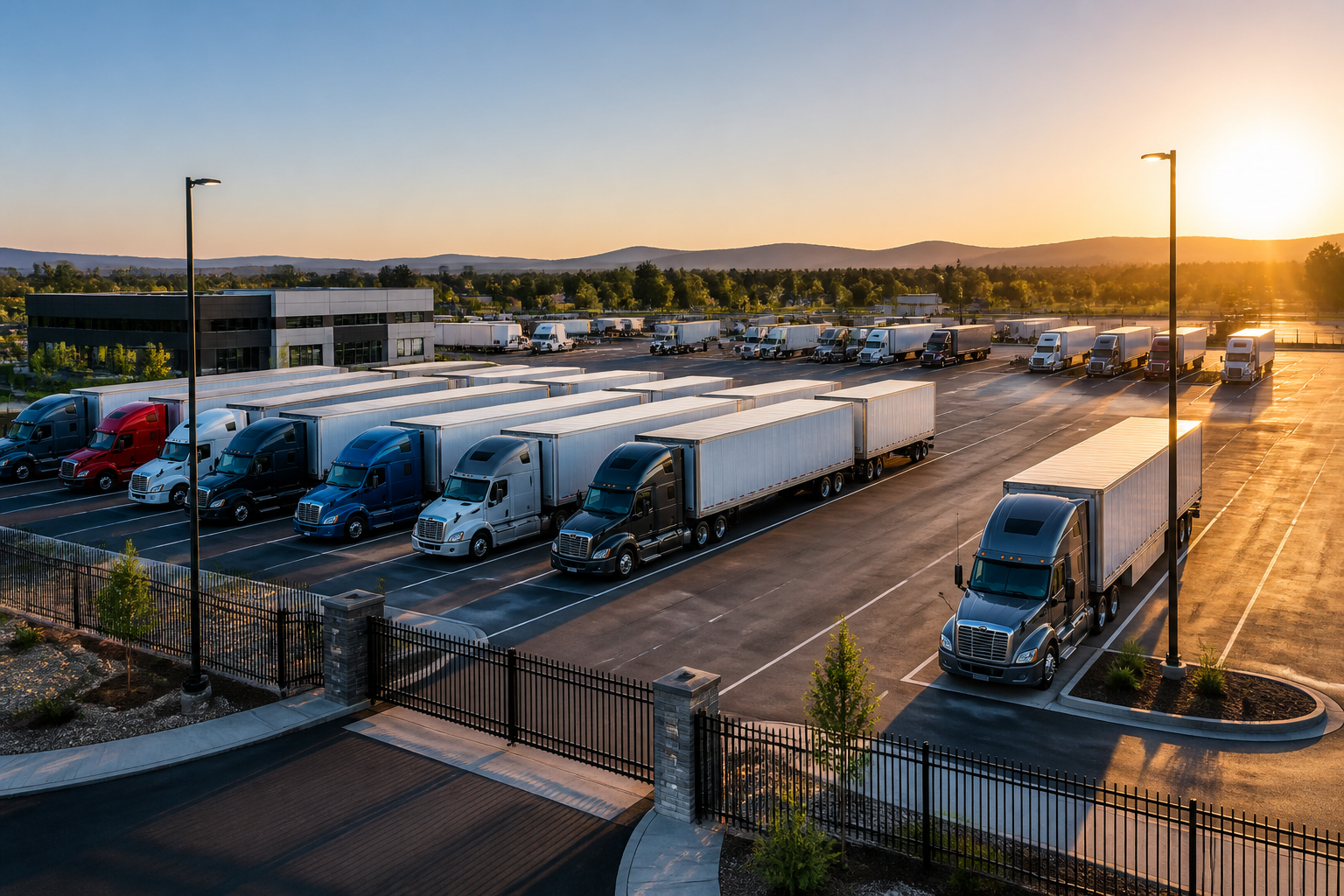
Learn how to capitalize on the truck parking shortage with this comprehensive semi truck parking business investment guide for real estate investors.
Table of Contents
- The Growing Opportunity in Semi-Truck Parking
- Market Research and Feasibility Analysis
- Creating Your Truck Parking Business Plan
- Choosing the Right Location for Your Semi-Truck Parking Lot
- Legal Requirements and Permits
- Financing and Startup Costs
- Designing and Building Your Truck Parking Facility
- Technology and Security Systems
- Operating and Managing Your Truck Parking Business
- Marketing Strategies to Attract Drivers
- Scaling and Expanding Your Business
Here's the thing about semi-truck parking: it's not sexy, but the money is real. A severe and worsening shortage of safe, legal truck parking has created a structural supply-demand imbalance that investors with the right land, capital, and operational plan can capitalize on for years to come. You won't see Blackstone or Starwood fighting over these deals. That means less competition, stronger recurring cash flow, and a customer base — professional truck drivers — whose demand is tied directly to the U.S. economy's reliance on freight and logistics. And unlike multifamily or office, the fundamentals don't shift with interest rates or consumer sentiment. This guide walks you through every stage of building a semi-truck parking business: from market research and site selection through facility design, permitting, technology, marketing, and long-term scaling strategies.

The Growing Opportunity in Semi-Truck Parking
The Supply-Demand Crisis Driving Investment Returns
Here's the reality: the truck parking shortage in America is massive. ATRI and BTS-supported research from July 2025 lays out the numbers, and they're stunning — there's only 1 public truck parking space for every 11 truck drivers across the country. That's not a minor inefficiency. It's a systemic failure in public infrastructure, which means it's a direct opportunity for private operators who can fill the gap. The data gets worse from there. Public rest areas average just 19 spaces each, with the Northeast bottoming out at 15 and the South reaching 25. And get this: only 26% of states have acquired new land for truck parking in the last decade. The government isn't fixing this.
Safety issues are already piling up on U.S. highways. A January 2026 study by Altitude by Geotab found 2.2 million ramp-parking events per year. That includes more than 300,000 long-duration stops where drivers park on highway ramps — they're breaking federal law because there's nowhere legal to go. And it's costing the industry real money. According to ATRI's 2024 annual survey, truck drivers ranked lack of parking as their #1 concern, while the industry flagged it as the #2 concern for the second year running. But here's what matters most: industry estimates from RigLots in 2025 put the annual cost of this shortage at $5.5 billion per year. That's how much economic pain the right private operator could relieve.
The takeaway for investors is obvious. Public infrastructure isn't solving this. It's not going to. Private capital is the answer. Nail the location, execute development cleanly, and run operations efficiently — and you're capturing steady, recurring monthly revenue from one of the simplest asset classes in commercial real estate.
Who This Guide Is For
You're a real estate investor evaluating semi-truck parking as a new asset class. Or you're an agent advising investor clients on commercial land deals. Either way, this guide is built for you. Whether you're an experienced commercial investor testing out industrial-adjacent niches or a newer investor hunting for lower-complexity cash-flow assets, you'll find what you need here — feasibility assessment, regulatory landscape breakdown, operational framework. Just starting your real estate journey? Take a look at our How to Start a Real Estate Investing Business: 2026 Guide first, then come back to this niche.
Back to topMarket Research and Feasibility Analysis


Assessing Demand in Your Region
Don't buy the land until you've done the work. Serious investors don't wing it when it comes to market research, and frankly, neither should you. Here's the reality: truck parking is hyper-local. A lot crushing 75% occupancy in a freight corridor outside Memphis might sit half-empty in rural Montana. Location determines everything.
Start with freight corridor mapping. Identify which Interstate highways, U.S. routes, and state roads actually move commercial truck volume in your target area. The Federal Highway Administration publishes freight flow data publicly—use it. State DOT truck count reports are there for the taking, and they're your first move in any serious feasibility study.
But here's what really matters: find property near major distribution centers, fulfillment warehouses, intermodal rail terminals, and port access. E-commerce has fundamentally changed where trucks congregate. Large logistics hubs are the anchors now, generating consistent, year-round parking demand instead of sporadic hits.
Competitor Mapping and Pricing Research
Map your competition before you pick your site. And when I say map, I mean everywhere within your target radius.
Your competitive universe includes public rest areas, weigh stations that allow overnight parking, the big chains like Pilot Flying J and Love's, independent truck stops, and other private operators. Write down their capacity, services, pricing, and operating hours. This isn't optional—it's the foundation of your underwriting.
Pricing tells you where the money actually is. As of July 2026, chain travel centers charge roughly $12–$25 per night for daily and overnight parking. Private or secured urban lots? They're pulling in $150–$500+ per month—and in hot markets like LA or Chicago, you'll see rates pushing above $400 per month. SemiYard's investor data from July 2026 confirms the same range: $150–$500 per truck per month depending on location, security, and what amenities you offer.
That gap isn't random. A secured, private lot with real amenities commands a premium over a basic rest area, and truckers actually pay it. The market validates the model.
Seasonal Demand Considerations
Truck parking demand swings with the calendar, though not as wildly as you might think. Expect peaks October through December when holiday freight demand spikes. January and February soften a bit. Agricultural areas see their own cycles tied to harvest.
Here's what matters for your projections: e-commerce distribution hubs generate steadier year-round demand than regional truck stops. If you're sitting near a major fulfillment center, you're insulated from seasonal dips. Rural locations? Plan for volatility and keep cash reserves for the slower months. Know your specific market's rhythm before you build your financial model.
Back to topCreating Your Truck Parking Business Plan

Revenue Streams and Business Model Options
Don't just plan for overnight parking. That's leaving money on the table. A solid business plan maps out every revenue stream you can actually capture, and the semi-truck parking business has plenty of them. Stack these models together, and you'll crush your occupancy rates and average revenue per space.
- Daily/overnight parking: Pay-per-use, highest flexibility, and drivers love it because there's zero commitment. You'll see strong walk-in revenue near busy corridors, especially near interstates.
- Monthly leases: Fixed monthly contracts with individual drivers or small trucking companies bring predictable cash flow and kill your vacancy risk dead.
- Fleet contracts: Land agreements with trucking companies or logistics operators to park multiple trucks at negotiated rates. Sure, the per-unit revenue drops. But you get higher volume, rock-solid occupancy, and your marketing costs collapse.
- Ancillary services: Fuel, truck washing, minor maintenance, food vending, driver amenities—these add meaningful revenue per visit. Drivers stick around longer, loyalty goes up, and your ARPU shoots higher.
SemiYard's July 2026 analysis says a well-located acre of developed truck parking pulls $5,000–$8,000+ per month in gross revenue. That's your sanity check number. Keep in mind it assumes near-full occupancy, strong pricing power, and tight operations—so don't treat it as a floor.
Financial Projections and Break-Even Analysis
Your five-year model needs to account for reality. Brand-new truck parking lots don't fill overnight. Budget six to twelve months for lease-up—that's when occupancy climbs gradually from opening day forward. What goes into your model? Total spaces developed. Blended average monthly rate per space. Year-by-year occupancy projections. Operating expenses: maintenance, staffing, insurance, property taxes, debt service. And capital reserves for surprises.
Work backwards from your target monthly revenue to find your minimum occupancy threshold. That number—the one that covers debt service and keeps the lights on—is your operational break-even point. It should drive every decision you make about lot sizing and phasing.
And here's the thing: the financial modeling discipline you'll need mirrors exactly what we cover in our Commercial Real Estate Investing: Complete 2026 Guide. Cash-on-cash returns, IRR analysis, non-traditional commercial assets—it's all there if you want to stress-test this further against your broader portfolio.
Back to topChoosing the Right Location for Your Semi-Truck Parking Lot
Strategic Site Selection Criteria
Location wins every single time. You could build the nicest facility imaginable, but put it in the wrong spot and you'll lose to a mediocre competitor in a great location—nearly every time. Here's what separates a high-value site from the rest:
- Interstate proximity: Land within one to two miles of a major interstate exit (on a truck-accessible route) sees dramatically higher demand. Think about it: drivers finishing an 11-hour shift aren't navigating miles of local roads to find parking.
- Freight density: Are there distribution centers, warehouses, intermodal terminals, or manufacturing plants nearby? That's your customer base. Local and regional drivers need regular overnight or long-term parking, and they'll use a facility that's close to where they operate.
- Accessibility for large vehicles: The site has to handle the turning radius and approach angles of full tractor-trailer combinations. What looks convenient on a map might be functionally unusable if your access road or driveway geometry can't accommodate a 53-foot trailer. Test this in person.
- Low competition density: Don't ignore this one. Run a serious check for well-capitalized competitors—national truck stop chains especially—planning to open in your primary trade area.
- Favorable zoning: Commercial or industrial zoning compatible with truck parking is non-negotiable. Retrofitting a residentially zoned parcel? Not worth it.
Real Estate and Land Acquisition
Industrial-adjacent and highway commercial land trades at a fraction of urban commercial real estate pricing. That's precisely why this niche is accessible to savvy investors. Raw land near freight corridors frequently sells at prices that support strong returns once you develop it. When you're negotiating land acquisition, dig into topography (flat beats sloped every time—and costs way less to develop), soil conditions, existing utilities, and environmental history. Brownfield sites with prior industrial use? They may need environmental remediation before you can break ground. Commission a Phase I environmental assessment before closing, and a Phase II if the Phase I raises any red flags. Need help structuring the deal itself? Our Real Estate Investment Negotiation Tips: Your Go-To Guide has the frameworks you need for this asset class.
Back to topLegal Requirements and Permits
Zoning and Land Use Approvals
Here's the thing: permitting requirements for semi-truck parking vary wildly by state and municipality. But certain rules show up almost everywhere. Before you write a check for land, verify zoning compatibility with your local planning department — this is non-negotiable. Truck parking fits in heavy industrial zones (I-2 or I-3). Sometimes you'll find it allowed in light industrial or highway commercial zones too. The catch? It's often flagged as a conditional use, which means you'll need a conditional use permit (CUP) or special exception. The CUP process isn't quick. You're looking at a public hearing in front of the local planning commission or zoning board. They'll want traffic studies, site plan approvals, and proof you notified neighbors. Plan for several months here — build that into your acquisition timeline.
Federal and State Regulatory Compliance
The Federal Motor Carrier Safety Administration (FMCSA) doesn't regulate parking lots directly, but it regulates the drivers who'll park at yours. That matters. Understanding Hours of Service (HOS) rules lets you market smarter and price accordingly. Here's what you need to know: under current FMCSA regulations confirmed as of 2026, drivers of property-carrying commercial motor vehicles can drive a maximum of 11 hours within a 14-hour on-duty window — and only after 10 consecutive hours off duty. They're also required to take a 30-minute break after 8 hours of driving. Weekly limits? 60 hours over 7 days or 70 hours over 8 days, with a 34-consecutive-hour restart requirement to reset. And here's your real opportunity: when drivers hit these limits, they stop. Period. No flexibility. That mandatory demand for overnight parking is gold — your facility solves a real problem.
State-level rules get more granular. Some states require a specific business license for commercial parking operations. Environmental permits pop up if you're dealing with stormwater management, fuel storage, or you're near wetlands. Lighting levels. Drainage systems. Restroom facilities. Many states have hard requirements on all three. Don't guess on this stuff — consult a local land use attorney before you break ground. For a comprehensive breakdown state-by-state, check our Real Estate Investment Business Code & License Requirements by State guide.
Insurance and Liability
Insurance here is more complicated than typical commercial property coverage. You'll want to stack these: commercial general liability (CGL) for third-party bodily injury and property damage on the lot. Commercial property insurance for buildings and infrastructure. Garage keepers liability or bailee coverage if you're taking custody of vehicles. Workers' compensation if you have employees. And an umbrella policy to push your liability limits higher. This isn't overkill. A single incident involving a $150,000+ tractor-trailer can generate claims that blow past your basic CGL limits in a hurry. Work with a commercial insurance broker who actually understands transportation and parking operations — don't just call your standard commercial guy.
Back to topFinancing and Startup Costs
Initial Capital Requirements
Land cost. Site conditions. Development scope. Geographic region. These four variables will make or break your startup budget for a semi-truck parking operation. You're looking at major line items like land acquisition, site prep and grading, paving, utilities, lighting, fencing, security, technology, and working capital. Land prices swing wildly by region—there's no point generalizing. But construction and development costs? Those are way more predictable.
As of 2026, you're looking at $3,000–$8,000 per parking space for a surface lot build, whether it's basic or tech-integrated. When it comes to concrete, commercial paving runs $5–$11 per square foot. Here's the critical detail: truck lanes need 7–8 inch thickness. That's substantially thicker than the 6-inch standard for passenger cars. Why? Trucks crush pavement. The load differential is dramatic. And that's just paving—you still need to add land, utilities, fencing, lighting, and tech on top.
You'll need at least 2–3 acres to operate viably. That gives you room for approximately 15–25 trucks. Total development costs (excluding land acquisition) typically range from several hundred thousand to well over one million dollars. Amenity level matters. Your paving choice matters. Technology spend matters. Budget conservatively, and—this is non-negotiable—maintain a working capital reserve covering six months of operating expenses before you hit stabilized occupancy.
| Cost Category | Typical Range / Benchmark | Notes |
|---|---|---|
| Land Acquisition | Varies widely by region | Highway commercial / industrial land; conduct local comp analysis |
| Surface lot construction (per space) | $3,000–$8,000 | Standard to tech-integrated; 2026 benchmark |
| Concrete paving (per sq ft, commercial) | $5–$11 | Truck lanes require 7–8 inch thickness; June 2026 |
| Minimum land size for viability | 2–3 acres (~15–25 trucks) | 2025 industry standard |
| Working capital reserve | 6 months of operating expenses | Cover pre-stabilization period; adjust based on lease-up projections |
| Technology and security systems | Project-specific; see Technology section | Gate systems, CCTV, management software, lighting |
Financing Options
You've got multiple paths to fund this. SBA 7(a) and SBA 504 loans work well for commercial real estate and business development plays like this—SBA 504 is specifically designed for owner-occupied commercial properties where real estate is the bulk of your CapEx. Conventional commercial real estate loans from community banks and regional lenders are another route, though expect thorough pro forma scrutiny during underwriting. Then there's private capital. Real estate investment syndicates. Joint ventures with landowners. For larger deals that exceed your personal capital, syndicates and outside investors make sense. If you're going that direction, our How to Start a Real Estate Investment Fund: Complete Guide walks you through the structure. Some investors also look at sale-leaseback deals or partnerships where landowners prefer an operating partner over a straight cash sale.
Back to topDesigning and Building Your Truck Parking Facility

Parking Space Dimensions and Layout
Get your dimensions wrong, and drivers won't use your lot. It's that simple. Per 2026 industry design standards, a semi-trailer only (storage configuration) needs 55 feet long by 14 feet wide. Full tractor-trailer combos? That's 75 feet long by 14 feet wide. You'll want minimum stall widths of 12 feet, but 14–15 feet is preferred — drivers appreciate the extra room after pulling 600 miles.
Behind each stall, you need approximately 100 feet of clear backing clearance. Turning aisles must handle a minimum outer turning radius of 40 feet, though 40–60 feet is recommended for comfortable maneuvering. This isn't theoretical — it's the difference between drivers choosing your facility or your competitor's down the road.
And here's where capacity planning gets real. Industry layout rules of thumb as of July 2026 show you can fit approximately 25–30 spaces per acre after accounting for lanes, turning radius, and setbacks on 70–85% of usable acreage. Some operators use angle parking (45 or 60 degrees) to squeeze efficiency, but straight pull-through layouts almost always win with drivers — they're tired, and they want to park without overthinking it.
Paving, Drainage, and Infrastructure
A fully loaded tractor-trailer hits your pavement with up to 80,000 pounds of force. Standard asphalt parking lot material cracks and crumbles under that weight. Concrete is your best bet for long-term durability, requiring 7–8 inch thickness in truck travel lanes. If budget forces you toward asphalt, engineer it properly with adequate base course and thickness — cheap asphalt fails in years, not decades, and those repairs will kill your margins.
Drainage matters just as much as pavement.
Standing water degrades your surface, creates liability nightmares, and drivers actively avoid wet lots. You need properly engineered stormwater detention or infiltration systems built into your site design. Most states require a stormwater pollution prevention plan (SWPPP) anyway, especially with the risk of fuel and oil contamination from parked trucks. Don't treat this as an afterthought — it's a regulatory requirement and an operational lifesaver.
Lighting, Safety, and Driver Amenities
Lighting separates top-tier private facilities from forgettable rest areas. LED systems that deliver bright, consistent illumination 24/7 are now the baseline. Well-lit lots reduce theft, improve driver confidence, and rank among the top factors drivers consider when choosing where to park. Add perimeter fencing, controlled access points, and visible emergency contact information — and you've just created a facility drivers actively prefer.
Drivers spend serious hours resting in these spaces. What amenities separate your lot from the competition? Restroom and shower facilities. A driver lounge or waiting area. Reliable Wi-Fi. Food access, whether through on-site vending, a food truck partnership, or proximity to a restaurant. Pet-friendly areas are increasingly non-negotiable — many long-haul operators travel with animals. Each amenity you add directly increases the monthly rate premium you can charge and builds word-of-mouth loyalty within the driver community.
Back to topTechnology and Security Systems

Gate Access and Vehicle Management
Modern semi-truck parking is getting a serious tech upgrade. Automated gate systems with license plate recognition (LPR) eliminate the need for staff sitting in a booth 24/7, which cuts labor costs without sacrificing security. Here's how it works: a driver's registered vehicle pulls up, the gate recognizes the plate and swings open automatically. Unregistered vehicles? They either get denied or routed to a payment terminal. But there's a hidden benefit most operators miss — this system generates goldmine data on occupancy patterns, peak hours, and repeat driver behavior. That's the intel that actually moves your pricing and marketing needle.
Electronic logging device (ELD) integration is where you'll see the biggest opportunity in the next few years. Large fleet operators with dozens or hundreds of drivers on the road increasingly expect their parking partners to plug directly into their fleet management systems. The ability to track which drivers are parked where and consolidate invoicing into one bill? That's not a nice-to-have anymore. It's table stakes for landing premium contracts and long-term partnerships with the big operators.
Surveillance and Monitoring
You need full CCTV coverage. Every parking space, every entry and exit point, every common area — no blind spots. Drivers and fleet operators know what sits in your lot; they'll demand 24/7 surveillance as standard. Modern IP camera systems with cloud-based recording let you monitor remotely and pull incident footage in seconds. And honestly? Adding on-site security personnel during peak overnight hours is a smart move in high-crime markets or if you're positioning as a premium lot — it's a marketing differentiator that justifies higher rates. The surveillance investment is typically cheap relative to the liability exposure you're managing and the pricing premium it supports.
Parking Management Software and Digital Booking
Real-time occupancy tracking, reservation management, payment processing, and reporting — you need all of this accessible from one dashboard. Drivers expect mobile apps now. They want to reserve a space ahead of time, check in remotely, and pay without touching cash. Younger drivers especially won't use a lot that doesn't offer this. You don't have to build your own infrastructure from scratch, though. Platforms like Truck Parking Club let drivers find your lot and book directly without you reinventing the wheel. Day one of your launch strategy should include listings on these directory services.
Get your technology stack right early. It compounds over years. Just like you'd use a CRM to manage tenant relationships in apartment buildings or commercial deals, a purpose-built parking management system scales your truck parking operation far beyond what manual spreadsheets and phone calls ever will. The operational frameworks work the same way. For a deeper dive on how this actually scales real estate businesses, check out our How Real Estate CRM Software Scales Your Investing Business: Complete Guide.
Back to topOperating and Managing Your Truck Parking Business
Staffing Models and Daily Operations
Your staffing options run the full spectrum. On one end: fully automated (no on-site staff, gate-controlled entry, remote monitoring). On the other: fully staffed operations with 24/7 attendants, on-site management, and concierge-level service. Most successful operators land somewhere in the middle — they use technology to handle routine access and payments while keeping on-call or part-time staff for customer service, maintenance, and incident response. What's right for you depends on four factors: scale, location, amenity level, and who you're targeting. Fleet operators on long-term contracts? They don't need much daily hand-holding. A high-volume transient lot pulling individual drivers? That's a different animal entirely.
Your daily ops checklist should cover regular lot inspections (looking for damage, hazards, potholes), restroom and amenity upkeep, security system checks, and routine customer contact. And don't sleep on preventive maintenance. A documented schedule — crack sealing, lighting checks, drainage inspection, perimeter fence work — saves money down the line. Ignore small problems now, and you're looking at expensive repairs later. This is exactly how you'd manage any real estate asset. In fact, our How to Manage a Real Estate Investment Business: 6 Expert Strategies lays out a management framework that works just as well here.
Pricing Strategy and Rate Management
Pricing in truck parking comes down to one thing: balancing what the market will bear against your revenue goals. Here's what you're working with — $12–$25 per night for daily parking and $150–$500 per month for monthly leases (as of July 2026). But your actual rates? They should reflect your location, what amenities you offer, and who else is competing nearby. Build a tiered model: base overnight rate for general access, a premium tier for reserved spaces (drivers pay more for guaranteed availability), and a discounted monthly rate that rewards long-term commitments. Fleet contracts need individual negotiation — you're trading volume for occupancy certainty, and the math looks different each time.
Dynamic pricing is game-changing if you've got the software to back it up. Adjust rates based on occupancy and demand, especially during peak periods. Pre-holiday freight surges? Raise rates as you approach capacity — just like hotels and airlines do. Slow season? Use promotional pricing or contract incentives to keep the lot full. Modern parking management software makes this simple.
Back to topMarketing Strategies to Attract Drivers
Digital Marketing and Local SEO
Most truck drivers find parking through mobile search, navigation apps, and industry-specific platforms. That's where you need to be. Your Google Business Profile matters — a lot. Make sure your hours are accurate, your address is correct, parking type is clear, amenities are listed, photos are sharp, and you're actively managing reviews. Want a deeper dive? Check out our How to Rank Your Google Business Profile for Real Estate: Complete Guide — the same optimization principles work for truck parking facilities. On your website, target location-specific keywords like "semi-truck parking near [city]" or "truck parking I-[highway number]". Make your calls to action crystal clear: reservations, contact form, phone number. No friction.
Fleet Partnerships and Third-Party Platforms
Here's the real money play early on: direct outreach to trucking companies and logistics operators in your region. Fleet managers make the decisions. One solid contract with a regional hauler can lock in dozens of trucks month after month, and that's revenue you can count on. Offer them volume discounts, consolidated invoicing, and dedicated spaces. Build these relationships through direct sales calls, showing up at regional trucking events, and leveraging driver referrals from folks already using your lot.
And then there's the long tail. Platforms like Truck Parking Club, Parker, and similar services reach individual drivers who've never heard of you. List on them. The cost is typically small compared to the revenue you'll pull in, especially for transient overnight parking. Push your satisfied drivers to leave reviews on Google and these platforms too — social proof moves the needle in this community in a way that paid ads just can't match.
Branding and Driver Loyalty
Consistency beats everything. Safe parking, clean facilities, good lighting, reliable access — that's what builds driver loyalty. Not fancy loyalty programs, though they can help. Drivers talk constantly. Forums, social media groups, CB radio. Word spreads fast. A facility that delivers on its promise generates referrals your marketing budget can't buy. The flip side? One security incident, poor maintenance, or access issues and your reputation tanks overnight.
Loyalty programs do have a place. Punch cards, points systems, discounted monthly rates for repeat customers — they reinforce service quality and keep drivers coming back. For high-transient volume facilities, consider a simple app-based program: free night after X stays. Low cost, builds digital engagement, and gives you real data on your customer base.
Back to topScaling and Expanding Your Business
