


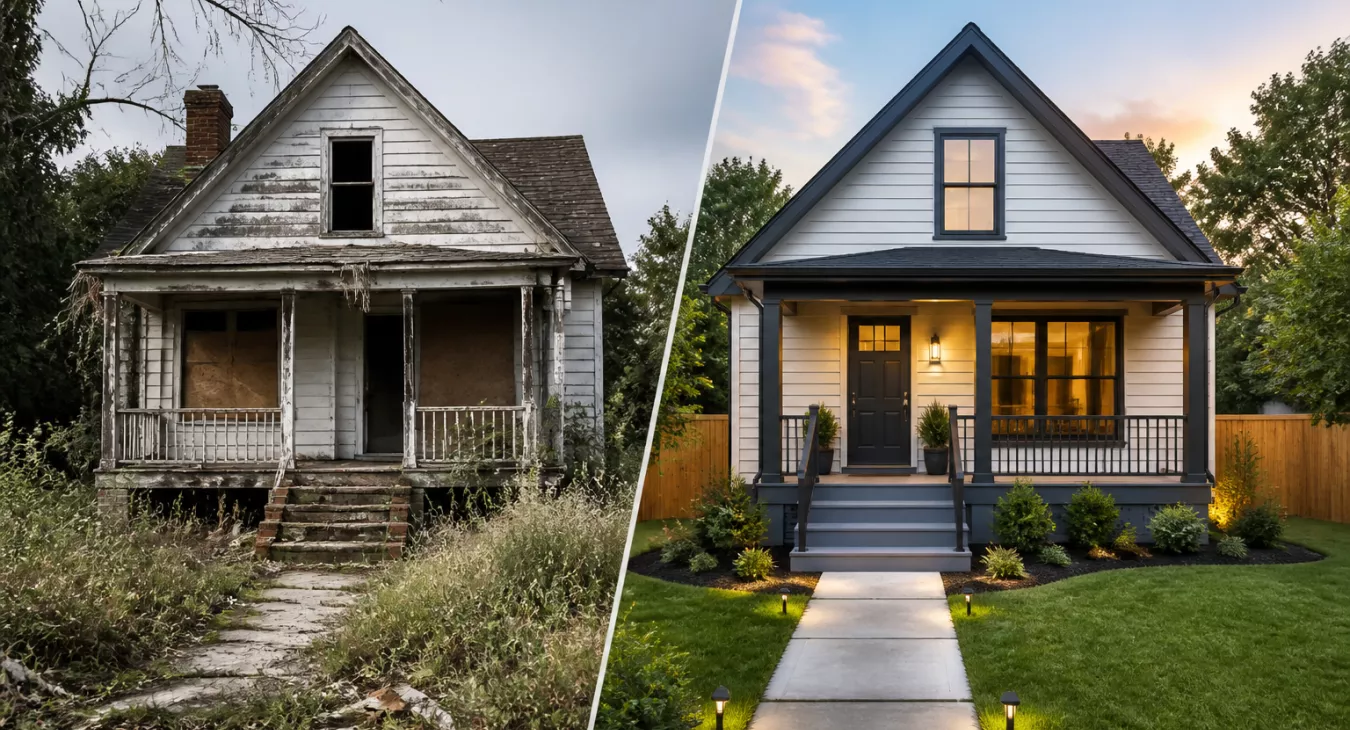
Master vacant property investing strategies to unlock hidden real estate opportunities. Learn how to find, finance, and convert abandoned properties for pr
Table of Contents
- What Are Vacant Properties and Why Invest in Them?
- How to Identify and Source Vacant Properties
- Financial Strategies for Vacant Property Acquisition
- Vacant Property Investment Strategies Compared
- Legal, Regulatory, and Insurance Considerations
- Rehabilitation and Renovation Planning
- Vacant Commercial vs. Residential Properties
- Tax Implications of Vacant Property Investing
- Risk Management and Common Pitfalls
- Building Your Vacant Property Investment Strategy
Vacant and abandoned properties sit at the intersection of community blight and investor opportunity. According to the U.S. Census Bureau's Housing Vacancy Survey, the overall housing vacancy rate stood at 10.5% of all housing units as of Q2 2026. That's a vast, largely untapped inventory that most investors walk past without a second look. Why? The complications are real—unclear title chains, deferred maintenance that bleeds money fast, structural unknowns that kill your proforma. But here's what separates winners from the rest: investors who understand the mechanics see what others miss. Vacant property investing strategies deliver discounted acquisition prices, motivated sellers, and repositioning potential that stabilized properties simply can't touch. And the upside is substantial if you execute right. This guide walks you through every stage—identifying opportunities, tracking down owners, securing financing, managing rehab, and exiting profitably. You'll learn how to turn blight into basis points.
New to finding deals? Start with our Guide to Finding Motivated Sellers.

What Are Vacant Properties and Why Invest in Them?
Defining Vacant vs. Unoccupied
People throw these terms around like they mean the same thing. They don't — and that distinction matters for your deal analysis. An unoccupied property is just temporarily empty. Snowbird's second home. Unit between tenants. The owner's still involved, the property's maintained, utilities are likely on. A vacant property is something else entirely. We're talking abandoned or neglected for years — deferred maintenance stacking up, unpaid taxes, code violations piling on, and an owner who might be impossible to track down.
Here's what the data shows. The Federal Reserve's FRED database logged 11.6 million year-round vacant housing units in Q4 2025. But USAFacts pegs total vacant homes at roughly 15.1 million based on the latest Census data. That gap? Seasonal properties and occasional-use homes inflating the broader number. For you as an active investor, the year-round vacant figure is what actually matters.
Hidden Value and Why Competitors Overlook These Deals
Most retail buyers won't touch vacant properties. Many investors won't either. Why? Because the friction is real — you've got to track down the owner, clear title, assess condition, and often get creative with financing. That friction is your advantage. Sellers of vacant properties are usually desperate. Carrying costs bleeding them dry. Estate settlements forcing their hand. Exhaustion from managing a problem asset for years.
What's the upside? Amerisave's research on abandoned acquisitions shows average ROI hitting 25–40% when you buy strategically and rehab properly. That return reflects both the acquisition discount and the value-add from the work. But here's the catch — and it's a big one.
Total renovation costs typically run $50,000–$150,000, with major rehabs pushing past $200,000. The opportunity is there. So are the expenses. You need to understand both sides before you make an offer — that's the foundation of winning at this game. Want to dig deeper into how vacant deals fit within distressed acquisitions broadly? Check out our full breakdown of vacant property investing strategy.
Back to topHow to Identify and Source Vacant Properties

Finding Properties Before They Hit the Market
Here's the truth: the best deals never touch the MLS. If you're waiting for a listing agent to post a vacant property, you've already lost. Your sourcing strategy needs to reach owners directly, before anyone else gets there. That means being systematic about it.
- Driving for dollars: Get into neighborhoods and look for the obvious red flags — overgrown lots, boarded windows, mail piling up, peeling paint, collapsed guttering, no utilities running. Visual distress signals tell you everything.
- County assessor and recorder databases: Most counties publish ownership records, tax payment history, and mailing addresses. Tax delinquency? Long gaps in permit activity? That's worth flagging immediately.
- USPS Vacant Address List (VAL): Available through licensed data resellers, this list identifies addresses where mail delivery's been suspended. But here's the catch — licensing terms and costs vary. Verify current pricing and access rules directly with resellers before you budget for this.
- Code enforcement records: Municipalities publish lists of properties with open violations. These are public records in most jurisdictions. Access procedures? They vary significantly by locality.
- Probate court records: Estates in probate sometimes hold real property that heirs want to move off the books fast. Access varies tremendously by state and county. Some jurisdictions expose only docket indexes. Others restrict the inventory documents that actually identify real property. Washington and Indiana both limit bulk court-record distribution under their court rules. Before you build a sourcing strategy around probate, research your specific jurisdiction's access rules. For a complete walkthrough of this approach, check out our guide to probate real estate investing.
- Tax deed auctions: When properties fall severely behind on taxes, they enter the tax deed or tax lien process. Our dedicated guide to tax deed investing walks you through this channel.
Locating Property Owners and Skip Tracing
You've spotted the property. Now find the owner. Start with the county assessor's record — that mailing address is probably stale for vacant properties, but it's your baseline. Then cross-reference with recorded deeds to confirm who actually owns it right now.
Skip-trace services pull from multiple data sources to return phone numbers and updated addresses. But there are serious legal and practical issues you need to understand:
- Skip-trace data sold for marketing purposes isn't protected under the FCRA under 15 U.S.C. §1681b. That's a double-edged sword: you can't use it for any FCRA-covered decision (tenant screening, owner financing evaluation, employment checks), and there's no accuracy guarantee or dispute rights. Don't ever use a non-FCRA marketing product for screening.
- Ask your vendor in writing if their data includes anything from DMV records. The Driver's Privacy Protection Act (18 U.S.C. §2721–2725) blocks using motor vehicle records for marketing without explicit consent. Penalties are $2,500 per violation — no exceptions.
- When vendors brag about hit rates and match rates, they're talking about records returned. Not accuracy. Not currency. Be skeptical and verify before you spend serious outreach budget.
- Skip-trace pricing and accuracy swing wildly between vendors. Things change constantly. Get current quotes directly instead of trusting any published number you read.
Direct Mail and Outreach
Direct mail to the owner's address of record (or a skip-traced address) is one of your cleanest legal plays as a vacant property investor. A well-written letter works: explain your interest, prove you can close fast, and put a real offer on the table. Consistency over multiple touches is what closes these deals.
Phone outreach? That's where the regulatory minefield starts. Two 2025 federal district court decisions — Coffey v. Fast Easy Offer (D. Ariz.) and Aussieker v. Aghazadeh (E.D. Cal.) — ruled that a home purchase offer isn't a "telephone solicitation" under the TCPA, which might limit don't-call rules in those specific jurisdictions. But stop there. These are district court rulings only. They don't set binding precedent. No appellate court has backed this position. And here's what matters more: neither ruling touches 47 U.S.C. §227(b), which independently prohibits prerecorded calls, artificial voices, and autodialed calls to cell phones. Period. State laws are often stricter. Florida's FTSA (Fla. Stat. §501.059) and Washington's CEMA (RCW §19.190) aren't touched by these rulings. TCPA violations? $500 per call or text. $1,500 for willful violations. Private right of action. And the TCPA treats SMS as a call. Before you run any phone or text campaign, hire a telecommunications attorney. This isn't legal advice.
Back to topFinancial Strategies for Vacant Property Acquisition

Why Conventional Financing Is Often Unavailable
Here's the reality: Fannie Mae and Freddie Mac want habitable properties. The moment a deal has deferred maintenance, missing systems, or structural problems, conventional underwriting walks away. You're done.
Look at where rates sat as of August 6, 2026. The Freddie Mac Primary Mortgage Market Survey pegged the 30-year fixed at 6.69% and the 15-year at 6.01%. Those numbers matter — just not for vacant acquisitions. Most vacant properties never qualify for conventional loans in the first place, which means those rates are academic for what you're actually trying to do.
Financing Options in Practice
You've got real choices here. The table below breaks down the financing vehicles that actually work for vacant property investors — hard money, private lending, portfolio lenders, and more.
Quick heads up on rates and terms: Hard money, private lending, and portfolio lender pricing shifts constantly depending on market conditions, property condition, and your track record. What you see below is general market context as of mid-2026. Get actual quotes from multiple lenders before you commit to an acquisition strategy.
| Financing Type | Typical Use Case | Property Condition Requirement | Approval Speed | Documentation Burden | Key Consideration |
|---|---|---|---|---|---|
| Conventional (30-yr fixed) | Stabilized rentals post-rehab refi | Habitable; meets agency guidelines | 30–45 days | High (full income, credit, appraisal) | 6.69% as of Aug 6, 2026; not usable at acquisition for most vacant properties |
| Hard Money | Acquisition + rehab bridge | As-is acceptable; lender underwrites ARV | 5–15 days | Low-moderate (asset-based) | Higher rates and fees; short terms (6–24 months typical); designed to be replaced |
| Private Lending | Acquisition; relationship-based | Flexible; negotiated case-by-case | Variable | Low (negotiated) | Terms depend entirely on the relationship; document everything in writing |
| Cash | Distressed acquisitions; auctions | No restriction | Immediate | None | Strongest negotiating position; ties up capital |
| Portfolio Lender | Investors with track record | Moderate distress sometimes acceptable | 14–30 days | Moderate (lender-specific) | Not sold to secondary market; more flexible underwriting than agency |
| FHA 203(k) / Renovation Loan | Owner-occupant or investor (limited) | Distressed but structurally sound minimum | 45–60 days | High (plus scope-of-work requirements) | Generally not available for pure investment; 203(k) consultant required |
Starting out with thin capital reserves? Our breakdown on real estate investing with no money walks through creative structures like subject-to and seller financing that work well in vacant property plays.
Auction Deposits and Carrying Costs
Tax deed and foreclosure auctions demand serious upfront cash. Most jurisdictions hit you with 10–20% of purchase price at sale, and the rest is due in 30 days.
But there's more. Title searches on abandoned properties almost always turn up back taxes and liens sitting in the $10,000 to $50,000 range. These get resolved as part of closing — which means you need to bake that cost into your max offer before you ever step up to bid.
Back to topVacant Property Investment Strategies Compared

Your capital, timeline, appetite for risk, and what's happening in your local market — these four things dictate which strategy actually works for you. The comparison below breaks down how each one stacks up so you can figure out what fits.
| Strategy | Typical Timeline | Capital Required | Risk Level | Involvement | Primary Return Driver | Best Market Conditions |
|---|---|---|---|---|---|---|
| Fix-and-Flip | 3–12 months | High (acquisition + full rehab) | High | Very Active | Appreciation + forced equity | Low inventory, strong retail demand |
| Buy-and-Hold Rental | Long-term (5+ years) | High upfront; lower ongoing | Moderate | Moderate (ongoing management) | Cash flow + long-term appreciation | Strong rental demand; favorable price-to-rent ratio |
| BRRRR | 6–18 months to refi | High upfront; recycled via refi | Moderate-High | Very Active (rehab phase); moderate after | Equity extraction + cash flow | Properties with significant ARV gap; refi-friendly rate environment |
| Wholesale / Assignment | Days to weeks | Low (earnest money only) | Low-Moderate | Active (sourcing and marketing) | Assignment fee | Any market; buyer pool depth matters |
| Development / Repositioning | 1–5+ years | Very High | Very High | Extremely Active | Entitlement value + new construction margin | Undersupplied urban infill; zoning reform environments |
Want to see how these stack up against the full range of real estate investing approaches? Check out our real estate investing strategies comparison guide.
The BRRRR Method Applied to Vacant Properties
Vacant properties are tailor-made for BRRRR. Here's why: the discount you grab on acquisition creates the equity spread you need to pull your capital back out at refinance. Buy low, fix it up, rent it out, refinance on stabilized value, recycle your cash into the next deal — that's the cycle. The acquisition discount is everything. It's what makes the math work when you hit that refinance stage and pull out most (or ideally all) of your invested capital. Our guide on finding BRRRR properties walks through sourcing and underwriting in detail.
Here's what keeps people up at night with BRRRR: you blow your ARV estimate, or the rehab balloon goes over budget, and suddenly your refi proceeds don't cover what you actually spent. That's why conservative underwriting isn't optional — it's the baseline. Run the numbers pessimistically, not with rose-tinted glasses.
Wholesaling Vacant Properties
Here's how wholesaling works: you lock up a property under contract, then assign that contract to an end buyer. You never take title. You pocket the assignment fee. And vacant properties? They're gold for wholesalers because fix-and-flip and BRRRR investors are hungry for exactly this kind of distressed inventory. But here's the catch — and this matters. Wholesaling rules aren't the same everywhere. Several states now require wholesaler licensing, and more are considering it. Your state might have restrictions you don't know about. Before you close any assignment, talk to a real estate attorney licensed in your jurisdiction. This isn't legal advice — it's just common sense.
Back to topLegal, Regulatory, and Insurance Considerations
Vacant Property Insurance
Here's the hard truth: your standard homeowners or landlord policy won't touch a vacant property. Most carriers define "vacancy" as 30 to 60 consecutive days without occupancy, and once you hit that threshold, fire, vandalism, and liability coverage evaporates. You need a vacant property or "builders risk" policy — something actually designed for unoccupied or renovation-stage properties. The premiums run higher than standard coverage. They'll also demand regular inspections, secured entry points, and active utility management. Factor this into your closing costs. Don't get caught short.
Municipal Ordinances and Code Compliance
Many cities run vacant property registries. You've typically got 30 days from acquisition to register, and they're charging annual fees for the privilege. Miss the deadline? Daily fines kick in immediately. But here's what really stings: code violations don't disappear when the property changes hands. The prior owner's violations transfer to you at closing — they become your headache now. Before you lock in your purchase price, pull a full code violation search directly from the municipality. Don't rely on your title company's lien search alone. Some jurisdictions won't issue a certificate of occupancy or rental license until every violation gets resolved.
Pre-Foreclosure Properties: Mandatory Warning
Buying a property in foreclosure or pre-foreclosure? You're now operating under an entirely separate legal framework. States have stacked these laws high with foreclosure consultant statutes, equity purchaser rules, and equity skimming prohibitions. Some carry criminal penalties. Washington's RCW 61.34 is a perfect example. Get a local real estate attorney to review every contract and disclosure before you contact the owner. Speed and information advantage mean nothing here — that's exactly what these statutes punish. Don't even think about exploiting a distressed seller's lack of knowledge. This isn't legal advice.
Title Issues and Environmental Assessment
Vacant properties are title disasters waiting to happen. Unpaid judgments, mechanic's liens, IRS tax liens, HOA super-liens, botched probates — they pile up fast on properties sitting empty. Run a full title search and lock in a title insurance commitment before closing. For anything with prior commercial or industrial use, budget for a Phase I Environmental Site Assessment upfront. Finding recognized environmental conditions? A Phase II (soil and groundwater sampling) becomes the next step. Without it, financing and resale become nearly impossible.
Back to topRehabilitation and Renovation Planning

Assessment and Due Diligence
A general home inspection? That's not enough for vacant properties. You need specialists diving deep into structural, roofing, HVAC, electrical, and plumbing before you sign anything — or at minimum with a contingency period long enough to actually evaluate what they find. Here's what demands your attention:
- Foundation and structural: Settlement cracks, compromised load-bearing walls, water intrusion evidence
- Roof: Age, shingle condition, decking integrity, flashing, gutters and drainage
- Electrical: Panel age and capacity, knob-and-tube or aluminum wiring presence, grounding, GFCI compliance
- Plumbing: Material type (galvanized, polybutylene, cast iron), supply pressure test, sewer scope
- HVAC: Age, refrigerant type, ductwork condition, combustion safety
- Environmental: Asbestos (pre-1980 construction), lead paint (pre-1978), mold, radon
Renovation Cost Benchmarks
Light cosmetic work runs approximately $15–$40 per square foot right now in 2026. Want to gut the whole thing? That's a different animal — you're looking at $20 per square foot minimum for basic work, climbing to $200+ in high-cost metros.
And abandoned properties? Expect $50,000–$150,000 in total project costs, with complex deals pushing past $200,000. These numbers depend entirely on your property, local labor costs, and what you're actually doing. Don't treat benchmarks as gospel.
Add 15–20% contingency on top of your contractor bid. That's the standard. If you're new to this, bump it to 20–25% because walls always hide surprises. And here's what separates successful investors from underwater ones: you don't kill contingency to make the deal work. That's the quickest path to a failed project.
Contractor Selection and Project Management
With the scope most vacant properties demand, a general contractor who orchestrates multiple trades beats self-managing five subcontractors. Check their license status with your state contractor licensing board. Verify they've got general liability and workers' comp insurance — get the certificates. Pull references on comparable recent projects. Confirm they'll do proper lien waivers.
Payment draws tied to actual completion milestones — not calendar dates — keeps everyone honest.
Running this remotely? Our long-distance rental property investing guide lays out the systems and team infrastructure you'll need to manage projects from a distance.
Back to topVacant Commercial vs. Residential Properties

Residential and commercial vacant properties play by completely different rules. Before you pick one to target, you need to know what you're actually getting into.
| Factor | Residential Vacant | Commercial Vacant |
|---|---|---|
| Financing availability | Hard money widely available; clear refi path via agency products post-stabilization | Commercial hard money available but more expensive; agency refi typically requires DSCR and occupancy thresholds |
| Renovation complexity | Predictable scope; well-established contractor market | Often requires commercial-grade systems, ADA compliance, code upgrades for change of use |
| Tenant lease terms | Month-to-month or 12-month standard; residential landlord-tenant law governs | 3–10+ year NNN or gross leases negotiated; much greater variability |
| Valuation method | Comparable sales (comps) | Income approach (cap rate on NOI); market cap rates vary significantly by submarket and asset class |
| Exit timeline | Faster (6–18 months for flip or stabilized rental) | Longer (tenant lease-up can take 12–36 months for repositioned assets) |
| Adaptive reuse potential | Limited by residential zoning | High — retail to office, office to residential, industrial to creative — subject to zoning and entitlement |
| Depreciation (tax) | 27.5-year GDS/MACRS straight-line (≈3.636%/yr of depreciable basis) | 39-year GDS/MACRS straight-line for nonresidential real property |
Here's what most residential investors miss: commercial vacancies unlock repositioning plays that'll never happen in residential. Take a tired strip retail building on a corridor that's shifting to mixed-use. You could convert those storefronts to apartments — if zoning allows it, if entitlements don't kill your timeline, and if you've got the cash reserves to carry the deal through a 24–36 month lease-up.
That's adaptive reuse.
And it's not for everyone. You need either deep commercial development chops or serious relationships with city planning departments. The upside? Converting a 4,000 SF retail box to 8 residential units in a supply-constrained submarket can mean 6+ cap rate to a repositioned 4.5 — but only if you execute flawlessly.
Managing multiple residential units comes with its own set of challenges and opportunities. Our multifamily investing guide walks through underwriting and operations for properties with more than one dwelling unit.
Back to topTax Implications of Vacant Property Investing
Depreciation and Cost Segregation
You've rehabilitated the vacant property and it's now generating rental income. Here's what happens next: the depreciable basis gets recovered over 27.5 years using IRS GDS/MACRS straight-line methodology for residential rentals, which pencils out to roughly 3.636% annually of your depreciable basis (IRS Publication 527). But if you're doing a substantial renovation—and most vacant property flips are—don't sleep on a cost segregation study. It'll reclassify certain improvements into 5-, 7-, or 15-year buckets instead, which accelerates your deductions dramatically.
Bonus Depreciation Under the OBBBA
The One Big Beautiful Budget Act changed the game. 100% bonus depreciation is now available for qualified property placed in service after January 20, 2025. This applies to personal property and cost-segregated improvements—not the building itself, so don't get ahead of yourself. On a major rehab with $150k in personal property and improvements? You could write off the entire amount in year one. That's a significant first-year deduction against active or passive income, though passive activity loss rules still apply.
And there's more. Section 179 expensing limits jumped to $2.56 million in 2026, with phase-out starting at $4.09 million of total property placed in service. How do these provisions stack with your LLC structure or S-corp? That's where a CPA or tax advisor comes in—they'll tell you how the pieces fit together. This isn't tax advice.
Back to topRisk Management and Common Pitfalls

The Most Frequent Mistakes Vacant Property Investors Make
- Overpaying at acquisition: A discounted price doesn't mean anything if you're paying too much relative to ARV. Work backward from your comps—and use conservative ones, not wishful thinking.
- Underestimating renovation costs: Vacant properties hide problems. Behind walls, under slabs, inside mechanical systems. You need a thorough inspection and a real contingency buffer, not some token line item you'll ignore when the first surprise hits.
- Ignoring carrying costs: Insurance. Property taxes. Utilities. Security. Debt service. They're coming every single month while you're working. A rehab that stretches from six months to twelve? That's profit erosion you should've seen coming.
- Skipping title work: And this is a killer. The $10,000–$50,000 in back taxes and liens that turn up on abandoned properties? That's deal-changing money. You need to know before you commit.
- Neglecting market analysis: So you've got a beautifully renovated property. But the neighborhood's demand is falling, rents are declining, and inventory's piling up. You're not hitting the numbers your pro forma promised.
- Single-exit-strategy thinking: Markets shift. Before you buy, you need at least two solid exits mapped out. If flipping doesn't pencil anymore, can you rent it? If rental demand tanks, can you wholesale or sell to another investor?
Fair Housing Compliance
Federal Fair Housing law (42 U.S.C. §3604) and most state rules prohibit discriminatory targeting in marketing and acquisitions. Don't select or exclude areas based on race, ethnicity, or demographic proxies. And here's the detail most investors miss: don't frame marketing around homeowner age. Many states treat age as a protected class, and elder financial protection statutes carry serious penalties for unconscionable deals involving older adults. Get a fair housing-aware attorney involved before you build any targeted acquisition strategy.
Back to topBuilding Your Vacant Property Investment Strategy
Assessing Your Starting Position
Get honest with yourself first. Before you even scout your first deal, you need to answer some hard questions:
- How much capital can I deploy, including acquisition, renovation, carrying costs, and a 20% contingency — without risking funds I can't afford to lose?
- Do I