

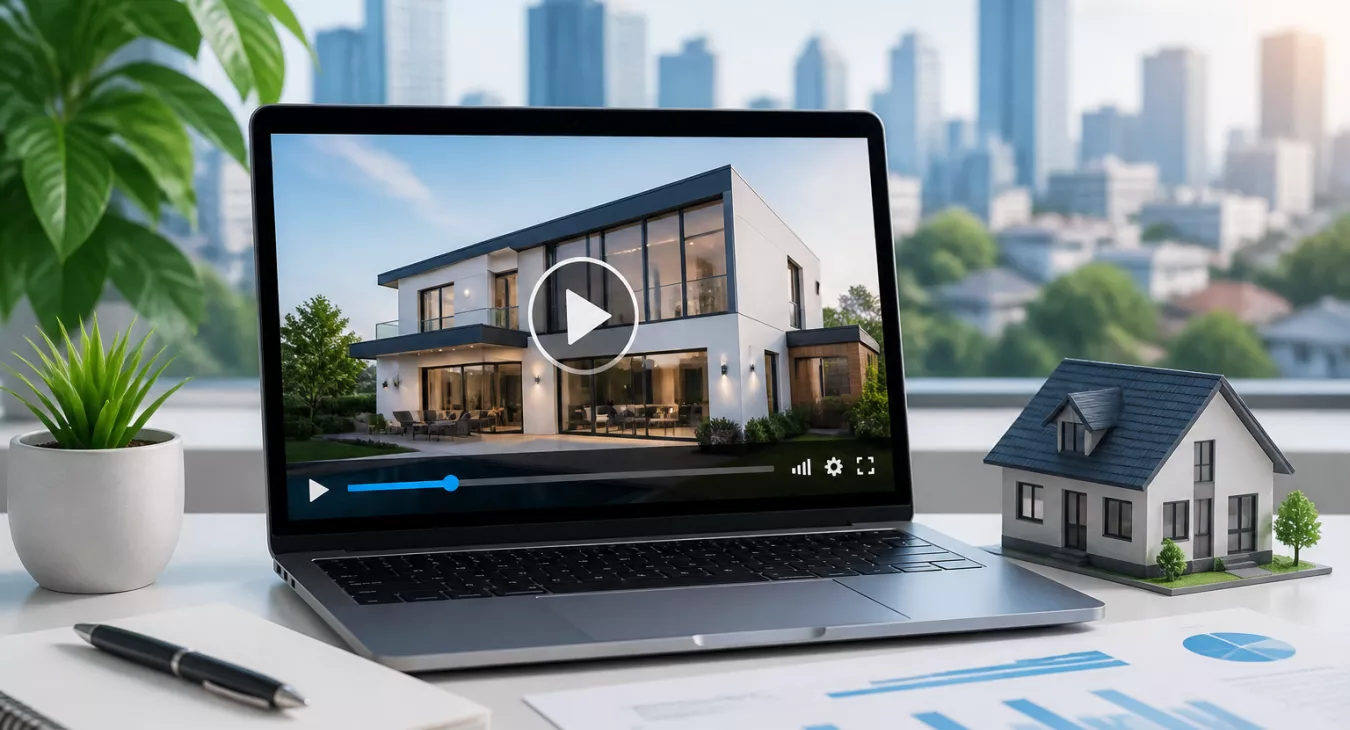
Videos increase real estate website conversion rates by up to 56%. Learn why video works and how to implement it for more leads and closed deals.
Products and Tools Mentioned in this Post

Matterport
Matterport creates immersive 3D virtual tours and digital twins for real estate. Capture properties with professional-grade technology and share interactive experiences.
Table of Contents
- The Data Behind Video's Impact on Real Estate Conversions
- 5 Types of Videos That Drive Real Estate Website Conversions
- Where and How to Place Videos on Your Real Estate Website
- Video Production: From DIY to Professional Solutions
- Video Marketing and Distribution Strategy
- Measuring Video Impact on Conversion Rates
- Common Video Mistakes That Kill Conversions
- Real Estate Video Best Practices for 2025–2026
- Conclusion: Making 2025 Your Year of Video Conversions
- Frequently Asked Questions
Your real estate website's getting traffic. But it's not converting. And the fix might be sitting right in front of you: video. Studies back this up consistently — adding video to landing pages lifts conversion rates by as much as 56%. That's not marginal. In a business where deals close or die in seconds, video isn't optional anymore. It's your most powerful conversion tool.
What does a real video strategy actually look like? This guide walks you through why video works, which formats crush it, optimal placement, how to produce quality content without breaking the bank, and how to track your ROI. Build this right, and you'll be closing more deals in 2025.

The Data Behind Video's Impact on Real Estate Conversions

Let's start with the numbers. The case for video in real estate isn't hype—it's backed by hard data from multiple research sources that all point in the same direction.
- 56% conversion rate increase: Landing pages with embedded video convert up to 56% better than those without. That's Unbounce and Wyzowl data, and it's consistent.
- 403% more inquiries: Listings with video receive 403% more inquiries than listings with only photos and text. This comes from the National Association of Realtors—not some fringe study.
- 73% of homeowners: According to NAR, 73% of homeowners say they're more likely to list with an agent who uses video marketing. That's your competitive edge right there.
- Bounce rate reduction: Pages featuring video see bounce rates drop by 11–15% on average. Your visitors are staying longer and actually engaging with your content.
- Dwell time: Users spend 2.6x longer on pages with video versus text-only pages. That's where conversions happen.
Real estate benchmarks make the gap even starker. When you stack video against static content side by side, the winner's obvious. Want to know how to use these insights to drive your own investment returns? Check out Data-Driven Real Estate: How Top Investors Use Analytics for the full breakdown.
| Real Estate Metric | Without Video | With Video | Conversion Lift % | Industry Source |
|---|---|---|---|---|
| Landing Page Conversion | 2.9% | 4.5% | +56% | Unbounce / Wyzowl |
| Listing Inquiry Rate | ~1.2% | ~4.8% | +400% | NAR |
| Average Time on Page | 52 seconds | 2.5 minutes | +188% | Forrester Research |
| Email Click-Through Rate | 2.1% | 3.8% | +81% | HubSpot |
| Seller Lead Generation | Baseline | 73% preference | Significant | NAR Survey |
Here's what this tells you: video isn't optional. It's a competitive advantage. And if you're not using it yet, you're bleeding deals to investors who are.
Back to top5 Types of Videos That Drive Real Estate Website Conversions

Here's the reality: not all video content performs the same. Your competitors probably have videos scattered across their site collecting dust. The ones crushing it? They're strategic about which formats they use and exactly where they place them to hit conversion targets.
1. Property Tours and Virtual Walkthroughs
This is your bread and butter. Property tour videos are non-negotiable for real estate sites because they let buyers and tenants experience a space without showing up in person. The result? Way more qualified inquiries. Keep it tight at 2–4 minutes, make sure you've got natural light working for you, and always—and we mean always—end with a specific call-to-action like "Schedule your in-person showing today." Drone footage? That's the move for larger properties or homes with killer outdoor features. It signals quality and immediately boosts perceived value.
2. Agent Introduction and "About Me" Videos
Trust wins deals. And you build trust fast with a 60–90 second intro video on your homepage or About page. But don't just talk about yourself. Speak directly to your niche. Are you crushing it in distressed properties? Commercial assets? First-time investor portfolios? Say it. Then invite them to connect. The emotional friction drops immediately when someone can actually see and hear you before they pick up the phone.
3. Customer Testimonials and Success Stories
Want to know what crushes written reviews? A video testimonial. It's harder to fake, easier to connect with emotionally, and 1–2 minutes is all you need. Have your satisfied clients talk real outcomes—"We sold in 11 days above asking" beats generic praise every time. Shoot in well-lit spaces, coach them beforehand, and put these on your homepage and contact page. This stuff moves the needle on conversions.
4. FAQ and Educational Videos
Your prospects are drowning in questions. "How does wholesaling actually work?" "What happens after I submit an offer?" Answer them in 90 seconds to 3 minutes. You'll position yourself as the local expert, keep people on your site longer, and bonus—these videos rank. They're a killer complement to your broader SEO for real estate investors strategy too.
5. Market Trends and Neighborhood Guides
Monthly or quarterly market updates establish you as someone who knows the local game. Seller leads eat this up because they want real data on what their home's worth right now. Keep it 3–5 minutes, data-driven, and consistent in format so people know what they're getting. These videos have serious shelf life when you embed them in blog posts or email them to your database.
| Video Type | Production Complexity | Average Length | Expected Conversion Lift | Best Placement |
|---|---|---|---|---|
| Property Tour | Medium | 2–4 minutes | +30–50% on listing pages | Individual listing pages |
| Agent Introduction | Low | 60–90 seconds | +20–35% on About/Home | Homepage, About page |
| Client Testimonial | Low–Medium | 1–2 minutes | +25–40% on conversion pages | Homepage, Contact, Landing pages |
| FAQ / Educational | Low | 90 seconds–3 minutes | +15–25% dwell time increase | Blog posts, Resource pages |
| Market Update / Neighborhood | Medium | 3–5 minutes | +20–30% seller lead gen | Blog, Email campaigns |
Where and How to Place Videos on Your Real Estate Website

You can shoot the best video on the market. But placement? That's what actually moves deals. The difference between videos that convert and videos that nobody watches comes down to where you put them and what you want each one to do at different stages of the buyer's journey.
Homepage Hero Videos
Autoplay, muted background video in your hero section hits visitors immediately. It signals professionalism. More importantly, it creates emotional engagement before they even read a word. Keep it tight—15 to 30 seconds max—with sharp property footage or community shots. Add a clear headline and a button that actually tells people what to do next. On mobile devices, fall back to a static image so the page doesn't crawl. Want to see this done right? Check out Best Real Estate Investor Websites 2026 for real examples that move buyers.
Property Listing Page Integration
Every single listing needs its property tour video above the fold. Put it before the photo gallery. You want that thumbnail with the play button sitting front and center where people can't miss it. And the player itself should include a visible CTA overlay or a button right below it—schedule a showing, request info, whatever your conversion goal is. This one change routinely bumps inquiry rates. We're talking measurable lift here.
Building a Dedicated Video Tours Section
Create a "Video Tours" or "Virtual Walkthroughs" page in your main navigation. This tells buyers you're multimedia-first, not stuck in 2015. It becomes a destination for serious shoppers actively looking through inventory. Plus, you get better internal linking structure that helps Google crawl your site more efficiently.
Video Placement for SEO and A/B Testing
Embedding videos on blog posts dramatically increases your odds of landing featured snippets and video carousels in Google Search. That's free real estate. Use schema markup to tell search engines what they're looking at. Now, for the tactical stuff: test your CTA position. Does it crush it before the video plays? After? Smack in the middle as an overlay? Even small tweaks here compound over time into measurable conversion gains.
Back to topVideo Production: From DIY to Professional Solutions

Most real estate investors hesitate on video because they're worried about dropping cash on production gear they don't understand. Here's the thing: you don't have to. A tiered approach lets you start making money with video today, then upgrade your setup as your portfolio grows and cash flow improves.
DIY Production for Getting Started
Your iPhone 14 or Samsung Galaxy S series is already capable. Add a $50 clip-on microphone, grab a ring light, and you're basically set. CapCut or DaVinci Resolve are free and they work. What matters here is authentic, clear content—not some overproduced Hollywood thing that screams "trying too hard." For educational videos and FAQ content, DIY is genuinely the right call. Your audience doesn't care about 4K cinematography when they want answers.
Mid-Range Semi-Professional Setup
Spend $500–$1,500 and you jump to a different league entirely. A mirrorless camera like the Sony a6400, a solid lens, and a basic gimbal stabilizer will transform your property tours. Throw in Adobe Premiere Rush for cloud-based editing and you've built an in-house production operation that rivals outsourced work. This is the sweet spot if you're closing multiple listings per month and want to control your content pipeline.
Professional Videography
Your flagship listings deserve professional treatment. So do agent branding videos and major marketing pushes. Real estate videographers charge $300–$800 per property for the basics. But if you're selling luxury assets? You're looking at $1,500–$3,000 when drone footage and cinematic editing are in the mix. Does the ROI pencil? Almost always yes—a quality property video moves inventory faster and commands higher prices. The math usually works.
| Production Method | Setup Cost | Per-Video Cost | Time Required | Quality Level |
|---|---|---|---|---|
| DIY Smartphone | $50–$150 | $0–$20 (editing time) | 1–3 hours | Good for social/FAQ |
| Semi-Pro (Camera + Gimbal) | $800–$1,500 | $30–$75 (editing) | 3–6 hours | Good for most listings |
| Professional Videographer | $0 (outsourced) | $300–$800 per property | Minimal (review only) | High — all listing types |
| AI-Assisted Video Tools | $50–$200/month | $10–$30 | 1–2 hours | Good for market updates |
| Luxury / Drone Production | $0 (outsourced) | $1,500–$3,000 | Minimal | Premium — luxury listings |
And then there's AI. These tools are getting genuinely useful for market update videos and animated explainer content—no camera required. Want the full breakdown of how AI is actually changing real estate workflows? Check out AI Tools for Real Estate Investors: Complete Guide 2026.
Back to topVideo Marketing and Distribution Strategy
Post your video on your website alone? You're leaving money on the table. A real multi-channel strategy captures your audience wherever they actually hang out—YouTube, Instagram, TikTok, LinkedIn—and funnels them back to your site while building serious brand credibility across all platforms at once.
YouTube Optimization
YouTube is the second largest search engine in the world. For most real estate investors, it should be your primary hosting and distribution hub, full stop. Your titles need to be keyword-rich. Your description should be detailed, include timestamps, and drop your website link in the first two lines where people actually see it. Tag everything relevant.
And here's what most investors skip: organize your videos into playlists by content type—Property Tours, Market Updates, Investor Education. Playlists boost session watch time and improve your rankings. That's free juice you're leaving on the table if you don't do it.
Social Media Distribution
Take that 15-minute YouTube deep dive and chop it up. Instagram Reels need 15–60 seconds. Facebook video posts work best at 1–3 minutes. TikTok? 15–60 seconds for maximum reach. If you're in commercial real estate, LinkedIn is where institutional buyers and business owners actually scroll—don't sleep on it.
But here's the thing: every platform has its own algorithm. Native uploads crush embedded links in organic reach every single time. Upload directly instead of pasting a YouTube link if you want the algorithm to actually show your content.
Email Marketing With Video
Put the word "video" in your email subject line and your open rates jump by an average of 19% (Syndacast). Most email clients don't support autoplay, so embed a video thumbnail linked to your YouTube or website player instead. A solid thumbnail with a play button icon drives strong click-through rates.
This pairs perfectly with your email nurture sequences. Connect it to a solid CRM for real estate investors that lets you segment by behavior and track who's actually engaging with your content. Video becomes your natural nurture tool.
Video Platform Comparison
| Platform | Hosting Cost | Analytics Depth | Distribution Features | Best For |
|---|---|---|---|---|
| YouTube | Free | Good (YouTube Studio) | Excellent — built-in search discovery | All real estate video types |
| Vimeo (Basic) | Free / $20+/month | Good | Limited organic reach | Clean embeds, portfolio sites |
| Vimeo (Pro) | $75+/month | Advanced | Customizable player, no ads | Luxury listings, branded experience |
| Wistia | $99+/month | Excellent (heatmaps, CTAs) | Limited — website-focused | Conversion-focused landing pages |
| Facebook/Instagram Native | Free | Basic | Excellent for social audiences | Short-form social distribution |
Measuring Video Impact on Conversion Rates

Don't measure it, don't improve it. That's the rule. Without a solid analytics framework, video stays a black hole in your marketing budget—something you're doing because everyone else is, not because you actually know if it's working.
Key Metrics to Track
- Play Rate: The percentage of page visitors who click play. If you're sitting below 15%, your thumbnail or placement is probably costing you deals.
- Watch-Through Rate: How many of your video viewers actually stick around. The industry average sits around 37%, but anything above 50% tells you your content is genuinely compelling for real estate buyers.
- Click-Through Rate on CTAs: Use UTM parameters to track every click on your in-video and post-video calls-to-action. This tells you who's actually ready to move.
- Conversion Rate (Video Viewers vs. Non-Viewers): Pull this data separately in your analytics. Compare conversion rates for visitors who watched your video against those who didn't. This comparison? It's your smoking gun for ROI.
- Assisted Conversions: Google Analytics 4 shows you something crucial here—how often video pages show up in conversion paths, even when they're not the final click. Video's doing work you might not realize.
ROI Calculation Framework
Here's the formula that matters: (Revenue Attributed to Video-Assisted Conversions − Video Production Cost) / Video Production Cost × 100. Let's say you spent $600 on a professional property video and it helped close a $4,000 commission. Your ROI? 567%. And that's after paying for production.
Most attribution models give you positive returns fast. Videos work harder when they're doing double duty—serving multiple listings or staying active for a year or longer.
Want to connect all this back to your actual financials? Plug your video performance data into QuickBooks for Real Estate Investors. You'll see exactly how your marketing spend stacks up against transaction revenue, month to month.
Back to topCommon Video Mistakes That Kill Conversions

Get your video strategy wrong and you'll actually tank your conversion rates. Your brand takes a hit too. Here's what'll kill your performance:
- Poor audio quality: People forgive bad video. They won't forgive bad audio. A shaky recording with crystal-clear narration beats a gorgeous video with muffled sound every single time. Invest in an external microphone — it's non-negotiable.
- No call-to-action: And your video needs to end with something specific. "Visit our website" doesn't cut it. Instead? "Call 555-0147 now to schedule your private tour" — that's the CTA that moves people to action.
- Videos that are too long: Five minutes is the ceiling for property tours. Go longer and you'll watch your audience walk out the door. Cut every room that doesn't pull its weight.
- Autoplay with sound on: This is one of the fastest ways to get visitors to bounce. They'll leave before they even see your listing. Mute all autoplay videos by default.
- Missing captions: 85% of Facebook videos play without sound. Captions aren't a nice-to-have. They're essential. You need them for accessibility, engagement, and increasingly, ADA compliance on websites.
- Ignoring mobile optimization: Over 60% of real estate searches happen on phones now. Test every single video on mobile before it goes live.
- No thumbnail customization: Generic thumbnails leave money on the table. Design something custom — a compelling still frame with legible text overlay — and you'll see play rates jump significantly.
Real Estate Video Best Practices for 2025–2026
The video market's moving fast. Early adopters who nail these emerging trends will have a real competitive edge over slower-moving investors.
AI-Powered Video Creation
Synthesia, HeyGen, and Pictory—you've probably heard the buzz. These AI tools let you pump out professional market updates and explainer videos with avatar presenters and synthetic voice work. No need to be on camera yourself. Sure, nothing beats an actual agent testimonial or a real property walkthrough for pure authenticity. But here's what matters: you can now produce consistent, scaled content without the production headaches that used to eat up your time and budget.
Interactive Video Elements
Imagine a property tour where your buyer prospects aren't just watching—they're clicking. Interactive video platforms embed clickable hotspots, chapter navigation, and branching paths right into the video itself. Your viewers can jump to the floor plan, pull neighborhood comps, or skip straight to the kitchen they care about. Investors using this tech report significant jumps in engagement depth and time on site. That's not vanity—that's buyers spending more time with your asset.
Short-Form Vertical Video
TikTok, Reels, and Shorts have trained everyone under 40 to expect snappy, vertical content. For 2025–2026, this isn't a nice-to-have anymore—it's table stakes if you want younger buyer demographics. A 30-second before-and-after renovation reel will crush a polished 5-minute property tour in terms of lead generation. Period.
Personalized Video at Scale
Your CRM can now auto-generate personalized video messages and fire them to leads based on their actual browsing behavior. Someone clicked on three listings in the same zip code? They get an automated (but still personalized) video email calling out those properties by name. This personalization used to be a enterprise marketing team move. Now individual investors can run it through tools we break down in our guide to the best CRM for real estate investors in 2026.
360-Degree and VR Tours
Full VR adoption in residential real estate search is still ramping up. But 360-degree tours embedded on your listing pages? They work. Matterport and similar tools now cost way less than they used to, making them accessible for small- to mid-size investment shops. They're especially money for out-of-state buyer segments who can't visit in person.
Back to topConclusion: Making 2025 Your Year of Video Conversions
The numbers don't lie. A 56% lift in landing page conversions. 400% more listing inquiries. Videos crush every other content format when it comes to moving leads through your funnel. And honestly? The choice for real estate investors in 2025 isn't whether you should be using video anymore — it's how fast you can actually implement it into your lead gen system before your competition does.
Here's what getting started looks like:
- Week 1–2: Grab your smartphone and film two videos: a quick intro about yourself and a property tour. Upload them to YouTube, embed the intro on your homepage, and put the tour on a listing page.
- Month 1: Add video thumbnails to your three best-performing listing pages. Jump into Google Analytics 4 and set up conversion tracking so you can actually see which videos are working.
- Month 2–3: Film two client testimonials. Produce one market update. Push all three across YouTube, email, and your social channels.
- Month 3–6: Look at the data. Which video types are actually converting? Double down on those. If you're listing high-value properties, this is when you invest in better production quality.
- Ongoing: One video per week beats four videos dumped randomly throughout the month. Consistency is everything. Don't chase perfection — chase the publishing schedule.
Want to multiply your video's reach? Pair it with a solid Google Ads campaign and watch your results accelerate. And if you're building or rebuilding your site around video, see what the best real estate investor websites are actually doing in 2026.
Video isn't going anywhere. It's the baseline now. The investors who build their systems around it today will have a real edge that lasts.
Back to topFrequently Asked Questions
How much do videos really increase real estate website conversion rates?
Here's what the data shows: listing pages with video pull up to 403% more inquiries than those without. And conversion rates on landing pages? You're looking at a 30–56% lift. Of course, you won't see those numbers automatically. Video quality, placement, and your call-to-action all matter. Most investors start seeing real results within 60–90 days once they're posting videos consistently.
Do I need professional equipment to start using video for my real estate website?
You don't. Honestly. A smartphone from the last few years, a $30–$50 clip-on microphone, and free software like DaVinci Resolve or CapCut will get you started. What actually moves the needle? Clear audio, good lighting, and a specific call-to-action at the end. Professional gear will polish things incrementally, but consistency and solid content beat fancy equipment every single time early on.
Which video type delivers the highest conversion rate for real estate investors?
Client testimonials and property tours dominate. Why? Testimonials build trust—that's the friction point between a visitor and a call. Tours answer what every buyer actually wants to know: what does this space feel like in real life? For seller leads specifically, market update videos crush it. They position you as the expert in your market and give homeowners a reason to pay attention.
Should I host real estate videos on YouTube or directly on my website?
Host on YouTube, embed on your site. You get free hosting, built-in search discovery, and organic reach you won't get any other way. Embedding those videos improves your page engagement metrics—the signals Google actually uses to rank you. If you need serious conversion tracking—think in-video click heatmaps and advanced analytics—Wistia is worth considering, though you'll pay a monthly fee for that level of intelligence.
How long should real estate videos be for maximum conversions?
It depends on what you're doing. Agent intro? Keep it 60–90 seconds. Testimonials run 1–2 minutes. Property tours are 2–4 minutes for standard listings, stretch to 6 if it's luxury or commercial. FAQ and educational content? Stay between 90 seconds and 3 minutes. Market updates can go 3–5 minutes. The real rule: make it as short as possible while actually saying what people need to hear. Most viewers bounce hard after the 3-minute mark with real estate content—so edit with that in mind.
Back to top