

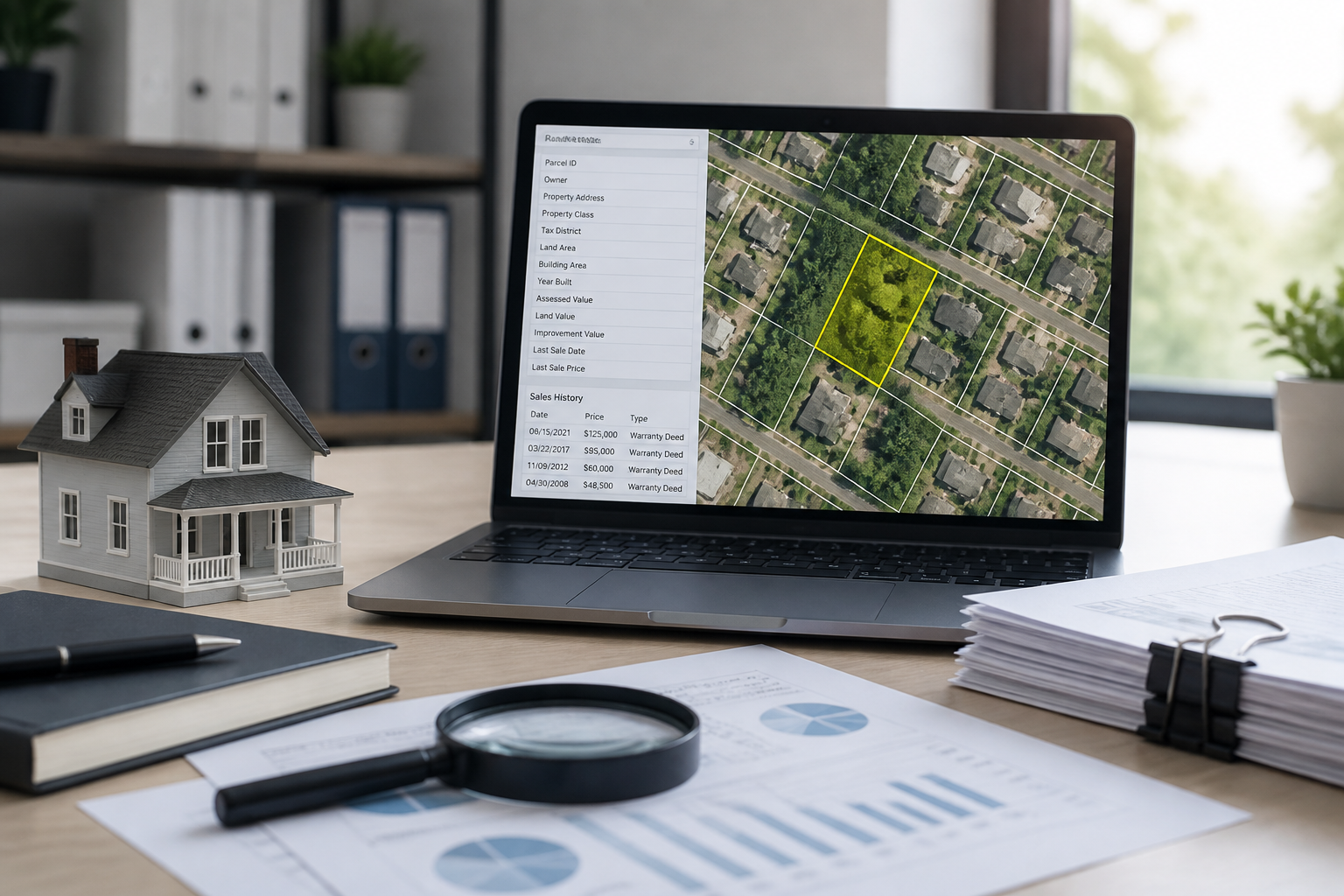
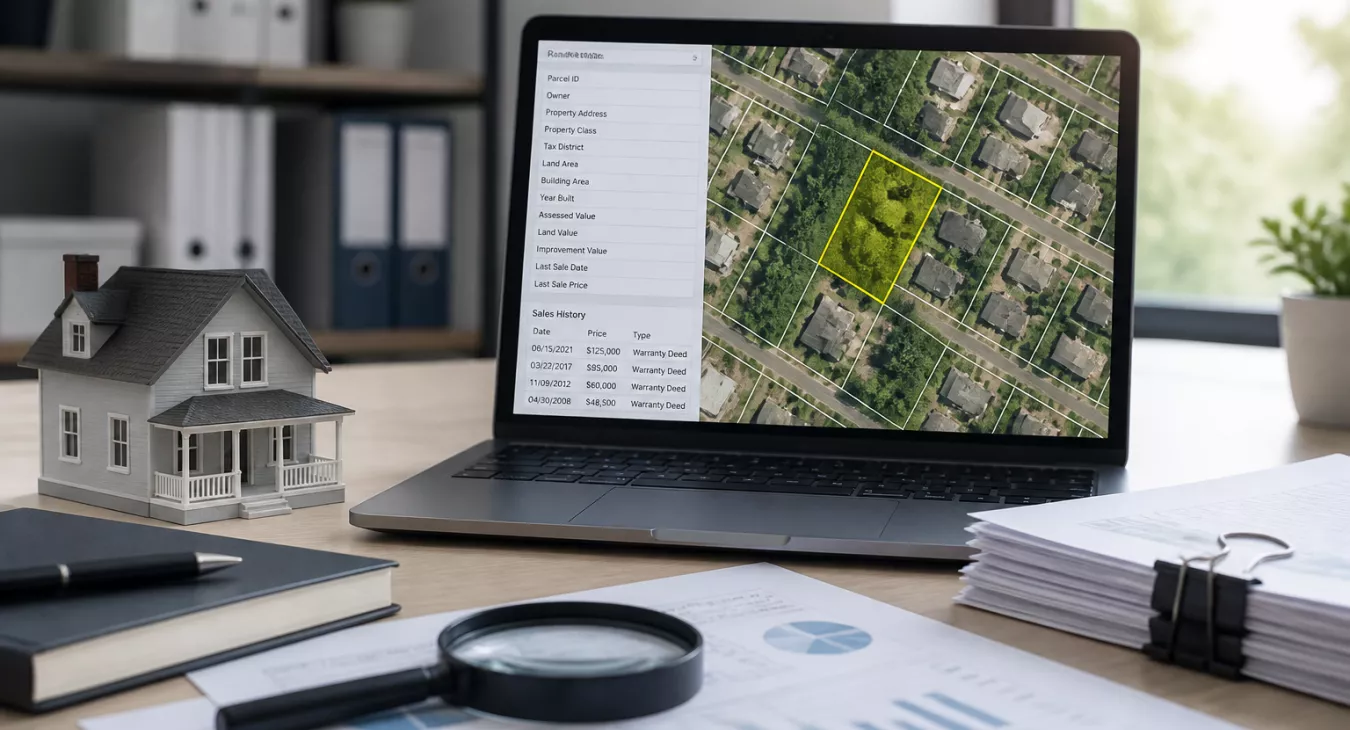
Learn how to use the county tax assessor database to research land deals like a pro. Access free ownership, valuation, and sales history data today.
Table of Contents
- What's a County Tax Assessor Database?
- How to Access County Tax Assessor Land Records
- Understanding Property Tax Records
- Real Property vs. Personal Property Records
- Popular County Tax Assessor Database Platforms: A Comparison
- Tips for Effective Property Record Searches
- State-by-State Snapshot: Where to Start Your Search
- Conclusion: Making Assessor Data Work for Your Deals
- Frequently Asked Questions
Every land deal starts with data. And the county tax assessor database? It's one of the most powerful free tools you have access to as a real estate investor or agent. You're vetting a vacant parcel. Tracking down an absentee owner. Researching a property's sales history. Assessor records give you direct access to ownership, valuation, tax status, and land use classifications — no subscription service required. This guide walks you through finding, accessing, and interpreting these records exactly like a seasoned pro would.

What's a County Tax Assessor Database?
Definition and Purpose
It's a government record system. Your local assessor's office maintains it—though they might call themselves the tax commissioner, appraiser, or auditor depending on which state you're in. The official job? Track who owns what property and calculate the assessed values that show up on your tax bill. But here's why investors care: those same records that generate tax bills also contain parcel numbers, legal descriptions, owner contact information, land use codes, and historical valuation data. That's actionable intelligence.
One thing to remember: the assessor and the tax collector usually aren't the same office. The assessor determines value. The collector—or treasurer—handles billing and payments. Some counties combine both functions, but you need to verify which office actually holds the record you're after before you call.
Types of Records Available
Pull up most county assessor databases and you'll find these categories:
- Ownership records: Current and sometimes historical owner names, mailing addresses, and deed transfer dates
- Parcel data: Lot size, legal description, parcel identification number (PIN or APN), and geographic boundaries
- Valuation data: Market value estimate, assessed value, and any exemptions applied
- Tax information: Annual tax amounts, payment status, and delinquency flags
- Land use codes: Property classification codes (residential, agricultural, commercial, vacant, etc.)
Here's the critical distinction most new investors miss: market value and assessed value aren't the same thing. Market value is what the property might actually sell for on the open market. Assessed value? That's the number used for tax calculation—usually a fixed percentage of market value set by state law. And they can differ dramatically, especially in the 18 states (plus DC) that cap annual assessment increases, a group that includes California, Florida, and New York as of 2025 data. This matters for your ARV calculations.
Back to topHow to Access County Tax Assessor Land Records

Step-by-Step: Online Search Methods
- Identify the correct county. Land records live at the county level, not the state level. Not sure which county your target parcel sits in? Use Google Maps or your state's GIS viewer to pin it down before you waste time searching the wrong jurisdiction.
- Find the assessor's website. Try searching "[County Name] county tax assessor" directly. Your state's Department of Revenue website usually aggregates links to all county systems in one place — saves time.
- Choose your search method. You can search by owner name, parcel number, address, or legal description. But here's the reality: parcel number is your most reliable bet if you've got it.
- Review the record. Pull the full parcel detail. Look at ownership, valuation, tax status, and land use code. Screenshot or export everything you need before the data refreshes or the system times out.
- Cross-reference everything. Critical step — verify ownership and lien status against actual deed records at the courthouse. Don't rely on assessor data alone. For a complete due-diligence workflow, see our guide on how to research property liens before buying land.
Major Platforms and State Resources
Two platforms dominate the assessor database space and cover most of the country:
- qPublic (Tyler Technologies): You'll find this in hundreds of counties across Georgia, South Carolina, and other southeastern states. It gives you parcel search, map views, and sales history. Fair warning: you'll occasionally hit a "not authorized" error when a county's data license expires. When that happens, bypass the platform entirely and go straight to the county assessor's website.
- actDataScout: This one covers Arkansas, Oklahoma, and surrounding states well. What makes it different? It pulls personal property records alongside real property, so you can spot business assets tied to the land.
State Departments of Revenue or Taxation maintain aggregator pages listing every county assessor link in one place. Georgia's Department of Revenue does this. So does South Carolina's Department of Revenue. Tennessee's Metro Nashville & Davidson County runs its own standalone system that's legitimately solid. Start at the state level if you're hunting across multiple counties — it'll save you hours.
Want to scale this up? Check our article on how to download county assessor data for land investing for bulk data strategies.
Back to topUnderstanding Property Tax Records

Assessment Cycles and Tax Control Dates
Here's what trips up most investors: property assessments don't update in real time. Most counties reassess annually or on a multi-year cycle, and each state locks in a "tax control date" — the exact moment ownership and property status freeze for that tax year. Sold your parcel in December? Don't expect the new owner info to hit the assessor's database until next year's roll goes live. That's why you've got to check the effective date on every assessor record you pull. If the sale closed within the last six to twelve months, treat that data like it's preliminary.
Property Tax Rates: Context for Land Investors
The national average effective property tax rate hovers around 0.90% of market value as of 2026. But here's the thing — that number's worthless for actual underwriting. New Jersey sits at roughly 2.23%, while Hawaii's closer to 0.27% (both 2026 figures). The variation is massive. And if you're holding land? Annual taxes eat into your returns every single year. You need to model this deal by deal using your local assessor's actual numbers — not national benchmarks.

Real Property vs. Personal Property Records

| Record Type | Information Included | Source Office | Availability |
|---|---|---|---|
| Real Property | Land, structures, parcel ID, legal description, ownership, assessed value, tax status | County Assessor / Appraiser | Widely available online |
| Personal Property | Business equipment, machinery, mobile homes (in some states), vehicles (in some states) | County Assessor or Tax Commissioner | Varies; often searchable via actDataScout in covered states |
| Business Property | Commercial inventory, fixtures, business-use assets filed annually by businesses | County Assessor | Often requires direct office contact; not always in online portal |
If you're a land investor, real property records are where you spend 90% of your time. But here's what most investors miss: personal property records matter when you're evaluating commercial or agricultural parcels, especially where equipment or mobile structures could affect your title or negotiating position. And when you're working unusual situations—think estates, business liquidations, or distressed owners—knowing both record types separates the professionals from the amateurs. You'll spot opportunities others simply walk past. Check out our guide on finding land deals from estate sales for more on this.
Back to topPopular County Tax Assessor Database Platforms: A Comparison

| Platform | States/Coverage | Key Features | Data Freshness | Cost |
|---|---|---|---|---|
| qPublic (Tyler Technologies) | GA, SC, and select counties in FL, NC, others | Parcel search, map layers, sales history, photos | Updated per county assessment cycle; varies | Free (basic); some features require county subscription |
| actDataScout | AR, OK, and neighboring states | Real + personal property, owner search, tax history | Updated per county; generally current within tax year | Free public access; premium exports may require account |
| County-Specific Systems | Nationwide (varies by county) | Deepest local data; often includes GIS and zoning overlays | Most current — often updated daily or weekly | Free; bulk data downloads sometimes fee-based |
Tips for Effective Property Record Searches

Search Strategies That Save Time
- Search by owner name when you've got an address but no parcel number. This move also uncovers whether a single owner's sitting on multiple adjacent parcels — which happens all the time with serious land investors.
- Use parcel maps to identify neighbors. Most assessor GIS viewers let you click straight into adjacent parcels on the map. It's a game-changer for comp research.
- Check for delinquent tax flags. Overdue taxes? That's often your signal for a motivated seller. Pair it with a courthouse records search and you'll see the full lien stack.
- Note land use codes carefully. Here's the thing — these codes aren't standardized across the country. "A-1" zoning in one county might mean 5 acres minimum, but 10 acres in the next one over. Always call the county planning department to confirm what's actually buildable before you commit to an acquisition.
Understanding Legal Disclaimers
Every single assessor database comes with a disclaimer: data for informational purposes only, no liability for errors. And you should take it seriously. Real talk — assessor records lag behind deed transfers. They miss inheritance changes. They mess up after foreclosures. Clerical errors on acreage? Common. Don't base your title decisions on assessor data alone. You need recorded deeds backing it up, and on any actual purchase, get a title search done. This matters even more when you're hunting off-market land deals where the paper trail gets messy.
Back to topState-by-State Snapshot: Where to Start Your Search
| State | Primary Platform | State Aggregator Available? | Notes |
|---|---|---|---|
| Georgia | qPublic / individual county sites | Yes — GA Dept. of Revenue | Most counties on qPublic; some maintain standalone portals |
| South Carolina | qPublic (e.g., Spartanburg County) | Yes — SC Dept. of Revenue | Spartanburg has strong qPublic integration |
| Tennessee | Metro Nashville standalone; county-level for others | Partial — TN Comptroller site | Davidson County has one of the strongest public portals in the Southeast |
| Arkansas | actDataScout | Yes — AR Assessment Coord. Div. | Strong personal property data alongside real property |
| Oklahoma | actDataScout / county assessor sites | Partial — OK Tax Commission | Coverage varies significantly by county |
| Pennsylvania | County-specific (e.g., Allegheny, Philadelphia) | No central aggregator | Must search county by county; quality varies widely |
| Virginia | County-specific portals | Partial — VA Dept. of Taxation | Northern VA counties have strong GIS integrations |
| Louisiana | Parish assessor sites | No central aggregator | Louisiana uses "parishes" not counties; each maintains its own system |
Here's what'll trip you up if you're not careful: agricultural exemptions, greenbelt programs, and rollback tax rules don't play by the same rules across state lines. Take Tennessee's Greenbelt law—it's a completely different statutory framework than what you'll find elsewhere. Before you assume that exemption status on an assessor's record is legit, call the local assessor's office and verify it yourself. That's non-negotiable. Our land investing terms and strategy guide breaks down many of these concepts in plain English, no jargon.
Back to topConclusion: Making Assessor Data Work for Your Deals
County tax assessor databases aren't perfect. Records lag. Values don't match reality. And yeah, there are disclaimers for a reason. But here's the thing — if you're a land investor willing to spend time understanding how your local system actually works, this is still one of the cheapest research tools you'll find. Start at your state's Department of Revenue aggregator. Then drill down to the county-level portal. Cross-reference everything against deed and lien records. And whatever you do, don't treat assessor data as your title work — that's how deals blow up. The real edge? Combine assessor research with actual sourcing strategies like owner-financed deal structures or equity-skipping approaches. Most investors skip this foundation entirely. You won't.
Back to topFrequently Asked Questions
Are county tax assessor databases free to use?
Most of the time, yes. qPublic, actDataScout, and individual county websites offer free basic parcel lookups through their public portals. But here's the catch: some counties will hit you with fees for bulk data exports or certified document copies. Need data in a weird format? Call the assessor's office directly.
How current is the information in a county assessor database?
That depends entirely on your county's assessment cycle. Most update ownership and valuation annually, tied to whatever tax control date the state sets. A property that just closed last month? It might still show the old owner's name on the record. Always check the "as of" date printed right on the parcel card, then cross-reference recent sales against the county recorder's deed index to catch what the assessor hasn't updated yet.
Can I use assessor data to find motivated sellers?
Absolutely. Delinquent tax flags. Long-term out-of-state owners. Parcels held in estate names. It's all there in the assessor database, and smart investors use it every day to spot potential deals. Just don't stop there—assessor data is your starting point, not your finish line. Always dig into lien research and deed verification before you call anyone or make an offer.
Why does a qPublic search sometimes return a "not authorized" error?
Tyler Technologies' data license with that county has usually expired or is being renewed. Don't waste time troubleshooting. Skip qPublic and go straight to the county assessor's website instead—most counties run their own independent portal, even if they're also part of the qPublic network.
Do assessor records show the same value as the market price?
Not even close, and that's by design. The assessor uses their own formula—one that's locked into state law and often capped at a fraction of actual market value. That's especially true in states with Proposition 13 style assessment caps. For context, the U.S. median home sale price hit $410,700 in Q2 2026 according to Census Bureau data. But your specific parcel? Its value hinges on local market conditions, what you can actually do with the land, and how accessible it is—numbers that no national average will ever tell you.
Back to top