

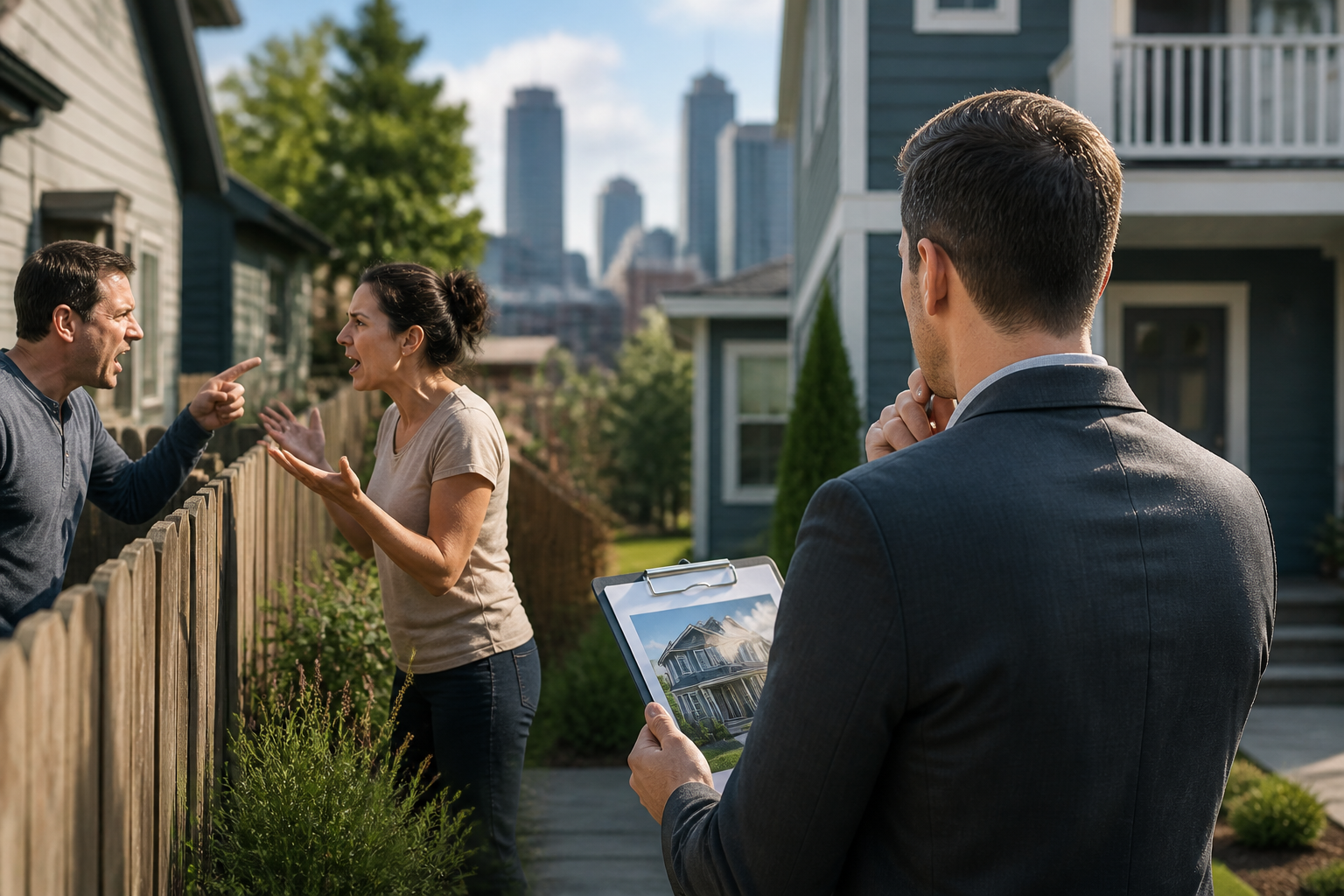

Learn how to deal with nightmare neighbors and protect your property value. Strategic legal solutions for investors managing problem neighbors effectively.
Table of Contents
- Understanding Nightmare Neighbors: Types and Behaviors
- Prevention: Building Positive Relationships Early
- De-Escalation and Communication Strategies
- Legal and Regulatory Options
- Escalation Path: When and How to Escalate
- Practical Protection and Security Measures
- Protecting Your Mental Health and Wellbeing
- When to Escalate: Involving Authorities
- When to Move: Evaluating Your Exit Options
- Conclusion: Protecting Your Investment, Your Property, and Your Peace of Mind
- FAQ: Common Questions About Difficult Neighbors
Nightmare neighbors aren't just annoying — they'll tank your returns. According to the Appraisal Institute, a problem neighbor can slash your property value by up to 10%. That's real money. With the median existing-home sale price at $417,700 as of April 2026, we're talking $40,000+ in lost equity on a single deal. And if you're managing a portfolio? That loss multiplies across every unit. Knowing how to deal with nightmare neighbors — the legal way, the smart way — isn't optional. It's critical infrastructure for protecting your portfolio.

Understanding Nightmare Neighbors: Types and Behaviors
You need to classify what you're dealing with first. And it matters — a lot. Not every problem neighbor plays by the same rulebook, and getting your response wrong can tank your investment. Come in too hot and you've escalated things unnecessarily. Move too slow and you've let a real threat fester.
Common Nightmare Neighbor Types
| Type | Common Examples | Severity | Recommended First Response |
|---|---|---|---|
| Noisy Neighbor | Late-night music, barking dogs, construction at odd hours | Low–Medium | Friendly direct conversation; document decibel levels |
| Neglectful Property Owner | Overgrown lawns, junk accumulation, visible blight | Medium | Report to code enforcement; photograph evidence |
| Pet-Related Issues | Unleashed dogs, waste on your property, excessive barking | Low–Medium | Direct conversation; reference local leash laws |
| Threatening Behavior | Verbal harassment, intimidation, property damage | High | Document immediately; contact non-emergency police line |
| Theft and Vandalism | Stolen packages, graffiti, intentional damage | High | File police report; activate security system |
The stakes here are simple: overreact to minor friction and you've poisoned the relationship. Underreact to actual threats and you've created liability. Both mistakes cost money.
Then there's the financial hit that nobody talks about openly enough. MIT research shows a single foreclosed property sitting 250 feet away tanks nearby values by roughly 1%. But if you're directly adjacent? Properties next door to vacant or foreclosed homes can drop up to 15%. Neglectful neighbors create the same blight effect — foreclosure or not. And that directly impacts your cap rate, your exit strategy, and which tenants actually want to live there. This isn't theoretical stuff.
Back to topPrevention: Building Positive Relationships Early

Here's the truth: your cheapest neighbor strategy is the one you actually implement before anything goes wrong. Most investors who buy rental properties completely skip this step, which means tenants end up managing neighbor dynamics solo with zero guidance. Big mistake.
Making a Good First Impression
When you move into a property—or your tenant does—walk over and meet your immediate neighbors within the first week. Keep it casual. A friendly 5-minute conversation works better than any formal meeting ever will. Managing rentals? Coach your tenants to do the same. Better yet, give them a short welcome note with your contact info so neighbors know exactly who to call if something comes up.
Establishing Communication Channels Early
Trade phone numbers and emails with at least two or three neighboring households. You're creating a direct line for small issues before they blow up into code enforcement calls or police reports. Want to know what most neighbor disputes have in common? They could've been solved with a single text message—if that communication channel existed in the first place.
Setting Expectations Proactively
Add a neighbor-relations clause to your lease if you're a landlord. Spell out noise limits, guest policies, and maintenance standards explicitly. This gives you real teeth for enforcement and shows tenants that community conduct actually matters. And for properties you own outright? Talk through the unwritten rules early—parking, trash days, fence maintenance. Ambiguity breeds resentment. Clarity doesn't.
Back to topDe-Escalation and Communication Strategies

Conflicts happen. Even with rock-solid prevention strategies, you'll eventually hit friction with a neighbor. Here's the thing: how you handle that first conversation? It'll make or break whether this stays a minor annoyance or turns into years of legal headaches and attorney fees.
Staying Calm and Objective
Your emotional state matters more than you think. It directly shapes whether the conversation ends in resolution or escalation. Before you walk over there, write down three specific, observable facts—not emotions, not interpretations. "Your music was audible in my bedroom at 1 a.m. on Tuesday" crushes "You're always inconsiderate." Specificity works because it's harder to argue with facts. Defensiveness collapses when you're not attacking their character.
How to Have the Conversation
Timing is everything. Don't knock on that door while the problem's still happening—both of you'll be running on adrenaline, and nothing gets solved that way. Midday on a weekend? That's your sweet spot. People are relaxed, their guard's down. Pick neutral ground, ideally outside. And here's the opening move that actually works: lead with alignment, not blame. Say "I want us to be able to get along as neighbors" instead of launching into accusations.
When to Involve Third Parties
Two or three direct attempts with no change? That's your signal. Same goes if the conversation's starting to feel like it could turn hostile. Time to bring in a neutral third party—a building manager, HOA board member, or community mediator. The data's clear on this: getting a third party involved early, before emotions spike, dramatically improves your odds of a voluntary resolution. You're basically buying yourself a better outcome by acting before things get personal.
Back to topLegal and Regulatory Options
When talking stops working, you've got the legal system backing you up. But here's what separates investors who win these battles from those who don't: knowing your options before you actually need them. Scramble mid-conflict and you'll make mistakes that cost real money.
Understanding Local Noise Ordinances
Most residential noise complaints fall under local ordinances. The EPA recommends keeping outdoor residential noise at 55 dB (day-night average), with indoor levels below 45 dB. Real-world ordinances? They typically set daytime limits at the property line between 55 and 65 dB. First violation usually means a fine somewhere in the $50 to $250 range. Repeat or serious offenders? That jumps to $1,000.
Take Fresno County, California. As of January 2025, they're running $250 on the first citation, $500 on the second within six months, and $1,000 on the third within six months. That escalation adds up fast.
Mediation Services
Most investors ignore this tool and it's a mistake. Mediation is often the most cost-effective legal option you've got — and the numbers prove it.
There are 400+ community mediation centers across the U.S. according to the National Association for Community Mediation (NAFCM). Want to know what they charge? Often free to $100 per party per session. Private mediators run $150–$500 per hour, but they'll resolve disputes that litigation would drag out for tens of thousands.
And here's why it matters: mediation is non-binding and confidential in most jurisdictions. Both parties can speak freely without creating a legal record hanging over them. The mediator doesn't pick a winner — they facilitate a conversation where both of you actually reach a voluntary agreement. When both parties show up in good faith, success rates on neighbor disputes stay consistently high.
Small Claims Court
Got a destroyed fence? Water intrusion from neglected gutters? Stolen property? Small claims court handles quantifiable damages. The catch: limits vary wildly depending on where you are. As of 2026, you're looking at anywhere from $2,500 in Kentucky to $25,000 in Tennessee and Delaware. California caps individual claims at $12,500, Texas goes to $20,000, and New York City maxes out at $10,000. You don't need an attorney, though having one review your case beforehand pays off on larger amounts.
Documentation Log: The Foundation of Every Legal Remedy
Your evidence determines your outcome. Period.
Start your incident log the moment problems begin and keep it running. Document everything systematically — don't rely on memory when you're six months into a dispute.
| Date | Time | Incident Description | Witnesses | Evidence Collected | Actions Taken |
|---|---|---|---|---|---|
| MM/DD/YYYY | HH:MM AM/PM | Brief factual description | Name / contact | Photo, video, audio, text | Verbal warning, complaint filed, etc. |
Back it up to the cloud. Managing multiple properties? Use one of the AI tools available for real estate investors to organize and timestamp evidence without breaking a sweat. When you actually need this log in court or mediation, the timestamps and organized structure matter.
Back to topEscalation Path: When and How to Escalate
| Stage | Action | Trigger to Move to Next Stage |
|---|---|---|
| 1 | Friendly direct conversation | No change after 1–2 attempts |
| 2 | Written notice (letter or email) | No response or continued behavior after 7–14 days |
| 3 | Community mediation | Mediation fails or refused; behavior worsens |
| 4 | Code enforcement / HOA complaint | Regulatory violation confirmed; ongoing non-compliance |
| 5 | Legal consultation / small claims court | Quantifiable damages; harassment pattern documented |
| 6 | Police involvement / restraining order | Threats, violence, criminal activity, safety risk |
Practical Protection and Security Measures

Here's the reality: while you're working through communication and legal channels, you need physical and technological measures protecting your property right now. Security investments pull double duty. They protect your asset and create the documentation you'll need if this escalates. That combination makes them worth the money.
Security Cameras and Smart Technology
Not all cameras are created equal — placement matters more than specs. Where do you position them? Cover your entry points, the shared property line, and anywhere disputes have actually happened. Time-stamp everything. Store footage in the cloud for at least 30 days minimum.
And here's why this matters to you: video evidence wins code enforcement hearings. It settles small claims cases. Police take it seriously. If you're already using 3D documentation tools for your listings, apply that same documentation mindset to property management.
Soundproofing and Environmental Controls
Noise disputes? Soundproofing solves two problems at once. You reduce your actual exposure to the noise while you're working on resolution. Plus, future tenants will pay more for a quieter property. That's real ARV impact.
Start with acoustic insulation, double-pane windows, and white noise machines in common areas. These aren't band-aids — they're investments that stick around.
Physical Barriers and Landscaping
Fences, privacy hedges, strategic landscaping. They create physical separation and psychological distance. But there's something bigger here: a clearly defined boundary eliminates ambiguity about property lines — and that's often what sparks the whole dispute in the first place. When you're running multifamily rentals, shared outdoor spaces especially need clear demarcation.
Back to topProtecting Your Mental Health and Wellbeing

Chronic neighbor conflicts hit different. When you're managing multiple properties, these disputes stack up fast—and they tank your sleep, your judgment, and your ability to execute deals. Your mental health isn't a side issue here. It's the foundation for everything else.
Managing Stress and Maintaining Perspective
Here's what actually works: block out specific windows each day for the dispute. Don't let it bleed into morning coffee or weekend downtime. Review docs and draft communications during those windows only. Then close the laptop.
And honestly? Physical exercise, solid sleep, and people outside the conflict will save your decision-making. These aren't luxury add-ons—they're the tools that keep you sharp when you need it most.
Setting Emotional Boundaries
Your property isn't your identity. This is the hardest reframe for most investors, but it's also the most protective one.
Treat the dispute like a business problem. A systematic problem. Investors who take neighbor conflicts personally? They make terrible decisions—escalate when they should negotiate, ignore red flags, burn cash on pointless legal moves. The ones who compartmentalize win.
When to Seek Professional Support
If threats, harassment, or genuine fear for your safety enter the picture, get a counselor. This isn't weakness—it's portfolio management for your mental state.
Most employers offer employee assistance programs (EAPs) with free short-term counseling. Community mental health centers run sliding-scale services in virtually every market. Use them.
Back to topWhen to Escalate: Involving Authorities
Police involvement makes sense when there's an immediate threat, criminal activity, or a documented pattern of harassment that demands a formal report. Here's the key: use the non-emergency line for non-urgent issues. Reserve 911 for genuine emergencies — this protects your credibility with local law enforcement and prevents unnecessary escalation.
Always request a written report number when officers respond. Follow up in writing. Documentation matters.
Most investors sleep on HOA enforcement. That's a mistake. HOAs have contractual authority to compel compliance and levy fines — sometimes faster and cheaper than court action. Don't walk into that HOA complaint filing without your documentation log and specific rule citations. Bring both.
Back to topWhen to Move: Evaluating Your Exit Options

Sometimes you've got to cut bait. If neighbor problems are tanking your rental income, jacking up tenant turnover, or exposing you to liability you can't fix, it's time to consider selling. The business case shifts.
Selling a Property With Neighborhood Issues
Most states require you to disclose known material defects and neighbor disputes that tank property value. But requirements vary. Talk to a real estate attorney before you list — seriously, don't skip this step.
Here's the thing: neighbor-related blight crushes values. We're talking 10-20% haircuts depending on the market and severity. The same red flags that should've pushed you to exit early need to inform your pricing strategy now. You can't pretend the problem doesn't exist and hope a buyer doesn't notice.
Who's your buyer? That matters more than you might think. Distressed property investors operate differently than owner-occupants. They've got different pain points, different financing, different expectations. Target the right audience. Resources on finding motivated sellers work both ways — they teach you how other investors think. And if speed matters, check whether MLS vs. off-market deals makes sense given your neighborhood dynamics.
Choosing Better Next Time
Due diligence on the next deal starts with the block, not the building.
Walk it at 8 a.m. Walk it at 6 p.m. Talk to actual residents — they'll tell you things you'll never find online. Pull local code enforcement records. Most municipalities make them public. You'll see patterns. Chronic violations predict chronic problems.
If you're already driving for dollars to scout neighborhoods, you're collecting data on property conditions that directly correlate with neighbor quality. That intel is as valuable as the deal spread itself. But don't stop there. Factor in how local property tax burdens interact with neighborhood stability and your long-term hold costs. High taxes + declining block = margin compression fast.
Back to topConclusion: Protecting Your Investment, Your Property, and Your Peace of Mind
Nightmare neighbors aren't going away fast. But here's the thing — they're absolutely manageable if you have a strategy and stick to it. Start early. Build relationships. Talk proactively. Document everything from day one, not later when you're in a dispute and scrambling to remember what happened in March.
When problems hit, move methodically. Direct conversation first. Then mediation. Then legal remedies. Each step should use the evidence you've already collected — which is why that documentation matters so much. Security technology does double duty here: it protects your property AND it creates the paper trail that makes legal action actually work.
Don't forget about yourself in this process.
Stressed investors make bad decisions. Full stop. Taking care of your own wellbeing isn't soft — it's essential to handling disputes correctly.
The financial stakes aren't theoretical. With median home values where they sit in 2026, letting a neighbor dispute spiral unchecked is bleeding money. You wouldn't ignore a 15% cap rate deal, and you shouldn't ignore a neighbor problem that could tank your property value or make refinancing impossible.
The investors who win at this treat it like what it is: a business problem. Data. A plan. Willingness to escalate systematically when the situation calls for it. That's it.
Back to topFAQ: Common Questions About Difficult Neighbors
Can a bad neighbor legally reduce my property's value?
Absolutely. The Appraisal Institute documents reductions up to 10% from problem neighbors alone — and properties next to neglected or vacant homes? They can lose significantly more. It's a recognized appraisal factor. Your refinancing options, insurance rates, and exit price all take a hit.
What's the fastest legal way to stop a noisy neighbor?
File a complaint with code enforcement or your local police non-emergency line. Be specific about which ordinance they're violating. Most jurisdictions start fines at $50–$250 for first offenses. And here's the crucial part — request written documentation of your complaint. That paper trail becomes ammunition if you need to escalate.
Is mediation actually effective for neighbor disputes?
It works when both sides show up willing to solve it. There are 400+ community mediation centers across the U.S. offering services cheap or free. Before you drop $10K on legal fees, try mediation first. It's faster, cheaper, and keeps the relationship intact — which matters when you're stuck as neighbors for years to come.
When should I call the police instead of filing a complaint?
Dial 911 for physical threats, violence, or active crimes. Period. Use the non-emergency line when you've got a harassment pattern, ongoing vandalism, or noise violations you want officially documented but there's no immediate danger. Save formal complaints to code enforcement or your HOA for maintenance violations and ordinance breaches.
Do I have to disclose neighbor problems when selling a property?
State laws vary, but most require disclosure of anything materially affecting value or habitability. Ongoing disputes, neighbor HOA violations, documented harassment patterns — these fall into that bucket. Talk to a real estate attorney in your state before listing. The liability exposure from burying neighbor conflicts almost always outweighs whatever short-term pricing edge you'd gain.
Back to top