

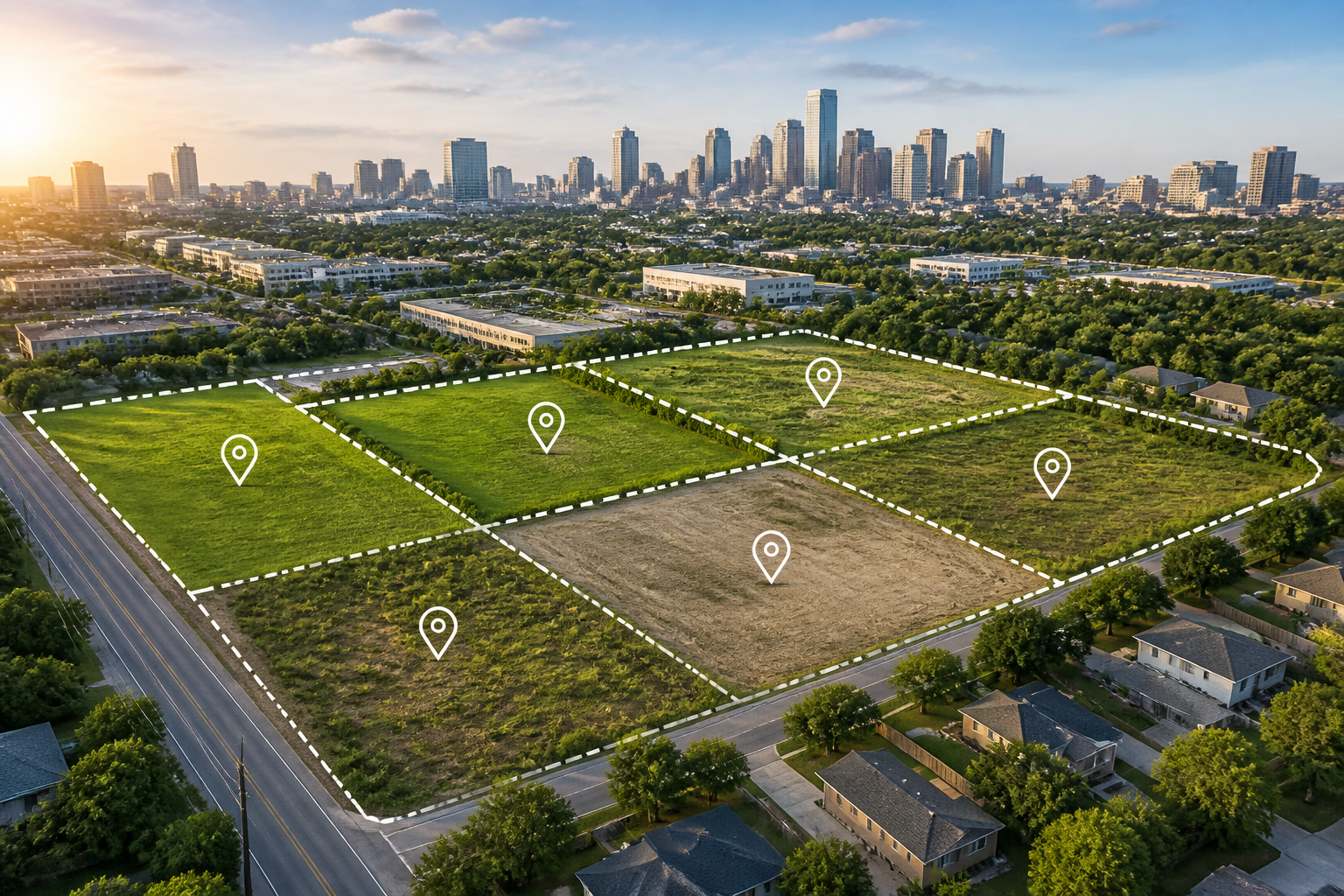
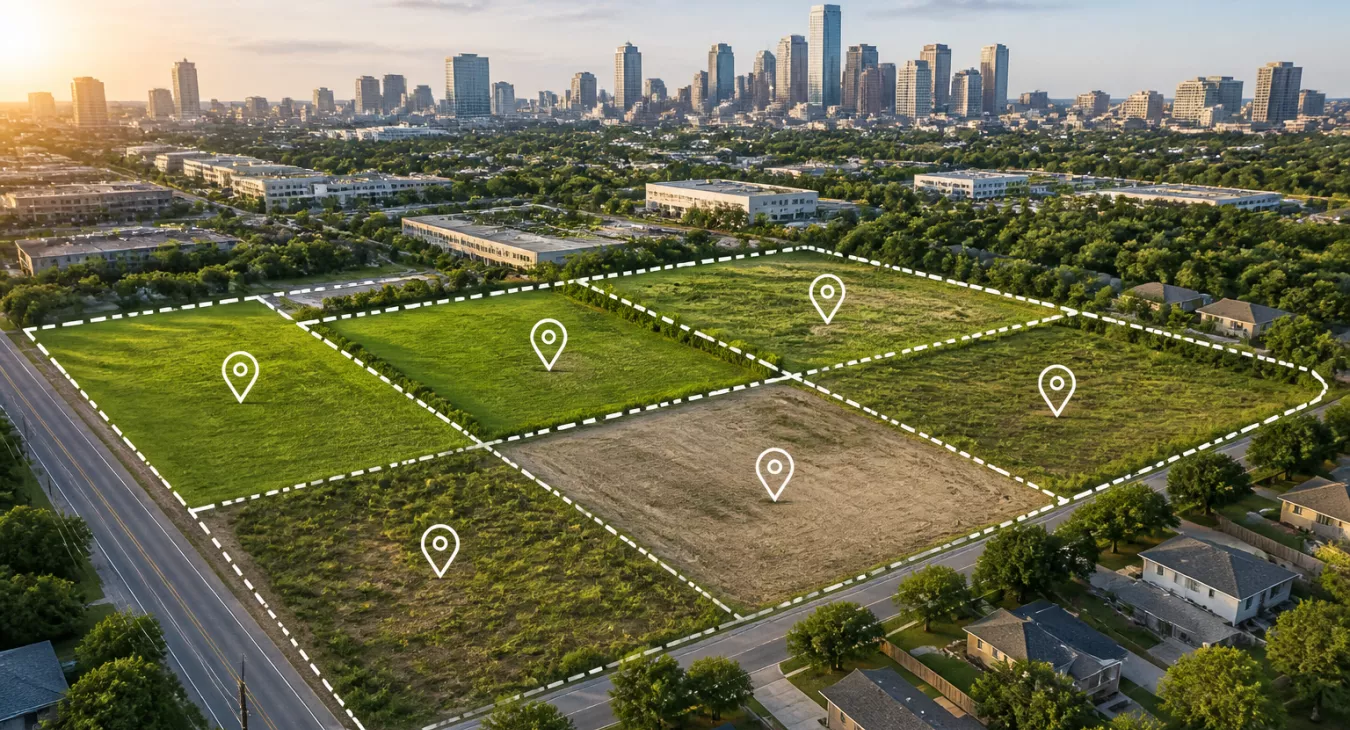
Learn how a land assembly strategy for buying multiple parcels unlocks greater development potential and maximizes returns on real estate investments.
Table of Contents
- What's Land Assembly and Why Does It Matter?
- The Land Assembly Process Step-by-Step
- Financial Valuation: The Residual Value Method
- Land Assembly Value Creation: Illustrative Example
- Negotiation Tactics and Overcoming Holdout Sellers
- Planning, Regulatory Approval, and Zoning
- Property Types Suitable for Assembly
- Benefits of Land Assembly Strategy
- Challenges and Risks to Plan For
- Land Assembly vs. Land Banking
- The Expert Team You Need
- Conclusion: Is Land Assembly Right for You?
- Frequently Asked Questions
Land assembly — buying multiple parcels and stitching them together into one larger site — is one of the most powerful yet underutilized tools in your toolkit. Here's the math: an assembled site is worth more than the sum of its parts. Larger, contiguous parcels unlock development possibilities that fragmented land simply can't touch. Think multi-family housing, mixed-use projects, commercial centers. For investors willing to navigate the complexity, the rewards can be substantial. But you need to know exactly what you're getting into. This guide walks you through every stage — from initial feasibility through closing — with honest guidance on costs, risks, and negotiation tactics that actually work.

What's Land Assembly and Why Does It Matter?
Land assembly is straightforward: you buy two or more adjacent parcels and combine them into one development site. In tight urban markets, individual lots are usually too small to pencil out for serious projects. Assembly fixes that. It's how you unlock development potential when land ownership is fragmented across multiple owners.
Here's where the real money shows up. Take four adjacent parcels, each worth $100,000 on its own. Assemble them into a single 200-lot site? That combined property could fetch $500,000 or more from a developer looking to build. That's a 25% premium over the $400,000 you'd get selling them separately. This "assemblage premium" exists because the assembled parcel can support development that none of the individual lots ever could alone. And that's the whole game.
One caveat: assemblage premiums swing wildly depending on your market and project type. There's no universal national benchmark, so pull local comparables with a qualified appraiser before you commit. Don't guess on this.
You'll see assembly across every property type—residential subdivisions, commercial centers, mixed-use transit-oriented developments, industrial parks. Most of them started the same way: someone bought multiple parcels and made it work. Want the full picture on how land deals actually function? Check out our guide on learning the language of land investing: terms, deals, and strategy.
Back to topThe Land Assembly Process Step-by-Step

Step 1: Market Study and Initial Feasibility Analysis
Don't approach a single property owner until you've done your homework. You need to assess local demand drivers — population growth, employment trends, infrastructure proximity, and zoning capacity. Then figure out what development actually makes sense on that assembled site and work backward from there using residual land value analysis.
Here's how residual valuation works: subtract your hard costs (construction, financing, developer profit, transaction expenses) from the finished project's expected value. What's left is what you can afford to pay per parcel. This number becomes your absolute ceiling when negotiating.
As of 2025, NAR/RLI data showed national land prices averaging approximately $7,200 per acre, with a 1.5% growth rate in 2025. But here's the thing — location demolishes these averages. 2026 state-by-state data shows vacant land ranging from roughly $2,200 per acre in New Mexico to approximately $65,000 per acre in Massachusetts. Always anchor your feasibility study to verified local comparables, not national averages.
Step 2: Identifying and Mapping Target Parcels
GIS mapping tools, county assessor databases, and commercial real estate platforms let you identify and map target parcels quickly. Look for adjacency (contiguous lots are ideal), consistent zoning, and motivated ownership structures. Aging owners, small landlords with passive income properties, or estates tend to be the most negotiable buyers.
Technology platforms like LandVision, CoStar, and county parcel viewers can cut months off this phase. And if you want a tactical deep-dive, our article on bulk land buying strategy: how to acquire multiple properties covers parcel identification in detail.
Step 3: Negotiation Strategy and Owner Engagement
This is where most inexperienced investors mess up.
Approach owners individually and discreetly, at least initially. Reveal your full assembly strategy too early, and every subsequent seller knows exactly what you're doing — and prices you accordingly. Direct outreach works better than open-market acquisition for assembly deals. Personal letters, door-knocking, or intermediary contacts all beat putting a sign on a lot.
We cover negotiation sequencing and offer structuring in detail in the section below on buying land by owner: negotiation tips and avoiding realtor fees.
Step 4: Legal and Rights Considerations
Hire a real estate attorney before you start writing checks. Multi-parcel assemblies require title searches on every single parcel, easement analysis, rights-of-way review, and potentially "Rights of Light" issues in urban markets. And yes, title insurance is essential — it's just more complex in assembly projects because each parcel carries its own title history. Our complete guide on whether you need title insurance when buying land breaks this down fully.
Zoning matters just as much. R-1 in one jurisdiction looks nothing like R-1 somewhere else — there's no national standard. Talk to your local planning department and review current zoning maps before you commit capital. Our investor's guide to rezoning strategy shows you how to evaluate and pursue rezoning when it makes sense.
Step 5: Closing the Assembly
Structure your closings in phases where you can, with contingencies tied to acquiring a minimum number of parcels. That protects you if owners suddenly get cold feet or prices spike mid-assembly.
A modest assembly — five to ten parcels in a suburban market — typically takes 12 to 24 months from initial outreach to final closing. Complex urban assemblies with dozens of owners? Three to seven years. Set realistic expectations from day one.
Back to topFinancial Valuation: The Residual Value Method
Understanding Residual Value in Land Assembly
Work backward from your finished project's value. That's the residual value method in a nutshell. Start with the projected gross development value (GDV) — what you'll actually sell or lease the completed project for. Now subtract everything: construction costs, finance charges, fees, contingencies. Don't forget the developer's target profit margin. What's left? That's your residual land value — the absolute maximum you can pay for the land. Divide by the number of parcels and you've got your per-parcel ceiling price.
Assembly projects aren't like buying a single improved property. Every single parcel demands its own legal due diligence, title work, and closing costs. Holding costs creep up as you acquire parcels sequentially over months or years. And financing? Raw land loans are expensive. As of August 10, 2026, commercial real estate bridge loan rates range from approximately 4.63% at the low end to 13.63% at the high end, with raw land sitting toward the higher end because of the risk. This discipline matters because those costs add up fast.
Tax Implications of Land Assembly
You can't ignore taxes in assembly deals — your entity structure and how long you hold the land directly hit your net returns. This is where the numbers get serious. Long-term capital gains on land held more than one year are taxed at 0%, 15%, or 20% at the federal level for 2026. But income thresholds matter. Single filers above $545,500 face the 20% rate; married filers above $613,700 hit 20% too. Hold for less than a year and you're paying ordinary income rates up to 37% — that'll kill your profit on a quick flip.
High earners face another layer: the 3.8% Net Investment Income Tax (NIIT). This applies if you're a single filer above $200,000 MAGI or married filing jointly above $250,000. That pushes your effective federal rate to 23.8% on long-term land gains. Want to avoid this? A §1031 like-kind exchange defers taxes when you sell your assembled parcel and reinvest in another qualifying property. The rules are strict, though. You've got 45 days to identify and 180 days to close. Good news: §1031 remains available for qualifying real property held for investment or business purposes with no legislative changes in 2026. Before your first parcel closes, sit down with a qualified tax advisor. They'll structure your entity — LLC, partnership, or corporate vehicle — the right way.
Back to topLand Assembly Value Creation: Illustrative Example
| Scenario | Number of Parcels | Individual Parcel Value | Aggregate Value | Assembled Site Value (Illustrative) | Value Premium |
|---|---|---|---|---|---|
| Pre-Assembly (Fragmented) | 4 | $100,000 each | $400,000 | — | — |
| Post-Assembly (Consolidated) | 1 combined site | — | — | $500,000+ | 25%+ above aggregate |
Here's what matters: these are example numbers only. Real assembly premiums swing wildly depending on your market, what you're planning to build, and how the zoning works. Talk to a local appraiser before you commit capital.
Back to topNegotiation Tactics and Overcoming Holdout Sellers

Understanding Owner Types
Start by understanding who you're actually sitting across the table from. Owner-occupiers are a different animal entirely — they care about lifestyle, their roots in the community, and the genuine pain of uprooting. They need time. They need relationship-building. And they almost always want things money can't buy directly: relocation assistance, a right to stay through transition, or a move-in-ready replacement home lined up before they sign. Investor-owners? They speak one language. Price signals, structured contingencies, certainty of close. They move fast when the numbers make sense.
| Owner Type | Primary Motivation | Recommended Approach | Key Challenge |
|---|---|---|---|
| Owner-Occupier (Resident) | Lifestyle, community, certainty | Relationship-first; offer relocation assistance; allow adequate timeline | Emotional attachment; non-monetary concerns |
| Passive Investor / Small Landlord | Financial return; capital deployment | Lead with price and certainty; structured contingencies | May use competing offers as use |
| Estate / Heir Ownership | Simplicity; fair distribution among heirs | Engage all decision-makers early; clean offer structure | Multiple decision-makers; legal complications |
| Corporate / Institutional Owner | Asset optimization; process compliance | Formal proposal; board-level approval timeline; above-market offer | Long approval cycles; price expectations |
The Holdout Problem
This is the thing that keeps most assemblers up at night. One parcel stands between you and a $50M development, and suddenly that holdout seller knows it. The negotiating power flips — they can extract a disproportionate chunk of your assembled value just because they're last. It happens every time. Economic theory gives you some real tools here: buy parcels in a scrambled, non-obvious order so nobody figures out the full picture early. Use blind offers through intermediaries. Structure conditional contracts that only lock in each seller if you close the whole deal. Or go bigger — make your target area larger than needed so no single parcel becomes irreplaceable.
Then there's eminent domain. It sounds like a silver bullet. But it's not — not for private developers. You need government involvement, a public purpose finding, fair market compensation, and years of political push-back. Don't run your financial model assuming you'll use condemnation to squeeze out a holdout. It won't work. For the tactical offer structuring side — how to actually structure deals that don't blow up — check our deep dive on range offers vs. blind offers: which buying strategy wins.


Planning, Regulatory Approval, and Zoning
Here's what kills most first-time assemblers: they think buying multiple parcels automatically means planning approval follows. Wrong. Local planning authorities don't care how you assembled the land. They're evaluating density, height, design standards, infrastructure capacity, and community impact on their own terms. Get a planning consultant or land use attorney in the room before you buy the first parcel—not after you've already spent six figures acquiring land.
Zoning is purely local. And it changes constantly. Setbacks, minimum lot sizes, height limits, permitted uses—they're all different by state, municipality, and sometimes by district within the same municipality. Pull the actual current zoning code from your local planning department yourself. Don't rely on what the broker told you last month. Our full guide on the land use entitlement process: steps, timeline, and investor strategy shows you how to actually navigate these approval processes.
Brownfield sites hit different. Previously developed or industrial land often qualifies for specific regulatory pathways and government money—environmental remediation grants, tax increment financing, and other programs that can meaningfully move your project economics. But you've got to engage environmental consultants and local economic development agencies early. What's available in one jurisdiction might not exist fifty miles away.
Back to topProperty Types Suitable for Assembly
| Property Type | Typical Complexity | Key Advantage | Key Challenge | Best Fit |
|---|---|---|---|---|
| Residential Garden Plots | Medium | Lower competition; willing sellers | Owner-occupier emotional attachment | Suburban infill residential |
| Brownfield / Industrial Land | High | Government incentives; large site sizes | Environmental remediation costs | Mixed-use, commercial, industrial |
| Urban Commercial Parcels | Very High | Prime location; high end-value | Price, complexity, sophisticated sellers | High-density mixed-use, office |
| Suburban Fringe / Agricultural | Low–Medium | Larger parcels; fewer owners | Infrastructure gaps; entitlement risk | Residential subdivision, logistics |
Here's the hard truth: infrastructure proximity kills deals. Without water, sewer, power, and road access, you're looking at jaw-dropping off-site improvement costs that'll tank your whole project economics. Before you lock in an assembly on fringe land, you need actual utility availability data — not assumptions. And don't forget to pull the real connection costs from each provider's tariff. Those numbers swing wildly depending on who owns the infrastructure.
Want context on whether land investing makes sense for your portfolio right now? Check out our analysis of land investment viability in 2026.
Back to topBenefits of Land Assembly Strategy
If you've got the capital and the patience, land assembly is where the real money lives. Here's why.
- Value creation above individual parcel prices: A assembled site isn't just worth the sum of its parts—it commands a significant premium. Larger-scale development unlocks opportunities that a single parcel simply can't deliver.
- Reduced per-unit land costs at scale: When you're spreading your land acquisition costs across 200 units instead of 20, the math changes dramatically. Multi-family and mixed-use projects benefit from this economies-of-scale advantage in ways single-family development never will.
- Less competition: Most investors chase listed properties. That's where everyone fights. Off-market assembly deals? You're competing against far fewer buyers, which means better pricing and smoother negotiations.
- Design flexibility: You get a unified canvas. Architects and planners can actually optimize layout, parking, amenities, and phasing when they're not trapped by fragmented ownership and easement wars.
- Stronger negotiating position with lenders and partners: An assembled, entitled site with a real development program isn't just a real estate deal—it's a bankable asset. Lenders see it differently than a scattered collection of individual lots.
- Urban revitalization contribution: Done right, assemblies transform dead zones into functioning neighborhoods. That broader community impact often qualifies you for public incentives and tax credits that solo development projects never reach.
Want to go deeper? Understanding what a stacking plan is in real estate shows you exactly how assembled sites get structured and managed for maximum return.
Back to topChallenges and Risks to Plan For
Land assembly isn't for the faint-hearted or undercapitalized. Here's what'll actually keep you up at night:
- Capital intensity and extended holding periods: You're sitting on early parcels for years while you hunt down the rest. Meanwhile, financing costs, property taxes, and carrying expenses pile up month after month.
- Exponential complexity: Each new parcel doesn't just add to your problems — it multiplies them. A 10-parcel assembly isn't twice as complex as a 5-parcel deal. It's exponentially harder. Legal, logistical, negotiation headaches compound at every stage.
- Market timing risk: Development markets shift. Fast. That deal you underwritten in year one? It might not pencil in year three if construction costs spike or demand tanks. And you're locked in by then.
- Holdout risk: One stubborn seller in the final stages. That's all it takes. They know you're desperate. They'll extract an outsized price or kill the deal outright.
- Regulatory uncertainty: Planning approval isn't guaranteed. Ever. Size doesn't matter. Your assembly effort doesn't matter.
- Rights of Light and easement issues: In tight urban markets, existing easements and rights of light can torpedo your development plans — even after you've stitched all the parcels together.
Before you commit to an assembly strategy, lock in a solid real estate exit strategy. Build in fallback options if the full assembly falls apart.
Back to topLand Assembly vs. Land Banking

Here's the key difference: they're related, but they're not the same thing. Land banking is what institutional investors and larger developers do when they're systematically buying up parcels over years — sometimes five, ten, or even twenty years — while they wait for market conditions to actually make sense. They're building a pipeline. Land assembly? That's tighter, faster, and way more focused. You're targeting specific parcels to combine them into one development-ready site.
Think of assembly as tactical. Spot the deal, grab the parcels you need, develop or flip the assembled land. Done. Banking, on the other hand, is pure strategy — you're stashing land for future capacity. Both demand patient capital and discipline around carrying costs. Here's where it gets interesting: the best operators do both simultaneously. They'll bank parcels in emerging submarkets, then assemble specific clusters the moment market conditions line up and cap rates look attractive. Need context on shorter investment cycles? Check out our guide on the land flipping business: buying and selling raw land — it breaks down strategies that work alongside (or instead of) assembly plays.
Back to topThe Expert Team You Need
Land assembly isn't a solo sport. You can't execute a complex multi-parcel deal alone — not even if you've been developing for twenty years. Your core team needs to include these specialists:
- Real estate attorney: They'll handle title analysis, contract structuring, entity formation, and closing coordination across all your parcels.
- Land use planner / planning consultant: These folks run pre-application meetings with city/county, analyze zoning restrictions, and build your entitlement strategy from day one.
- Licensed surveyor: You need boundary surveys, topographic mapping, and easement identification across the full assembled footprint.
- Commercial appraiser: They'll run residual value analysis on each parcel, value the site individually, and appraise the assembled property for your lenders.
- Environmental consultant: Phase I and Phase II ESAs are non-negotiable. This gets critical on brownfield or industrial land.
- Commercial real estate broker (land specialist): Market intelligence matters. Off-market sourcing matters more. Transaction facilitation? That's how deals actually close.
- Project finance specialist / lender: Construction financing, bridge loans, equity structures — this person ties the whole capital stack together.
Conclusion: Is Land Assembly Right for You?
Land assembly is one of the most value-creative plays in real estate. It's also one of the most demanding. The math works: when you combine adjacent parcels, you unlock development potential that individual lots simply can't touch. Those combined sites command premiums — sometimes 30-50% above the sum of individual parcel values. But here's the catch: you need disciplined feasibility analysis, patient and sophisticated owner negotiations, a strong expert team, enough capital to weather an extended timeline, and a realistic grip on planning and regulatory risk.
Is this strategy for you? If you've got the resources and genuine risk tolerance, land assembly offers something increasingly rare: the chance to actually create value instead of just capturing what's already there. Don't skip the market research phase. Build your team before you make your first offer — not after. And when you're negotiating with each owner, know their motivations inside and out. What do they actually need?
The deals that reward patience most richly are the ones most investors skip. That's where your edge lives.
Back to top
Frequently Asked Questions
How many parcels are typically needed for a viable land assembly project?
There's no magic number. You might pull off a solid suburban assembly with just two parcels, or you might need dozens for a major urban mixed-use play. What actually matters is whether your assembled site can support your intended use under local zoning, market demand, and infrastructure realities. Start with a residual value analysis before you buy anything — that's how you figure out exactly which parcels you need to acquire and what you can actually afford to pay for them.
How do I deal with a seller who refuses to sell or demands an unreasonable price?
First move: dig into their real motivation. It's rarely just about money. Relocation assistance, seller financing, flexible closing timelines, or a life tenancy option can unlock deals that look dead at first glance. And if they genuinely won't budge? Redesign your project so that holdout parcel doesn't kill the whole deal. When you've got alternative site configurations, you strip away any single seller's leverage. Eminent domain sounds like a backstop, but it's not — private developers shouldn't count on it.
What legal entity structure is best for a land assembly project?
Most investors go with an LLC or LP. Why? Liability protection and tax flexibility. Beyond that, it depends on how many partners you're bringing in, your timeline, and your tax bracket. Single-member LLC keeps things simple. Multi-member LLC or LP works when you've got outside equity. Pick your structure before the first parcel closes. Retitling multiple parcels after acquisition is a nightmare — time-consuming and expensive. Get a real estate attorney and CPA on this before you commit.
Can a §1031 exchange be used in a land assembly project?
Yes, absolutely. As of July 2026, §1031 like-kind exchanges still work for qualifying real property held for investment or business purposes. Sell an existing investment property, use those proceeds to buy assembly parcels, defer your capital gains tax. Sounds clean. But here's the catch: those 45-day identification and 180-day completion windows are brutal in multi-parcel deals where closing timelines slip constantly. Bring in a qualified intermediary and experienced 1031 counsel from day one.
How long does a typical land assembly take from start to finish?
It's all over the map. A straightforward three- to five-parcel suburban assembly with motivated sellers? Twelve to eighteen months. But a complex urban deal with twenty-plus parcels, mixed owner types, and planning approvals stacked on top of each other? Three to seven years is realistic. This is critical: build extended timelines and carrying costs into your financial model from the beginning — unrealistic schedules are the number one reason assembly projects blow up.
Back to top