


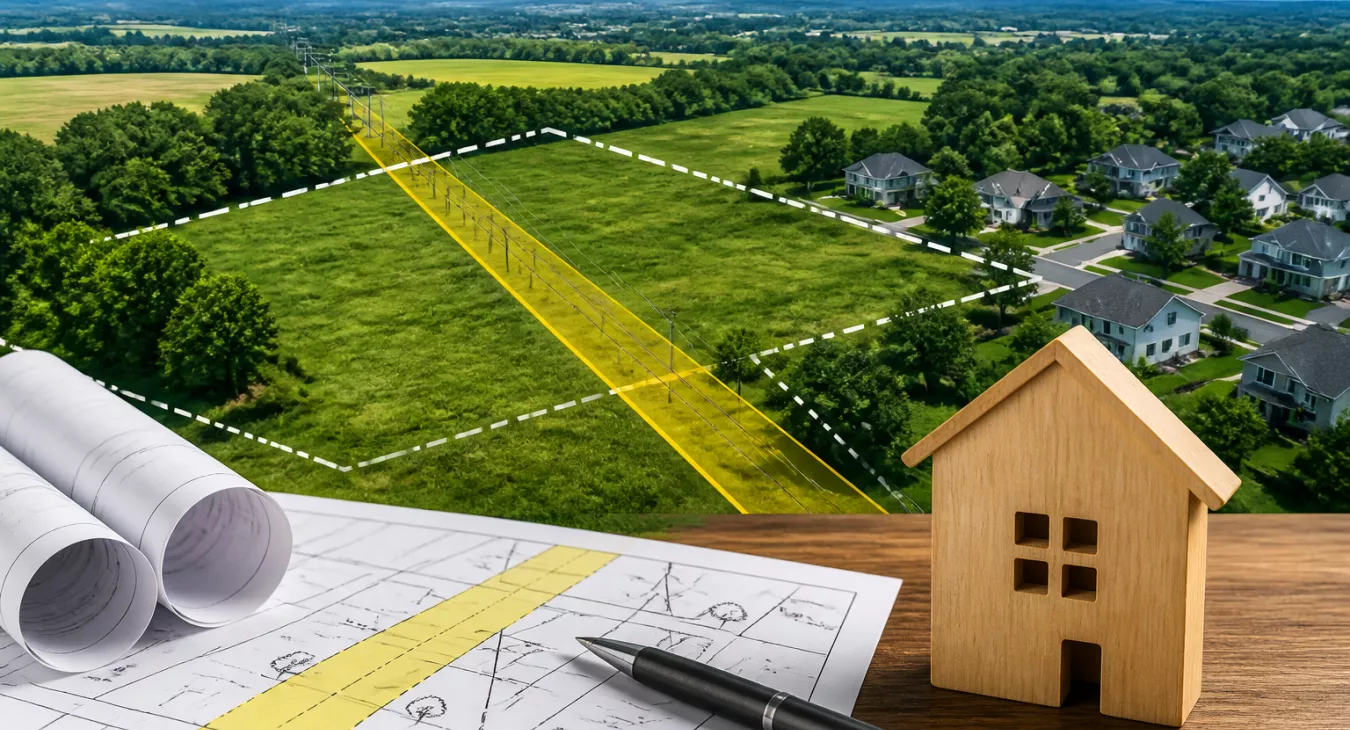
Discover what real estate investors need to know about easements on land. Learn how they impact property value, usage, financing, and your bottom line.
Table of Contents
- What's an Easement in Real Estate?
- Types of Easements Investors Need to Know
- How Easements Affect Property Value and Investment Returns
- How to Identify and Research Easements Before Buying
- Investing in Easements: Opportunities and Compensation
- Risks and Considerations for Real Estate Investors
- Easements in Different Property Types
- Steps to Take if Your Investment Property Has an Easement
- Conclusion: Easements Are Manageable — If You Do the Work Upfront
- Frequently Asked Questions About Easements for Real Estate Investors
Easements are everywhere in real estate investing, and most investors don't understand them. That's a problem. They can tank your development plans, wreck your financing, or crater your exit strategy. Whether you're buying raw land, a commercial office building, or a residential rental, you need to know what easements are, how they get created, and exactly how they'll hit your numbers. Miss this due diligence and you're stuck with restrictions you can't undo. Get it right, though? You can price risk like a pro, negotiate harder, and sometimes even make money off easements. This guide walks you through everything—how to spot them, research them, structure compensation, and fight them if you have to.

What's an Easement in Real Estate?
Definition and Core Concept
An easement is a recorded legal right. It lets a non-owner use part of someone else's property for a specific purpose. Here's the key difference from ownership: the easement holder gets use rights, but the property owner keeps the title. That said, the owner's ability to use that portion becomes legally constrained. You'll find easements recorded in public land records, and they're enforceable against both the current owner and practically every future buyer.
Picture a utility company running power lines across your parcel. Or neighbors sharing a driveway. A municipality maintaining sidewalk access. Pipeline companies threading infrastructure through farmland. These are all easements in action. For a deeper look at how these rights interact with your investment, see our article on Easement Rights in Real Estate: What Investors Need to Know.
Dominant and Servient Tenements
When an easement benefits an adjacent property, the benefiting property is the dominant tenement. The burdened property? That's the servient tenement. The servient property owner keeps the title but must allow the easement holder to use that designated area on the easement's terms.
How Easements Differ from Ownership

An easement holder can use the land. That's it. They can't own it, sell it, or develop it. No permanent structures unless the agreement explicitly allows them. They can't exclude the owner from walking through it or expand the easement beyond the original scope. This distinction absolutely matters when you're modeling a property's development potential or mapping your exit strategy—get this wrong and you're leaving serious ARV on the table.
Back to topTypes of Easements Investors Need to Know
Here's the thing: not every easement hits your deal the same way. The type matters because it dictates how long you're stuck with it, who actually benefits, and whether you can even get rid of it down the road. That's critical intel before you underwrite the property.
| Easement Type | Beneficiary | Transfers with Land Sale? | Typical Duration | Common Uses | General Value Impact |
|---|---|---|---|---|---|
| Appurtenant | Adjacent property owner | Yes (both parcels) | Perpetual (unless terminated) | Shared driveways, access routes | Moderate negative on servient; positive on dominant |
| In Gross | Individual or company | Often not (depends on agreement) | Fixed or perpetual | Utility lines, pipelines, billboard rights | Moderate to significant negative |
| By Necessity | Landlocked property owner | Yes | Perpetual | Access to landlocked parcels | Significant negative on servient |
| Prescriptive | Established user | Depends on jurisdiction | Perpetual if established | Paths, roads used without permission | Significant negative |
| Utility | Utility company | Yes | Perpetual | Power, water, gas, telecom infrastructure | Moderate negative |
| Conservation | Land trust or government | Yes | Perpetual | Open space, agricultural preservation | Significant negative on development; tax benefits possible |
| Public | General public | Yes | Perpetual | Sidewalks, beach access, trails | Moderate to significant negative |
Prescriptive easements? Pay attention to these. Someone can actually claim a right to use your land if they've been doing it openly, continuously, and without your permission for long enough. We're talking 5 to 21 years depending on where you are — every state's got its own timeline.
If you're acquiring a property and a neighbor's been cutting across it for years, don't skip this step. Call a local real estate attorney before you close. That path might already be a legal easement, even if nobody bothered recording it. And here's the kicker — this ties directly into your contract review. Always dig into what encumbrances are actually addressed in your real estate contract. Missing this detail can tank your numbers.
Back to topHow Easements Affect Property Value and Investment Returns

Impact on Property Valuation
Here's the reality: easements tank property value. How much depends on what you're dealing with. A utility easement running through the back forty of a residential lot? Probably a 2–5% haircut, maybe less. But a pipeline easement that cuts right through your commercial development site and wipes out entire building envelopes? That's a project killer. The location, scope, and duration all matter. And they matter a lot when you're underwriting.
Use Restrictions and Limitations
Many easements come with teeth. Construction restrictions. Height limitations. Vegetation rules — sometimes you can't even plant trees within a certain distance of the corridor. Before you run the numbers on any deal, you need to physically map which portions of the property are off-limits. Calculate your actual buildable square footage. This is just as critical as understanding subdivision rules when you're evaluating land development potential. Skip this step and you'll blow your pro forma estimates.
Disclosure Requirements and Legal Obligations
Sellers have to disclose known easements. They don't, they're looking at fraud or misrepresentation claims down the line. But here's the catch: you can't rely on their word alone. Recorded easements are considered constructive notice. That's legal-speak for "you're presumed to know about them whether the seller mentioned them or not." Title research isn't optional. It's your first line of defense.
Long-term Investment Implications
Easements stick with the land forever. New owner, same restrictions. When you close on a property with an unfavorable easement, you're inheriting the whole package — the restrictions, the maintenance obligations, the liability exposure, the limits on future use. Price the deal accordingly before you sign. Not after. Build that impact into your ARV calculation and your projected cap rate.
Back to topHow to Identify and Research Easements Before Buying

Do your homework. Here's the data: the American Land Title Association found that approximately 25% of residential real estate transactions hit a title issue during the search — and easements show up constantly. That's why knowing how to work with title companies is non-negotiable for serious investors.
| Research Step | Where to Look | What You're Looking For | Red Flags |
|---|---|---|---|
| Title search & abstract review | Title company or county recorder | All recorded easements, liens, encumbrances | Gaps in title chain; unrecorded easement references in deeds |
| Deed review | County recorder's office | Easement grants, reservations, and restrictions in deed language | Vague "subject to easements of record" language without specifics |
| ALTA/NSPS survey | Licensed surveyor | Physical location and boundaries of easements on the ground | Easement area overlapping planned development or building footprint |
| County assessor/recorder data | County government offices or online portals | Recorded easement agreements and plat maps | Missing or illegible easement documents |
| Direct seller inquiry | Seller or seller's agent | Known but unrecorded use agreements or informal access arrangements | Reluctance to provide full documentation |
| Utility company records | Local utility providers | Existing and planned utility easement corridors | Blanket easements with undefined boundaries |
You're looking at $75–$200 for a basic residential property and $200–$500 or more for commercial or complex deals (2025–2026 pricing). That's pocket change compared to what a nasty easement discovery can cost you after closing.
And here's something to pay attention to: starting in 2026, the updated ALTA/NSPS Survey Standards require surveyors to explicitly state whether each recorded easement is shown, can't be located, is a blanket easement, is illegible, or doesn't affect your property. They also have to flag anything in the county records that didn't show up in your title materials — and notify the title insurer directly. This matters. You're getting far more transparency on an ALTA survey now than you would've gotten even a year ago. Just make sure your surveyor's actually working under the current 2026 standards.
Back to topInvesting in Easements: Opportunities and Compensation
Granting Easements for Income
Want to turn your land into a revenue stream? Property owners can grant easements to utility companies, pipeline operators, telecommunications providers, and others in exchange for cash. That compensation might come as a one-time lump sum, annual or periodic payments, or revenue-sharing deals. The structure depends on what type of easement you're granting, how long it lasts, and how hard both sides negotiate.
Conservation Easements and Tax Benefits
Conservation easements work like this: you permanently restrict development rights on your land and donate those restrictions to a land trust or government entity. The tax benefits can be substantial—but the IRS watches this area closely. For 2026, general taxpayers who donate a qualified conservation easement can deduct up to 50% of adjusted gross income (AGI) per year, with a 15-year carryforward for any unused deductions. Qualified farmers and ranchers—those pulling more than 50% of gross income from farming operations—get a better deal: they can deduct up to 100% of AGI per year, also with a 15-year carryforward.
And there's an estate tax angle. Under IRC §2031(c), heirs can exclude up to 40% of the encumbered land's value from the taxable estate, capped at $500,000. Here's the catch: you only get the full 40% exclusion if the easement's value equals or exceeds 30% of the land's total value. Every percentage point the easement falls short of that threshold reduces the exclusion by 2 percentage points.
Syndicated Conservation Easements: Significant Legal Risk
Syndicated conservation easements (SCEs) are where investors pool capital to buy land, donate an easement, and claim massive deductions. The IRS hates them. They're still on the Dirty Dozen list, and the agency disallows deductions when they exceed 2.5 times the partner's or shareholder's relevant basis in the contributing entity (per final regulations that kicked in October 2024). Penalties are brutal—a 40% gross valuation misstatement penalty under §6662 applies to abusive arrangements, as confirmed in IRS guidance updated July 27, 2026.
If you're sitting on a pending SCE case, pay attention. The IRS announced a 2026 settlement initiative (IR-2026-65). Jump in during the first 90 days? You face a 10% penalty on revised tax due. Miss that window but settle between days 91–135? The 20% gross valuation misstatement penalty applies. After day 135, or if your case goes to court, you're looking at the full 40% penalty. Don't overlook the documentation requirements either. Any qualified appraisal for a conservation easement exceeding $5,000 must be attached to Form 8283, Section B. Historic preservation easements with claimed deductions over $10,000 require a $500 filing fee to the U.S. Treasury. Talk to a specialized tax attorney before you commit to anything here.
Self-Directed IRAs and Easement Investments
Self-directed IRAs can hold easement rights as an alternative investment. You get tax-advantaged growth on income from easement compensation. But this gets complicated fast—prohibited transaction rules, UBTI considerations, custodian requirements. Skip the DIY approach on this one. You need specialized legal and tax guidance.
Back to topRisks and Considerations for Real Estate Investors
You need to understand easement risks as much as the upside. That's how you avoid deals that look good on paper but tank your returns. These headaches pop up everywhere — whether you're buying Class A multifamily, a Class B, C, or D property, industrial land, or agricultural acreage.
- Liability exposure: Easement users get hurt on your easement area? You might be on the hook. Premises liability law varies by jurisdiction, and that's not something you want to find out after the fact. Talk to a local attorney before closing.
- Maintenance costs: The easement agreement doesn't say the utility company maintains it? Then you do. And that cost hits your operating expenses directly, eating into your cap rate.
- Landscaping and improvement damage: Utility companies have broad rights here. They'll trim trees, excavate, whatever they need. The kicker? They don't have to restore your property afterward. You're stuck with the bill.
- Financing complications: Lenders get nervous about easements. Some won't touch properties with them, especially if the easement limits development or kills your exit strategy. This matters when you're financing the acquisition and again when you refinance or sell.
- Dispute resolution costs: Easement disputes are money pits. They delay closings, trigger lawsuits, and cloud your title. Your carrying costs balloon while lawyers fight it out. Read your purchase agreement carefully on how title disputes get handled — and check out our defeasance clause guide for related protections.
- Encroachment beyond scope: A utility company stores equipment outside the easement corridor? That's encroachment, and you've got legal grounds to stop it. But enforcement costs money and time. Is it worth the fight? Usually not.
Easements in Different Property Types

Here's the thing: an easement on a 50-acre industrial parcel? Barely a blip. That same easement on a tight 0.25-acre residential infill lot? It could tank your entire investment thesis. The impact depends entirely on your asset class.
- Residential: You'll see utility easements and shared driveways more than anything else. They won't wreck your day-to-day operations, but they will kill your fence expansion plans, block shed placement, and tie your hands on landscaping. And expect buyers to grill you on disclosure—residential transactions get scrutinized hard.
- Commercial: Access easements hit different here. They mess with tenant visibility, parking configurations, and ADA accessibility. You're probably sharing access with adjacent retail properties. That's standard in most retail corridors, but don't sign without understanding exclusivity, who pays for maintenance, and what you can actually modify.
- Industrial: Pipelines, rail spurs, utility lines—they're everywhere on industrial sites. These eat into your building footprint, restrict what you can do in the easement zone, and usually come with safety buffer requirements. Before you commit, ask: does this easement corridor collide with your dock placement? Your storage expansion? Your three-phase buildout? That matters whether you're pricing based on current market comps or modeling 10-year hold appreciation.
- Agricultural: Conservation easements, irrigation ditches, farm access roads. They're the norm out there. But here's where you need to pay attention: these can permanently lock down your subdivision rights and kill density upside. If you're betting on agricultural land appreciation and eventual development, that easement might strangle your exit strategy. Get crystal clear on what it means for a vacant land play before listing.
Steps to Take if Your Investment Property Has an Easement

- Obtain complete easement documentation. Get your hands on the full recorded easement agreement — skip the summary. You need the original grant, any amendments, plus all exhibits with maps or legal descriptions.
- Clarify your rights and obligations. What can the easement holder actually do? What can't they? Who pays for maintenance? And here's the key question: what notice do they need to give before accessing your property?
- Attempt renegotiation before closing. Bad terms on an easement? Negotiate modifications as a purchase condition. Do this now. Renegotiating after you own the property is exponentially harder.
- Hire a local real estate attorney. Easement law changes state to state. Enforceability, termination options, maintenance obligations — it all depends on your jurisdiction. General legal principles won't cut it here.
- Price the deal to reflect the easement's impact. Your offer, development budget, and exit timeline need to account for the reality: use restrictions, ongoing maintenance costs, and limits on how you can eventually sell. Build these numbers into your analysis.
- Document all easement terms for future buyers. When you flip it, full disclosure upfront protects you legally and actually builds buyer confidence. A clean file with survey exhibits, recorded agreements, and your correspondence with the easement holder? That's money in the bank at closing.
Conclusion: Easements Are Manageable — If You Do the Work Upfront
Here's the reality: easements aren't going away. They're on millions of properties across every asset class you can think of. And the good news? Most of them won't kill your deal — not if you actually understand what you're looking at.
The investors who blow this are the ones checking the easement box and moving on. They don't dig. They don't price the risk. Then the deal falls apart and they're shocked.
The winners? They're doing something different. They're accurate about easement risk. They're hunting for compensation opportunities. They're negotiating terms before closing, not scrambling after. Whether you're analyzing your first land deal or your fiftieth, this framework gives you what you need to walk into every easement conversation prepared and confident.
Back to topFrequently Asked Questions About Easements for Real Estate Investors
Can I legally block or interfere with an easement on my property?
No. Once an easement is legally established and recorded, you can't touch it. Erecting a fence, gate, or structure that blocks access violates the easement agreement and exposes you to injunctive relief, damages, and legal fees. Don't try self-help remedies. If you believe an easement holder is overstepping their permitted scope, your only legitimate move is legal action.
Do easements automatically transfer when a property is sold?
In most cases, yes — and this is critical. Easements appurtenant and most utility and conservation easements run with the land. That means they automatically bind the new owner upon transfer. This is why you absolutely need a thorough title search and ALTA survey before purchase. Sellers are generally required to disclose known easements, but here's what matters: recorded easements constitute constructive notice regardless of what the seller tells you.
Can an easement be terminated or removed?
It can happen. But don't count on it being easy.
Common termination methods include mutual written agreement between the easement holder and property owner; abandonment by the easement holder through documented nonuse for a statutory period (which varies by jurisdiction); merger (when the same party acquires both the dominant and servient estates); expiration of a fixed-term easement; or court action establishing that the easement's purpose no longer exists. Terminating a perpetual easement? That generally requires legal proceedings and isn't guaranteed. And here's the reality: always consult a local real estate attorney before assuming an easement can be extinguished.
What's the difference between an easement and a right of way?
A right of way is a specific type of easement that grants the holder the right to pass through or across the property — commonly used for roads, paths, railroads, and pipelines. All rights of way are easements, but not all easements are rights of way. Some easements grant rights to use an area without passing through it, such as a conservation easement that restricts development over a defined area. The legal principles governing both are largely the same.
How do easements affect my ability to get financing on a property?
Certain easements can tank your financing. Lenders require that easements be disclosed in the title commitment and reviewed by their underwriters — no exceptions. Easements that significantly limit the property's use, marketability, or value — such as a conservation easement that eliminates development potential — may cause lenders to reduce loan amounts, impose additional conditions, or decline financing altogether. If you're purchasing an easement-burdened property with use restrictions, discuss the specific easement terms with your lender and title company early in the process. Don't wait until the commitment deadline in your purchase contract.
Back to top