

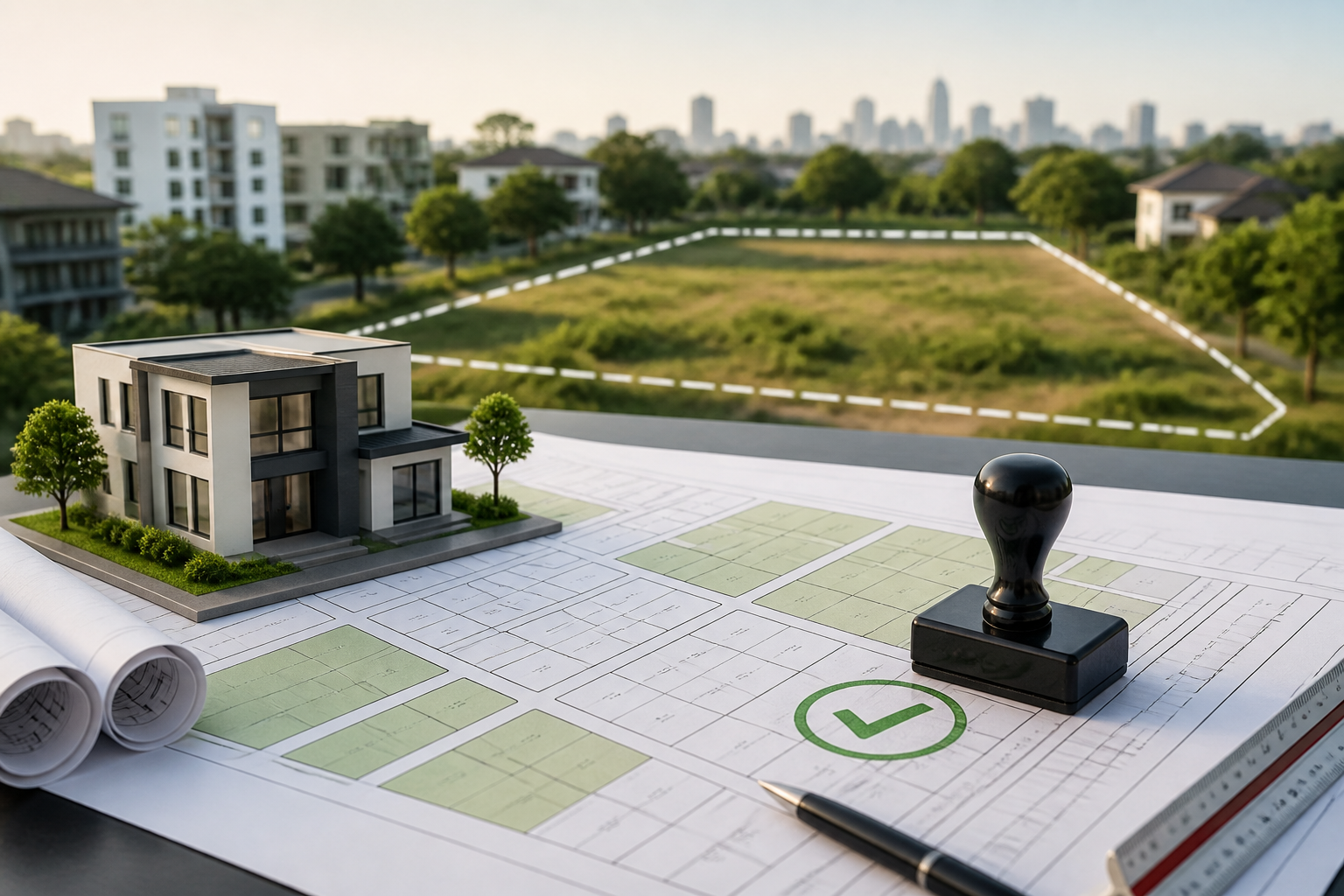
Learn the zoning variances land investing approval process to unlock property value. Expert guide to navigating boards and getting variance approval.
Table of Contents
- What's a Zoning Variance?
- Types of Zoning Variances
- Step-by-Step Zoning Variance Approval Process
- Criteria for Variance Approval
- Types of Variances: Decision Factors Comparison
- Variance vs. Rezoning vs. Conditional Use Permit: Which Path Is Right?
- Cost and Timeline Planning for Land Investors
- Working with Local Zoning Authorities and Legal Representation
- Important Considerations After Approval
For land investors, the difference between a profitable deal and a stranded asset often comes down to one thing: does the zoning board approve your variance? Zoning variances let you break free from strict local zoning codes — and if you know how to work the zoning variances land investing approval process, they're your golden ticket to unlocking value in parcels that'd otherwise sit dead or face heavy restrictions. Need to build closer to the property line than code allows? Want to develop a mixed-use project in a single-use zone? Trying to subdivide a parcel that's just short of minimum lot-size requirements? The variance process makes it happen. This guide takes you through every step — realistic costs, actual timelines, and the strategic moves that win with local boards.

What's a Zoning Variance?
Definition and Legal Basis
A zoning variance is permission from your local zoning board to break the rules. The board might be called a Zoning Board of Appeals (ZBA), Board of Zoning Adjustment (BZA), or Board of Standards and Appeals (BSA) — names vary by location. Basically, it's an official green light to use your land in a way that technically violates the local zoning ordinance.
Here's the thing: blanket zoning rules don't always make sense for every parcel. A property might have weird topography, an unusual shape, or some other unique physical characteristic that makes strict compliance genuinely unfair. That's where variances come in. Every U.S. state has laws on the books allowing municipalities to grant them, but the actual standards? They differ significantly depending on where you're operating.
Most jurisdictions require you to prove hardship. And we're not talking vague hardship — you need to demonstrate that the zoning requirements, as written and applied to your specific parcel, create an undue burden that neighboring properties don't face. This is fact-specific and property-specific. It's crucial to understand: a variance isn't a policy change or a precedent-setter. It's an exception for your one parcel. Go into the process with that realistic expectation, or you'll waste time and money.
Want to understand how zoning shapes your entire investment strategy? Start with our guide on land use restrictions and zoning codes before you tackle the variance process.
How Variances Differ from Rezoning and Conditional Use Permits
Investors mix these up constantly. Variances, rezoning, and conditional use permits (CUPs) sound similar — they're not. Get this wrong and you'll pursue the wrong path entirely.
- Rezoning completely changes your parcel's zoning designation, and it can set a precedent for neighboring properties too. City council or county commission votes on it. It's legislative, not administrative, and it opens the door to political considerations and community pushback. Need specifics? Check out our full guide on rezoning strategy.
- Conditional Use Permits (CUPs) are different animals. The zoning code already permits the use you want in that zone. A CUP just means you're adding conditions to approval — things like traffic studies, landscaping standards, or operating hour restrictions. The use is already allowed; you're just following extra rules.
- Variances let you deviate from the dimensional or use requirements without changing the underlying zoning classification itself. They're quasi-judicial decisions, not legislative ones. The board applies the law to your specific facts.
When Variances Are Necessary
You need a variance when your property's physical realities make strict compliance impossible. Shape, topography, size, lot configuration — if the land itself fights the code, you're looking at a variance.
Here's a real scenario: you pick up a legally existing but non-conforming lot. These are older parcels created before the current zoning rules took effect, and they don't meet today's dimensional standards anymore. Try to build or expand on one, and the variance process kicks in automatically. And here's something critical — zoning codes like "R-1" or "A-2" aren't standardized nationally. What "R-1" means in one municipality might mean something completely different fifty miles away. Always verify the actual local definitions directly with the planning department. Don't assume.
Back to topTypes of Zoning Variances

Use Variances
Want to run a commercial business on residential land? That's a use variance. Or maybe you're eyeing an industrial facility in a commercial zone — same deal. A use variance lets you operate outside the allowed land use for that zoning district. Sounds simple enough, right? It's not.
These are brutally hard to get. They directly conflict with what your zoning code actually says it's for, and boards know it. Worse, granting a use variance can look exactly like spot zoning — rewarding one property owner while every neighbor follows the rules. New York's been doing this for decades under strict standards, but plenty of jurisdictions won't touch use variances with a ten-foot pole. Before you structure a deal around one, dig into your specific jurisdiction's track record. Don't assume it's possible just because it happened somewhere else.
Area and Dimensional Variances
These are the ones you'll actually win. Area and dimensional variances are common, straightforward, and boards review them constantly. They handle the quantitative stuff in your zoning code:
- Setback requirements (minimum distance from property lines)
- Lot coverage maximums (what percentage of the lot can be covered by structures)
- Building height limits
- Minimum lot size
- Minimum lot width or frontage
- Floor area ratios (FAR)
Here's a real example. You're assembling four lots for a twelve-unit townhouse development. The rear parcel's got an odd shape — kind of a trapezoid — and you physically can't hit the standard rear setback and still build anything profitable. That's a dimensional variance. That's exactly what variance boards expect to see.
But here's the thing: setback rules aren't universal. What's legal in one county gets flagged in the next. The distance that triggers a variance request five miles north might be totally fine where you're building. Always verify your specific municipality's standards. Don't assume anything.
Back to topStep-by-Step Zoning Variance Approval Process

Most U.S. municipalities follow a consistent playbook when it comes to variance approvals, but don't get comfortable — the specifics, timelines, and who actually decides your fate shift dramatically based on jurisdiction size and state law. Here's what you're looking at:
Step 1: Pre-Application Review and Consultation
Start here. Before you file anything, get in the room with your local planning or zoning department for a pre-application meeting. This step is worth its weight in gold. Staff planners will tell you straight: does your deviation have legs, or are you throwing money at a dead deal? They'll spell out exactly what documentation they want, whether the board has greenlit similar requests before, and what your actual odds look like. Show up unprepared? That's how you burn thousands on applications DOA. The best part? These meetings usually cost you nothing or pocket change, and they can completely reshape your strategy before you're committed.
Step 2: Prepare Application and Supporting Documentation
This is where most investors trip up. Your application package needs to hit these marks:
- Completed application form(s) specified by the municipality
- Current survey and site plan prepared by a licensed surveyor or engineer
- Hardship statement or narrative explaining why strict compliance creates undue hardship
- Supporting photographs and maps
- A land appraisal (required for many use variance applications)
- Any required environmental or traffic studies
- Proof of ownership or authorization from the owner
Budget for that appraisal. Land appraisals run $600 to $3,500, with most deals landing in the $1,000–$2,000 sweet spot (2026 estimate). And here's my take: don't cheap out on the site plan or survey. Boards know sloppy work when they see it, and a half-baked submission screams that you're not serious about this deal.
Step 3: Submit Application and Pay Fees
Application fees? They're all over the map. Expect anything from $100 to over $1,000 just for the filing (as of July 2026). Want to see the spread?
- De Beque, CO charges just $75 for a variance (2026).
- Winter Haven, FL wants $240.19 for residential, $639.45 for commercial (FY 2025–26).
- Howard County, MD: $500 flat for a standard variance (effective July 1, 2025).
- Rockford, IL hits you for $647.90 on residential, half-acre or under (2026).
- New York City? $1,100 for 1–2 family, $3,950 for commercial up to 10K sq ft (April 2025).
That filing fee is just the tip. Add attorneys, surveyors, engineers, environmental studies — the real number gets ugly fast. Complex applications typically run $2,000 to $15,000 or more total (March 2026).
Step 4: Public Notice and Comment Period
Once the municipality accepts your complete application, they have to notify the public. Most jurisdictions require 10 to 30 days minimum before the hearing. Take Metropolis, IL — their code mandates not less than 15 days and not more than 30 days before the hearing. Neighboring property owners get notified by mail, typically anyone within 100 feet to 250 feet depending on where you are. They'll probably publish notice in the local paper too. This is your moment. Use this window to talk to neighbors, kill objections before they kill your deal.
Step 5: Planning/Zoning Board Hearing

It's a quasi-judicial process. The board hears from you, staff planners, and anyone from the public with something to say. You or your attorney presents, documents get entered into the record, and the board grills you with questions. The whole thing needs to happen within a statutory window after you submit everything complete. Ohio's Plain City? 45 days. Cleveland Heights pushes it to 75 days. And here's a kicker — Pennsylvania's Municipal Planning Code says the board has 60 days to hold a hearing, and if they miss that window, your application is automatically approved.
Step 6: Board Decision and Appeal Rights
The board votes. You get approved, approved with conditions, or denied. But here's what matters most right now: appeal deadlines. They're short, and they vary. Miss them and you're done.
Pennsylvania gives you 30 days to appeal. Florida's the same — 30 days from when the decision is rendered. Georgia also runs 30 days. New York State ZBA decisions? 60 days to appeal. And in Massachusetts, a variance you win doesn't actually take effect until the 20-day appeal period expires under MGL Ch. 40A §11. Calendar these immediately — blow the deadline and you lose the right to fight.
Soup to nuts, expect 30 to 120 days from application to final decision (June 2026). Major cities with complex projects? Plan for longer.


Criteria for Variance Approval
Demonstrating Hardship or Practical Difficulty
Here's the reality: hardship is everything in a variance application. Most jurisdictions want to see one thing — that zoning requirements, when applied to your specific property, create an undue hardship you can't find anywhere else in the zone. We're talking properties with irregular shapes, weird topography, or substandard lot dimensions. And there's a critical line you need to understand: true hardship (baked into the property itself) versus self-created hardship (you caused it with your own decisions).
Self-created hardship kills more applications than anything else. You bought the parcel anyway? Many boards won't care. They'll reject your variance because the hardship you're complaining about came from your own choice to buy a non-compliant lot. This is exactly why due diligence before you sign a contract is non-negotiable for any serious investor. Know the zoning profile before you're locked in. Our guide to land development investment, including zoning and permits, walks you through the due diligence framework.
Some states use a "practical difficulty" standard for area and dimensional variances. It's a lower bar than the hardship test they apply to use variances. But here's the thing — the standard changes depending on where you are. Always talk to a local land use attorney first. Get clarity on what your specific jurisdiction actually requires before you build your strategy.
Proving the Variance Won't Harm the Community
Hardship alone won't cut it. The board also needs confidence that granting the variance won't damage adjacent properties or the public interest. Be ready to prove three things: the deviation is the absolute minimum needed to fix the hardship, it won't create traffic or drainage issues, and it won't steal light or air from neighboring parcels. Make the case that your project fits the neighborhood's character.
Showing Compliance with Zoning Intent
Boards lean toward applications that technically deviate from code but still respect the underlying zoning plan. That's the winning move. Frame your application around how the variance actually serves the same goals as the code — don't fight the code's purpose, align with it. Experienced land use attorneys do this consistently for a reason. It works.
Legal Standards by Jurisdiction
Variance standards aren't uniform. Not even close.
They come from state enabling legislation and local ordinances — and they're all over the map. Some states have written multi-factor tests. Others rely on judge-made common law standards. Then individual municipalities add their own rules on top of that. A variance strategy that gets approved in one county might get killed three miles away under a different municipal code. This is why local expertise matters so much. You need someone who knows that specific board, that specific town, how they actually decide cases.
Back to topTypes of Variances: Decision Factors Comparison
| Variance Type | Definition | Common Investor Uses | Relative Approval Difficulty | Key Hardship Requirement |
|---|---|---|---|---|
| Use Variance | Permits a land use not allowed in the zoning district | Commercial use on residential land; industrial use in commercial zone | High — many boards rarely grant these | Strict hardship; property must be incapable of yielding a reasonable return under permitted uses |
| Area/Dimensional Variance | Permits deviation from numerical standards (setbacks, height, lot size, coverage) | Reduced setback for irregular lot; reduced lot width for infill development | Moderate — most common variance type; boards have more experience evaluating these | Practical difficulty or hardship due to physical characteristics of the parcel |
Here's the thing: no national database tracks approval rates on these. The "difficulty" column is based on real planning practice and legal precedent — not hard stats. Use it as directional guidance, not gospel.
Back to topVariance vs. Rezoning vs. Conditional Use Permit: Which Path Is Right?
Pick the wrong regulatory tool before you file, and you've just torched time, money, and your reputation with the zoning board. This might be the single most consequential decision in the entire land approval process. Get it right, and you move fast. Get it wrong, and you're damaged goods on that parcel for years.
| Characteristic | Variance | Rezoning | Conditional Use Permit (CUP) |
|---|---|---|---|
| Decision Maker | Zoning Board of Appeals (quasi-judicial) | City Council / County Commission (legislative) | Planning Commission or Board (quasi-judicial or administrative) |
| Standard for Approval | Hardship or practical difficulty unique to parcel | Consistency with full plan; community need | Use is listed as conditionally permitted; applicant meets conditions |
| Scope of Change | Exception for one parcel only | Changes zoning district; may affect surrounding area | Specific use allowed under conditions; zoning district unchanged |
| Community Support Needed | Moderate — neighbor opposition can kill the application | High — requires political consensus and often planning staff support | Moderate — conditions can be negotiated to address concerns |
| Typical Timeline | 30–120 days (as of June 2026) | 3–18+ months (highly variable; requires multiple public hearings) | 60–180 days (varies by jurisdiction) |
| Runs with the Land? | Generally yes — attaches to the parcel, not the owner | Yes — permanent change to zoning map | Typically yes, though conditions may be owner-specific; verify locally |
| Relative Cost | $2,000–$15,000+ all-in (as of March 2026) | Often higher; more hearings, more professional time | Similar to variance; depends on conditions required |
| Best Used When | Physical property characteristics prevent code compliance | Parcel's highest and best use fundamentally conflicts with current zoning | Desired use is already listed as conditionally permitted in the district |
A variance works when the land itself won't cooperate — odd lot shape, wetlands, weird topography. You're proving hardship, not arguing policy. Rezoning, on the other hand? That's a political fight. You're asking the city to rewrite the map, and that takes months, multiple hearings, and real political capital. CUPs sit in the middle. The use you want is already allowed "with conditions," so you're negotiating terms, not asking for permission from scratch.
Want the deep dive on rezoning strategy? Check out our guide on getting properties rezoned for profit. And if you're still deciding whether land is even your asset class, our breakdown of land vs. residential real estate investing returns and risk will tell you what you're actually comparing.
Back to topCost and Timeline Planning for Land Investors
Here's the brutal truth: most land investors blow their budget on variances because they only look at the application fee. That's mistake number one. The fee? It's just the appetizer. What follows is a much longer—and much pricier—checklist:
| Cost Category | Low Range | High Range | Notes |
|---|---|---|---|
| Application Fee | $75 (small municipality) | $3,950+ (major metro, commercial) | Plan on $100–$1,000+ nationally (Jul 2026) |
| Survey / Site Plan | Included in total range below | Included in total range below | Every jurisdiction wants one. Cost scales with acreage and complexity. |
| Land Appraisal (if required) | $600 | $3,500 (most land hits $1,000–$2,000; 2026) | You'll need this for use variances. It's not optional. |
| Attorney Fees | Included in total range below | Included in total range below | Skip this only if you like losing to local boards. Get a real attorney. |
| Engineering / Environmental Studies | Included in total range below | Included in total range below | Drainage, environmental impact, traffic—any of these? You're paying for studies. |
| Total All-In (Complex Application) | $2,000 | $15,000+ | As of March 2026 |
| Appeal Costs (if denied) | $2,000 | $10,000+ (as of March 2026) | On top of your original spend. Plan for it now. |
Now—and this is critical—bake these numbers into your underwriting before you even make an offer. When you're running the flip model on vacant land, every dollar of variance cost cuts directly into your spread. A variance that unlocks $80,000 in additional ARV and costs $10,000? That pencils. A $5,000 variance that moves the needle $2,000? Walk away.
And here's something most investors miss: if wetlands or environmental constraints are in play, they don't sit neatly inside your zoning variance. They live in their own universe. We've got a separate deep-dive on wetland delineation timelines and process you should work through before you commit capital.
Back to topWorking with Local Zoning Authorities and Legal Representation

When to Hire a Land Use Attorney
You can skip the attorney on simple dimensional variances in smaller towns where the planning department actually wants to help. That's it. But here's the reality: use variances, contested hearings with angry neighbors, applications in major metros with political landmines, or anything where real capital is on the table? Hire a local land use attorney. Full stop. They know how the board thinks, they've got relationships with staff, and they can translate your hardship into the exact legal framework that makes board members comfortable approving you.
The word that matters is local. A general real estate attorney who's never appeared before your specific board is nearly useless. Demand a track record with that exact board and municipality — not just vague land use credentials.
Communicating with the Planning Department
Planning staff get overlooked constantly. That's a mistake. These people advise the board. Their staff report—the one the board reads before walking into the hearing room—can kill your deal or greenlight it. Think of them as allies, not gatekeepers. Be straight with them about what you're building. Answer their information requests fast. Don't ambush them at the hearing with documents they've never seen. Surprises breed delays and resentment.
Building Support in the Community
Neighbor opposition kills variances. Period. Walk the neighborhood before the hearing. Knock on doors. Explain what you're actually doing—not jargon, actual English. Some neighbors care about stormwater runoff. Others worry about traffic or how the building looks. Address those fears directly. Letters of support from adjacent owners in the hearing record? Incredibly persuasive. And if neighbors are organizing against you, host an informal community meeting beforehand. Let them ask questions. Show you listened. Solve what you can.
Navigating Political and Social Factors
These are appointed boards run by regular people—people with relationships, biases, and concerns about their community. Your variance doesn't exist in a vacuum. A project that reads as a genuine neighborhood asset, backed by solid professionals, and supported by residents will sail through. Something that looks extractive or desperate will crash. It's not just politics. It's how these decisions actually work in the real world.
Back to topImportant Considerations After Approval
Variance Conditions and Long-Term Compliance
Boards don't just hand out approvals. They attach conditions—landscaping buffers, construction methods, parking standards, hours of operation, limits on future expansion. All of it's legally binding and runs with the land. Violate those conditions? Your variance gets revoked, period. Before you pop the champagne, sit down and read every single condition. Can your development plan actually comply? Sometimes what looks like an approval is really a denial dressed up in conditions that tank your project economics entirely.
Variances Running with the Land
Here's what most investors miss: an approved variance sticks to the parcel itself, not to you as the applicant. When you sell, the next owner inherits both the variance and every condition attached to it. That's a double-edged sword. A prior owner's approval can be a gift when you're the buyer—but their restrictions bind you too. Pull the complete variance file when you're doing title due diligence. Don't skip this step.
Financing Implications
Lenders hate zoning uncertainty. A parcel sitting on a pending variance or one that just got approved? That's higher risk in their eyes. Many won't touch non-conforming land until the variance is legally final and the appeal period has expired. In Massachusetts, a variance doesn't actually take effect until 20 days pass under MGL Ch. 40A §11—that's when the appeal window closes. Build that timeline into your closing schedule if you're financing the deal. For market context and data-driven land selection, see our land analysis guide.
Back to top