


The world of real estate investment offers numerous opportunities to build wealth, and investing in long-term rentals is a popular choice for many investors looking for steady returns.
Table of Contents
- How a long-term rental makes money
- Choosing a market
- Choosing the right property
- Running the numbers
- Example deal (illustrative numbers)
- Financing a rental property
- Finding and keeping good tenants
- Landlord law in plain terms
- Taxes at a high level
- Scaling from one rental to several
- Common mistakes
- Where to go next
- All our long-term rental articles
- Frequently asked questions
Long-term rental investing means buying a home or small building, renting it on leases of a year or so, and holding it for many years. Rent pays the mortgage and expenses, the loan balance falls each month, and the property may gain value over time. The idea is simple. Most of the work is in buying the right property at the right price and running it carefully.
This guide walks through the full process: how rentals actually produce a return, how to choose a market and a property, how to estimate every expense, and how to calculate cash flow and cash-on-cash return with a worked example. It also covers financing (including DSCR loans), tenant screening and management, landlord law in plain terms, taxes at a high level, and how investors grow from one property to several.
Buy and hold fits people who have steady income, cash reserves, and a time horizon of five to ten years or more. It suits patient investors who would rather build wealth slowly than chase a fast payday. It is a poor fit if you need the money back soon, have no savings for repairs, or expect it to be passive from day one. Even with a property manager, someone still has to make decisions.
Back to topHow a long-term rental makes money
A rental can produce returns in four ways. Knowing which ones you are counting on helps you judge risk.
- Cash flow. This is rent collected minus every operating expense and the loan payment. It is the only return you can spend each month, and it pays for surprises.
- Principal paydown. Each mortgage payment reduces the loan balance. Tenants are effectively paying down your debt. You only get this money when you sell or refinance.
- Appreciation. Property values may rise over long periods. They may also fall or stay flat for years. Treat appreciation as a bonus, not as the reason a deal works.
- Tax benefits. Depreciation and deductible expenses can reduce the tax owed on rental income. The rules are covered below, and they depend on your personal situation.
The trade-offs are real. Rentals are illiquid. Selling takes months and costs money. You carry the risks of vacancy, damage, lawsuits, rising insurance and taxes, and large repairs. Leverage magnifies both gains and losses. A deal that only works if rents rise or values climb is a speculation, not a hold.
Back to topChoosing a market
The market sets your rent, your expenses, your legal environment, and your tenant pool. Pick the market before you fall in love with a house.

Look for durable rental demand
Rental demand comes from jobs and population. Look for areas where employment is spread across several industries rather than one large employer, where population is stable or growing, and where people are moving in rather than out. Local government data, census figures, and employer news are useful starting points. A step-by-step approach is laid out in data-driven ways to identify the best places to buy rental property.
Compare rent to price
In some high-priced areas, rents are low relative to purchase prices, so cash flow is thin or negative and the return depends mostly on appreciation. In lower-priced areas, rent covers more of the cost, but values may grow more slowly and repair costs can take a bigger share of rent. Neither is automatically better. Decide which return you are after and accept the trade-off on purpose.
Check the costs that vary by place
- Property tax. Rates and reassessment rules differ widely. Ask the county assessor how the tax will be calculated after a sale, not what the current owner pays.
- Insurance. Storm, flood, wildfire, and other hazard zones can push premiums far above what you expect. Get a real quote before you make an offer.
- Landlord law. Eviction timelines, deposit rules, rent control, and registration or inspection requirements vary by state and city. For a comparison of how states differ, see the most landlord-friendly states for investors. Then confirm the details with a local real estate attorney.
Decide on local or long-distance
Investing near home lets you see properties, meet contractors, and step in when needed. Investing out of state can open better numbers, but you rely completely on a manager, an inspector, and a local agent. If you go long-distance, build that team before you buy, not after.
Back to topChoosing the right property
Property type
- Single-family homes are easy to finance, appeal to tenants who stay longer, and are simple to sell. With one unit, a vacancy means zero income.
- Small multifamily (2 to 4 units) spreads vacancy risk across several units. In many cases, an owner-occupant can live in one unit and use residential financing. Turnover and management can be heavier.
- Condos and townhomes can be cheaper to buy, but HOA dues, rental restrictions, and special assessments can hurt the numbers. Read the HOA documents before you commit.
Condition and age
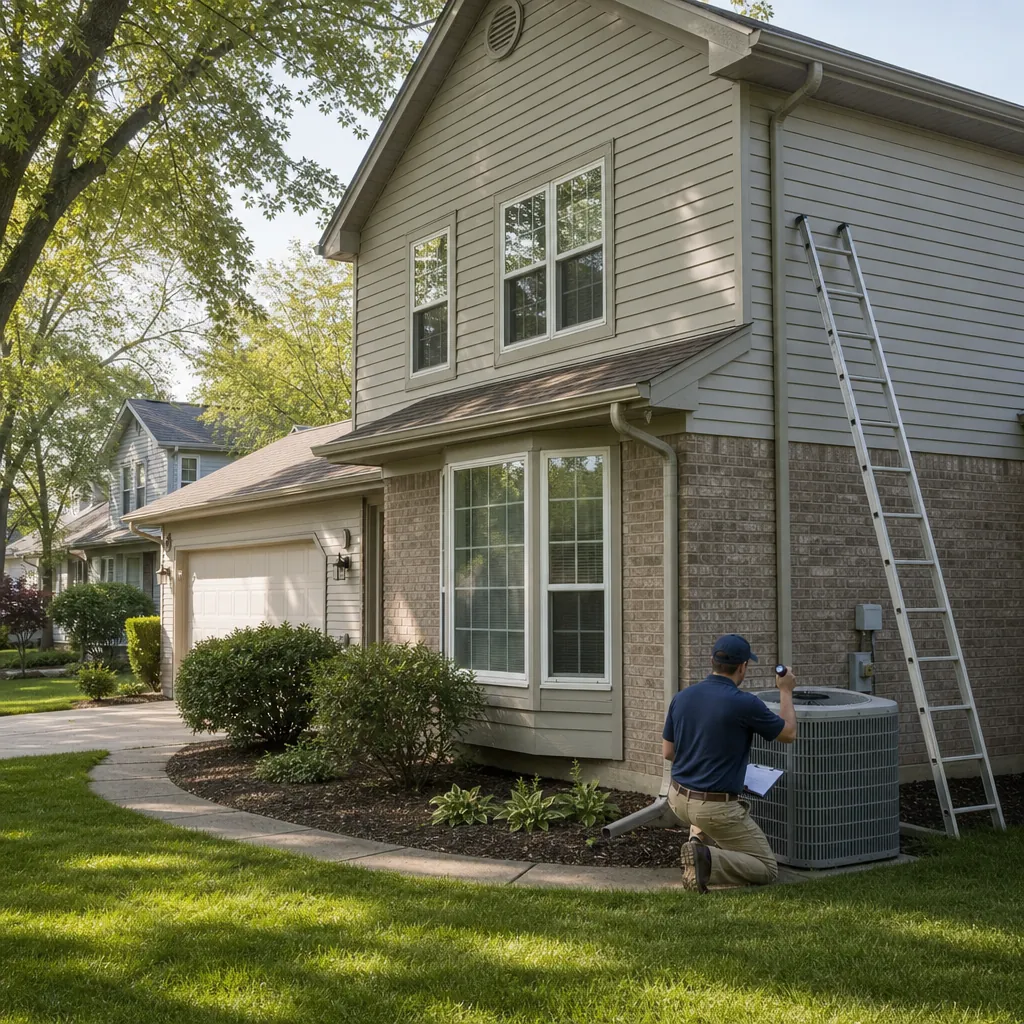
An older home at a low price may need a roof, HVAC, a sewer line, or electrical updates soon. A newer home costs more but usually has lower near-term capital expenses. The key is to price these items into your offer. Hire a qualified inspector, get a sewer scope where relevant, and use a rental property walkthrough checklist so you do not miss expensive systems.
Tenant appeal
Think about who will rent the property. Bedroom count, a second bathroom, parking, laundry, school district, and commute times all affect how quickly a home rents and how long tenants stay. A three-bedroom house in a family neighborhood usually rents more steadily than an odd layout on a busy road.
Buying with a tenant already in place
An occupied property produces income on day one. However, you inherit the existing lease, the deposit, and possibly a below-market rent or a problem tenant. Ask for estoppel letters, copies of leases, and the payment history before closing. The trade-offs are covered in buying properties with tenants in place.
Back to topRunning the numbers
Most rental losses come from optimistic estimates: rent set too high and expenses set too low. Build every analysis the same way, line by line, and use conservative inputs.
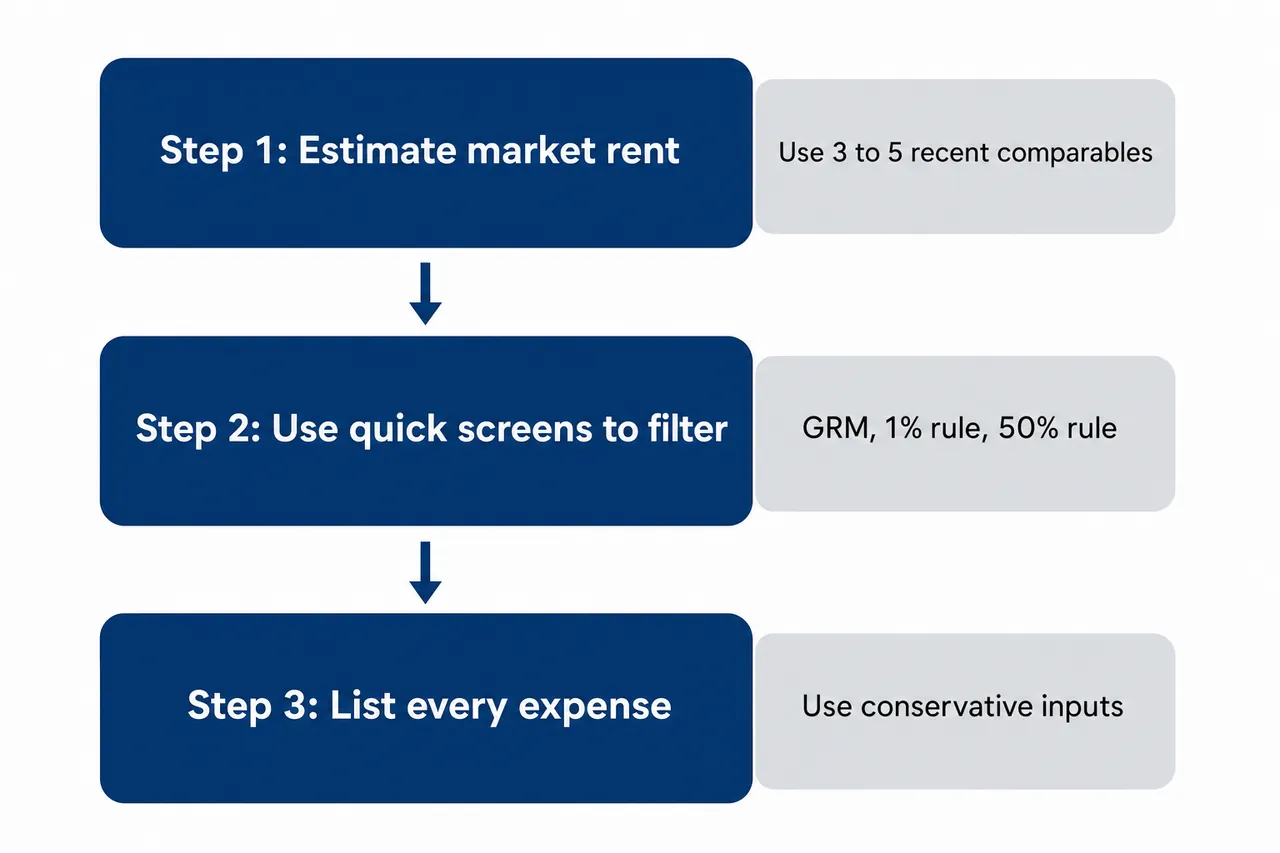
Step 1: Estimate market rent
Find three to five comparable rentals that are close by, similar in size and condition, and recently leased. A listing that has sat for two months is not a comparable at its asking price. Check how long similar homes take to rent. Methods for this are covered in how to set rental prices.
Step 2: Use quick screens only to filter
Rules of thumb help you sort many listings fast. They do not tell you whether a deal works.
- Gross rent multiplier (GRM) is price divided by annual rent. Lower means more rent per dollar of price. Compare GRMs within the same area using a GRM calculator.
- The "1% rule" asks whether monthly rent is at least 1% of the price. Many good deals in pricier markets fail it, and some bad deals pass it.
- The "50% rule" assumes operating expenses will eat about half of rent over time, excluding the mortgage. It is a rough check on expense estimates, not a substitute for them.
Step 3: List every expense
- Property tax: based on the expected post-sale assessment.
- Insurance: a landlord (dwelling) policy, plus flood or other coverage if needed. Consider an umbrella policy for liability.
- Property management: often a percentage of collected rent, plus leasing and renewal fees. Budget for it even if you self-manage, because your time has value and you may hire help later.
- Repairs and maintenance: routine fixes such as leaks, appliance repairs, and turnover cleaning.
- Capital expenditures (capex): money set aside for large items with a limited life, such as roof, HVAC, water heater, flooring, and appliances. Estimate the replacement cost and remaining life of each, then divide.
- Owner-paid utilities: water, sewer, trash, and lawn care where the owner pays.
- HOA dues, if any.
- Administrative costs: accounting, rental licenses, inspections, legal forms, and screening costs not passed to applicants.
Step 4: Account for vacancy and credit loss
No property is rented every day forever. Tenants move, units need turnover work, and some tenants do not pay. Ask local managers how long similar homes sit empty between tenants. Build in a vacancy and credit-loss allowance as a percentage of gross rent. Even one month empty per year is a little over 8% of annual rent.
Step 5: Calculate NOI, cash flow, and returns
- Net operating income (NOI) = gross rent − vacancy − operating expenses. It excludes the mortgage.
- Cash flow = NOI − annual debt service (principal and interest).
- Cash-on-cash return = annual cash flow ÷ total cash invested (down payment, closing costs, and initial repairs).
- Cap rate = NOI ÷ purchase price. It lets you compare properties without financing.
- DSCR = NOI ÷ annual debt service. Lenders use it to judge whether rent covers the loan.
You can run all of these at once in the rental property calculator. Use the cash-on-cash return calculator and the cap rate calculator when you want to test one figure at a time.
Back to topExample deal (illustrative numbers)
Here is a single-family example. These numbers are made up to show the math. They are not a forecast for any market, and your rate, taxes, and insurance will differ.
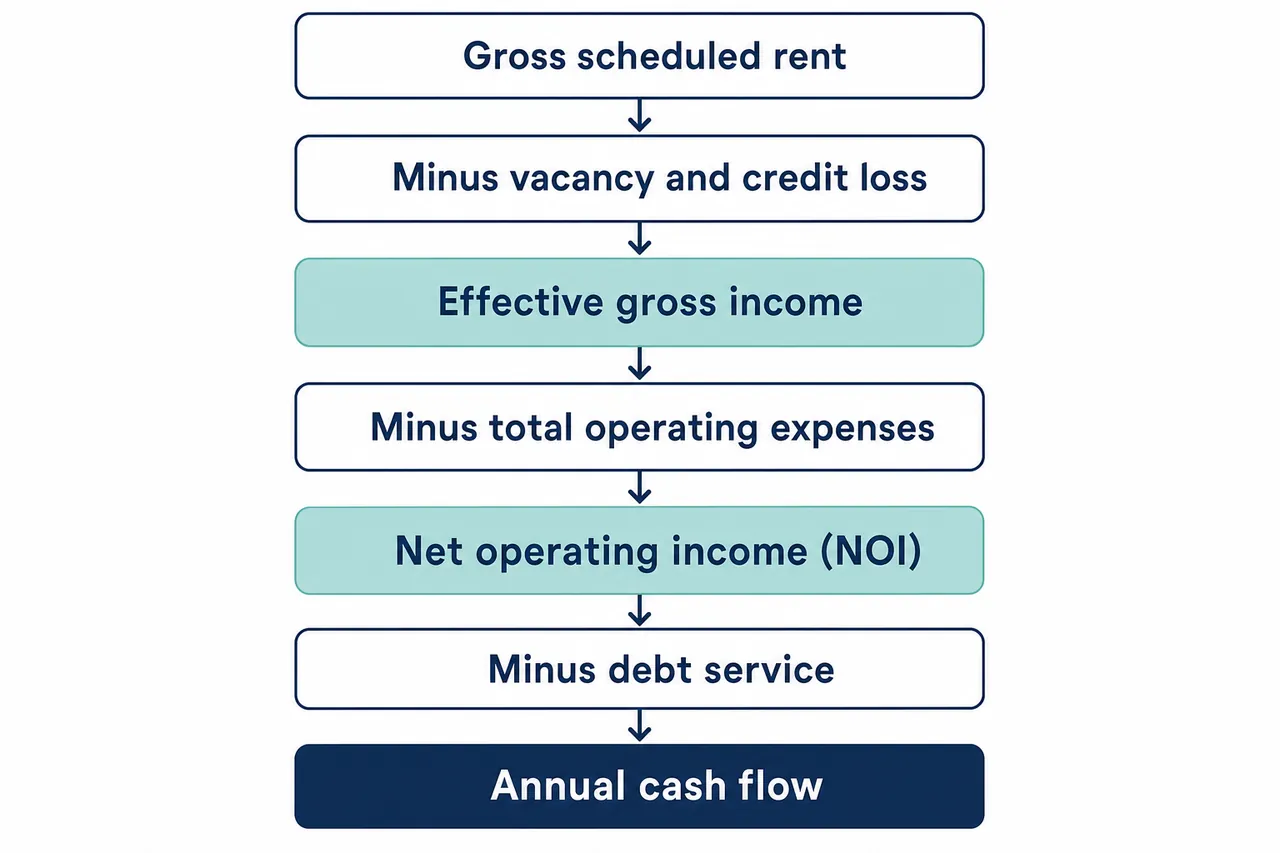
The property is a 3-bedroom, 2-bath house bought for $210,000 that rents for $2,000 a month. The buyer puts 25% down ($52,500) and borrows $157,500 on a 30-year fixed loan at an example rate of 7%. That gives a principal and interest payment of about $1,048 a month, or $12,576 a year. Closing costs are about $6,300, and the house needs $4,000 of make-ready work before the first tenant moves in.
| Line item | Assumption | Annual amount |
|---|---|---|
| Gross scheduled rent | $2,000 × 12 | $24,000 |
| Vacancy and credit loss | 5% of gross rent | −$1,200 |
| Effective gross income | $22,800 | |
| Property tax | 1.2% of price (assumed) | $2,520 |
| Insurance | $120 per month | $1,440 |
| Property management | 8% of collected rent | $1,824 |
| Repairs and maintenance | 5% of gross rent | $1,200 |
| Capex reserve | $150 per month | $1,800 |
| Admin, accounting, licenses | Estimate | $300 |
| Total operating expenses | $9,084 | |
| Net operating income (NOI) | $22,800 − $9,084 | $13,716 |
| Debt service | $1,048 × 12 | −$12,576 |
| Annual cash flow | $13,716 − $12,576 | $1,140 (about $95/month) |
Now the return measures:
- Total cash invested: $52,500 + $6,300 + $4,000 = $62,800
- Cash-on-cash return: $1,140 ÷ $62,800 = about 1.8%
- Cap rate: $13,716 ÷ $210,000 = about 6.5%
- DSCR: $13,716 ÷ $12,576 = about 1.09
- Principal paid down in year one: about $1,600
- Cash flow plus principal paydown: about $2,740, or roughly 4.4% on cash invested, before any appreciation or tax effects
What this example teaches
The deal is positive, but barely. One extra month of vacancy (about $2,000 of lost rent) or a single large repair turns year one negative. That is common when interest rates are high relative to rent-to-price ratios. You have a few honest choices:
- Accept a thin cash flow because you value principal paydown and long-term holding. If you do, keep larger reserves.
- Negotiate the price down. In this example, every $10,000 off the price saves roughly $800 a year in combined payment and tax.
- Find more rent. Each extra $100 a month adds about $1,050 a year after vacancy and management fees.
- Self-manage to keep the $1,824 management fee. Only do this if you have the time and skills, which are discussed below.
- Walk away and keep looking.
Also test the downside. Run the same deal with two months of vacancy, a 15% jump in insurance, and a $6,000 repair. If you could survive all three without selling, the deal is sturdy.
Back to topFinancing a rental property
Investment property loans usually require larger down payments and carry higher rates than loans for a home you live in. Lender rules on credit, reserves, and how rental income is counted vary from lender to lender, so compare several. Each loan type is explained in 8 types of rental property loans.
| Option | How it qualifies you | Good fit | Watch out for |
|---|---|---|---|
| Conventional investment loan | Your personal income, credit, and debt-to-income ratio | W-2 earners with strong credit buying 1 to 4 units | Limits on the number of financed properties; documentation-heavy |
| Owner-occupied (house hack) | Personal income; you live in one unit | First-time buyers of a 2 to 4 unit property | Occupancy requirements must be met honestly |
| DSCR loan | The property's rent compared with its payment | Self-employed borrowers and investors with many properties | Usually higher rates and fees; prepayment penalties are common |
| Portfolio or commercial loan | The property plus your overall financial strength | Local banks, larger buildings, unusual properties | Shorter terms, adjustable rates, balloon payments |
| Home equity (HELOC, cash-out refinance) | Equity in a property you already own | Funding a down payment or an all-cash purchase | Puts the borrowed-against property at risk |
| Seller financing | Negotiated directly with the seller | Owners with free-and-clear properties who want income | Balloon dates, due-on-sale issues if the seller has a loan |
How DSCR loans work
A DSCR loan qualifies the property rather than your tax returns. The lender compares rent to the monthly payment. Many lenders use principal, interest, taxes, insurance, and HOA dues for this, rather than full NOI. A ratio above 1.0 means rent covers that payment. Many lenders prefer something higher, and the rate or required down payment often improves as the ratio rises. How rent is documented (a lease or an appraiser's rent schedule) and the minimum ratio both vary by lender. Run your deal through the DSCR calculator before you apply so you know where you stand.
Using equity you already have
Many investors fund their next down payment from a home equity line or a cash-out refinance. This can speed up growth, but it adds debt against property you already own. The options and risks are compared in using home equity to buy your next rental property.
Fixed versus adjustable
For a long hold, a fixed-rate loan removes payment risk. Adjustable loans and balloon notes can work, but they require a plan for what happens if rates are higher when the loan resets. Never assume you will be able to refinance on good terms.
Back to topFinding and keeping good tenants
Tenant quality drives more of your results than almost anything else after the purchase price. A good tenant who stays several years beats a slightly higher rent with frequent turnover.

Screening
- Write your criteria down before you advertise. Examples include an income-to-rent ratio, credit standards, rental history, and what you do about past evictions. Apply the same criteria to every applicant in the same order.
- Use a complete written application. Get consent for credit and background checks.
- Verify income with pay stubs, offer letters, or bank statements.
- Call previous landlords, not just the current one. A current landlord may give a glowing review to get rid of a problem. Low-cost methods are listed in ways to check a tenant's rental history.
- Check local rules on screening fees, criminal history, and source-of-income protections. Many states and cities restrict what you can ask or consider.
Lease, move-in, and documentation
Use a lease written for your state. Have it reviewed by a local attorney once, then reuse it. Cover rent due dates, late fees (where allowed), maintenance responsibilities, pets, utilities, entry notice, and renters insurance. At move-in, complete a written and photo condition report signed by both parties. It is your best evidence when deposit disputes come up.
Retention
Turnover costs you vacancy, cleaning, paint, marketing, and leasing time. Respond to repair requests quickly, keep rent increases in line with the market, and offer renewals early. Retention is usually cheaper than replacement.
Self-manage or hire a manager
Self-managing saves the fee and teaches you the business. It also means late-night calls, screening, collections, and legal compliance. A good manager costs money but brings systems, vendors, and legal know-how. When comparing managers, look past the headline percentage. Ask about leasing fees, renewal fees, markups on maintenance, and how they handle evictions. The decision is broken down in should you hire a property manager. Even if you self-manage, keep a management line in your analysis.
Back to topLandlord law in plain terms
This section explains general concepts only. Landlord-tenant law is mostly state and local, and it changes. Before you buy, have a local real estate attorney walk you through the rules for your property's address.
- Fair housing. Federal law bars discrimination based on race, color, religion, sex, national origin, familial status, and disability. Many states and cities add more protected classes, such as source of income. Fair housing rules apply to your ads, screening, and the way you treat tenants.
- Habitability. In most places, landlords must keep the unit safe and livable. That generally includes working heat, plumbing, electrical systems, and weather protection. What counts and how fast you must fix problems varies.
- Security deposits. Many states cap the amount, set a deadline for returning it, and require an itemized list of deductions. Some require deposits to be held in a separate account.
- Entry and privacy. Most areas require advance notice before entering, except in emergencies.
- Disclosures. Homes built before 1978 require a federal lead-based paint disclosure. States and cities may add others, such as mold, flood, or bed bug history.
- Rent control and increase limits. Some states and cities limit how much or how often rent can rise, or require a reason to end a tenancy.
- Licensing and inspections. Some cities require rental registration, inspections, or a business license.
- Evictions. Evictions must go through the court process. "Self-help" such as changing locks, removing belongings, or shutting off utilities is generally illegal and can expose you to damages. Notice periods and timelines vary widely.
When rent stops coming in, you have choices short of filing, such as payment plans or a negotiated move-out. Each path is outlined in what to do when a tenant is not paying rent.
Back to topTaxes at a high level
Rental taxes reward good records and planning. The rules below are general. Your results depend on your income, how you hold title, and your state, so work with a CPA who handles rental property.
Income and deductions
Rent is taxable income. Ordinary and necessary expenses are generally deductible against it. These include mortgage interest, property tax, insurance, repairs, management fees, and travel to the property. Improvements that add value or extend the property's life are generally capitalized and depreciated rather than deducted right away. The line between a repair and an improvement matters, so keep receipts and notes.
Depreciation
Residential rental buildings are generally depreciated over 27.5 years. Land is not depreciable. In the example deal, if the building were worth $170,000 of the $210,000 price, annual depreciation would be roughly $6,180. That could more than offset the $1,140 of cash flow on paper. Whether a paper loss reduces your other income depends on passive activity rules, your income, and how involved you are in managing the property. Ask your CPA.
When you sell
A sale can trigger capital gains tax plus depreciation recapture on the depreciation you claimed or could have claimed. A 1031 exchange can defer that tax if you reinvest in another investment property under strict rules. Those rules include a 45-day window to identify a replacement and a 180-day deadline to close, and a qualified intermediary must hold the funds. Model the deferred gain with the 1031 exchange calculator, then plan the exchange with your CPA and intermediary before you list the property.
Ownership structure
Many investors hold rentals in an LLC for liability separation. Some lenders will not lend to an LLC, and transferring a financed property into one can raise due-on-sale questions. Insurance remains your first line of defense either way. Ask an attorney and your lender before you change title.
Back to topScaling from one rental to several
Growing a rental portfolio is mostly about capital, reserves, and systems, in that order.
Build reserves first
Hold cash for each property, such as several months of expenses and payments, plus a capex fund. Many lenders require reserves too. An investor with three properties and no reserves is one roof and one eviction away from a forced sale.
Recycle capital
Common ways to fund the next purchase include saving cash flow and income, refinancing after value has grown, drawing on home equity, and buying properties that need work at a discount, then renovating and refinancing. That last approach is often called BRRRR. It can return much of your cash, but it depends on the after-repair value and the refinance terms holding up.
Choose a direction
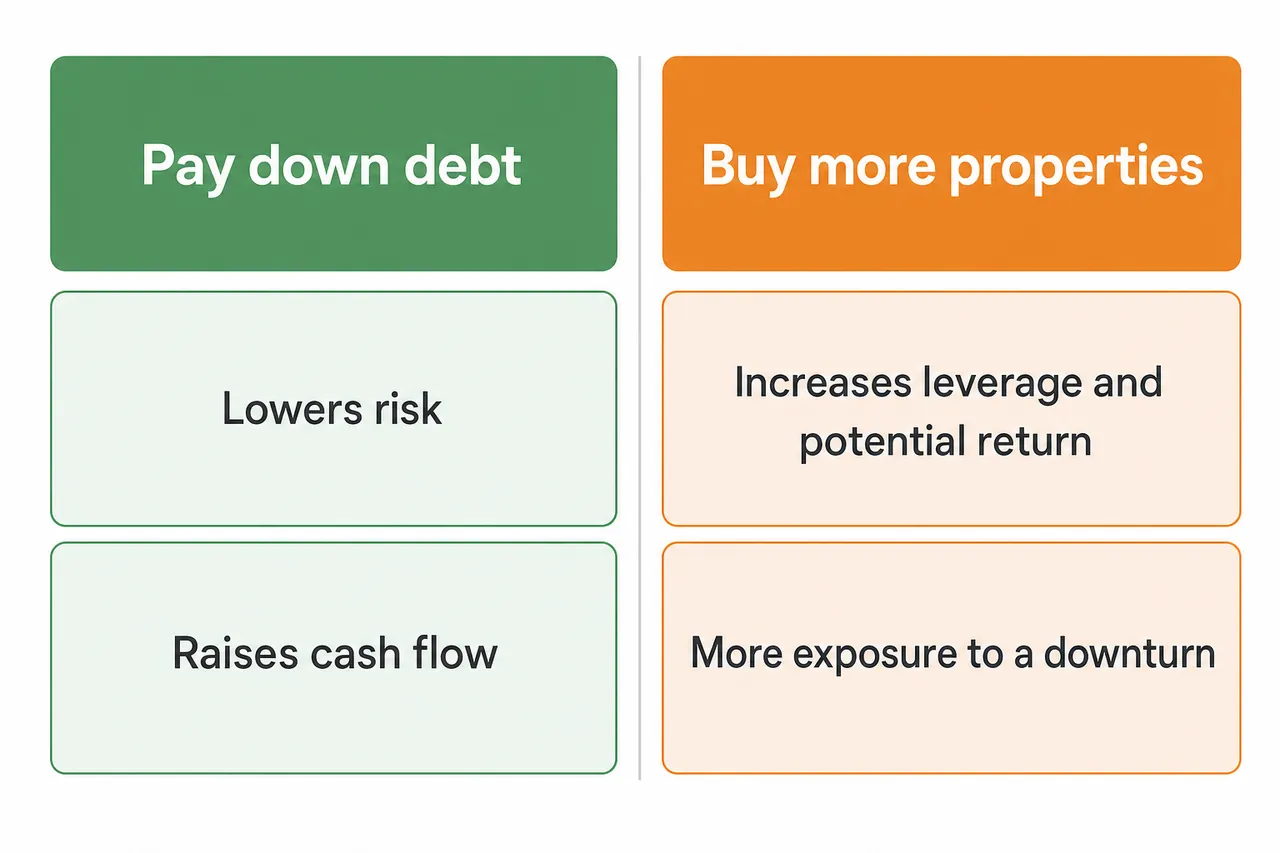
At some point you will choose between paying properties down and buying more. Paying down debt lowers risk and raises cash flow. Buying more increases leverage and potential return, along with exposure to a downturn. The trade-off is explored in paying off a rental property vs. buying more. Many investors grow first and pay down later.
Systematize
Use the same analysis template, screening criteria, lease, vendor list, and bookkeeping for every property. Keep separate bank accounts for the rental business. What feels manageable at one door becomes chaos at five without systems.
Back to topCommon mistakes
- Using the seller's numbers. Pro formas and listing figures often leave out vacancy, capex, and management. Rebuild every line yourself.
- Leaving out capex. A deal that shows cash flow without a reserve for the roof and HVAC is showing deferred bills, not profit.
- Underestimating tax and insurance after the sale. Reassessment and new hazard pricing can change both sharply.
- Buying for appreciation and calling it a rental. If the property needs rising values to survive, it is a different, riskier bet.
- Weak screening or inconsistent criteria. This leads to bad tenants and fair housing exposure.
- No reserves. The first big repair becomes a credit card balance.
- Skipping the inspection on a property that looks fine.
- DIY legal shortcuts: generic leases, mishandled deposits, or self-help evictions.
- Overleveraging with adjustable or balloon debt and no plan for the reset date.
- Mixing personal and rental money, which makes taxes, liability protection, and decisions harder.
Where to go next
- To speed up the screening step, use the method in how to analyze a rental property quickly and accurately.
- If spreading vacancy risk across units appeals to you, read the small multifamily investing guide.
- To buy below value, add value, and pull cash back out, see the BRRRR investing guide.
Run the numbers. Enter the price, loan, rent and expenses to see cash flow, cash-on-cash return, cap rate, NOI and DSCR. Free, no sign-up.
Back to top
Back to top
All our long-term rental articles
Long-term rental articles on KDS Development, grouped so you can go deeper on any part of this guide. Newest first.
Guides and how-tos
- How to Finance Rental Properties When Self-Employed: Loan Options & Tips
- How to Start Renting Out Your Home: Step-by-Step Guide for New Landlords
- How to Rent Out Your House: Step-by-Step Landlord Guide
- Sample Letter From Landlord to Tenant for Repairs: Templates & Examples
- Cash for Keys: When & How to Use This Eviction Alternative
- Rental Property Walkthrough Checklist: What to Inspect Before Buying
- How to File Eviction Papers: Step-by-Step Investor Guide
- Move-In Checklist Template: Protect Your Rental Property
- Triple Net Lease (NNN) Guide: How They Work & Investment Analysis
- Property Management Pro's Guide: Work Less, Earn More Strategy
- Finding Rental Property Management Companies Near You: Selection Guide
- How to Grow a 7-Figure Property Management Business: Scaling Strategies
Explainers
- Best CRM for Real Estate Property Managers: Tenant & Maintenance Tracking
- Can You Use a Business Loan to Buy Rental Properties?
- Why Landlords Should Require Renter's Insurance: Legal and Financial Protection
- Build-to-Rent Development Strategy: New Construction for Investors
- Buying Properties with Tenants In Place: Benefits & Considerations
- Landlord Tenant Court Records: Using Eviction Data for Property Leads
- Tenant in Common Land Investing: Structure, Benefits & Risks
- Cell Tower Lease Income: How Much Can Land Investors Earn?
- Hunting Lease Per Acre: Valuation and Income Strategy for Land
- Solar Farm Land Lease Rates: Income Potential for 2026
- Most Landlord-Friendly States for Real Estate Investors: 2026 Ranking
- Commercial Real Estate Tenant Mix Strategy: Maximizing Stability & Income
Comparisons
- Best Rental Property Websites 2026: Buy, Manage & Analyze
- Ground Lease vs. Land Purchase: Comparison for Long-Term Investors
- Best U.S. Cities for Rental Property Investment in 2026: Market Comparison
- Best Rental Property Management Apps for Landlords in 2026
- 5 Paid-Off Rentals vs. 15 With Mortgages: The Math Compared
- 7 Best Beginner Markets to Buy Rental Properties in 2026
- Repairs vs Capital Improvements: Tax Implications for Landlords
- Best Real Estate Markets for Cash Flow in 2026
- Self-Managing Rentals vs Property Manager: Decision Framework
- RentRedi vs TurboTenant: Best Landlord App 2026
- Buildium vs TenantCloud: Property Management Compared
- Avail vs RentRedi vs TurboTenant: Landlord Apps
Tool reviews
- How to Set Rental Prices: Market Research & Pricing Strategies
- Best Tenant Background Check Services: Compare Tools and Pricing
- Ark7 Review 2026: Fractional Shares of Rental Properties & Exit Strategy
- Doorvest Review 2026: Turnkey Rental Properties & Property Management
- 6 Tips for Gracefully Responding to Bad Reviews as a Property Manager
- How to Manage Online Reviews as a Landlord: Complete Strategy
- Mashvisor Review: Rental Analytics and Market Data
- TurboTenant Review: Free Landlord Software
- Roofstock Review: Turnkey Rental Property Marketplace
- Azibo Review: Free Landlord Banking Platform
- REI Hub Review: Accounting Software for Landlords
- Hemlane Review: Hybrid Property Management Platform
News and courses
- Assisted Living Property Investing: Higher Returns, Specialized Tenants & Regulations
- AppFolio Faces Antitrust Dispute: What Property Managers Need to Know
- AppFolio Data Breach Investigation 2025: What Property Managers Need to Know
Calculators
Frequently asked questions
How much money do you need to start long-term rental investing?
Plan for the down payment (often 15% to 25% or more on an investment loan), closing costs, any make-ready repairs, and cash reserves. In the example above, that came to about $62,800 before reserves on a $210,000 house. Lower-priced markets and owner-occupied purchases can reduce the amount needed. Ask a lender what you qualify for.
What is a good cash-on-cash return for a rental?
There is no universal target. It depends on your goals, the market, and interest rates. Compare a deal's return with what your cash could earn elsewhere with similar risk. Also remember that cash-on-cash ignores principal paydown, appreciation, and tax effects. A low number with sturdy reserves can still be a reasonable hold. A high number built on optimistic expenses is not.
Is a DSCR loan better than a conventional loan?
Not always. Conventional loans often have lower rates if you can qualify with your personal income. DSCR loans help when your tax returns do not show enough income or you have reached conventional limits, but they often cost more. Get quotes for both and compare total cost, including fees and prepayment penalties.
Should you self-manage your first rental?
Self-managing a nearby property can teach you a lot and save the fee, as long as you have time, learn your local laws, and can handle repairs and collections calmly. If the property is far away, your schedule is full, or you dislike conflict, a manager is usually worth the cost. Either way, include management in your numbers.
How much should you set aside for repairs and capex?
Estimate it item by item. List the roof, HVAC, water heater, flooring, and appliances, with each item's replacement cost and remaining life. Divide to get a monthly reserve, then add a separate amount for routine repairs. Older properties need more than newer ones. Percentages of rent are a rough cross-check, not a rule.
Do rental properties lower your taxes?
They can. Depreciation and deductible expenses often reduce or eliminate tax on rental income. Whether losses offset your other income depends on passive activity rules, your income level, and how involved you are. Depreciation is also generally recaptured when you sell. A CPA who works with rental owners can tell you how the rules apply to you.
Back to top